May 2026 will undoubtedly be remembered as one of the most revealing months for Tunisia’s current state of affairs. More than just a series of isolated events, it laid bare the overarching logic of an increasingly centralized government, a judiciary subject to the executive branch that is coming under growing scrutiny, and a civic space that is constantly shrinking. Trials against journalists and lawyers, tensions between the judiciary and the executive branch, arrests of citizens for slogans hostile to the government, growing concerns within civil society, persistent economic difficulties, and cultural unease: all these elements paint a picture that raises profound questions about the future of human rights in the country.
Nearly five years after the coup d’état of July 25, 2021, the president’s promise to “correct the course” (تصحيح المسار) has given way to a very different reality. Against this backdrop, the month of May stands as a true microcosm of the tensions currently dividing Tunisian society.
The justice system has become the main battleground
Never since the 2011 revolution has the justice system played such a central role in Tunisian political life. What is at stake in the courts today goes far beyond the legal framework: beyond the cases being heard, it is the very existence of civil liberties and the fundamental guarantees of the rule of law that are now seriously threatened.
The case of lawyer and columnist Sonia Dahmani is the most striking example of this. On May 25, she was sentenced to another prison term in a series of legal proceedings that have sparked strong reactions in Tunisia and abroad. Her dramatic arrest in May 2024, inside the Bar Association building itself, remains etched in people’s memories as one of the most striking images of the erosion of freedoms observed over the past several years.
The treatment meted out to Sonia Dahmani is not aimed solely at one individual but sends a message to all lawyers, journalists, and intellectuals who continue to criticize the government’s policies. Her case also symbolizes the increasing use of Decree-Law 54, which has become one of the most controversial tools in Tunisia’s legal arsenal. Originally presented as a tool to combat disinformation, this law is now denounced by human rights organizations as a mechanism for criminalizing the expression of critical opinions.
The same conclusion applies to the cases of Mourad Zeghidi and Borhane Bsaies. The harsh sentences handed down to these two journalists have sent shockwaves through the media sector. According to the National Union of Tunisian Journalists (SNJT), these prosecutions contribute to the creation of a climate of fear designed to encourage self-censorship and restrict opportunities for public debate.
The SNJT’s annual report, published on May 3, 2026, to mark World Press Freedom Day, painted an alarming picture: a rise in legal proceedings, economic pressure on the media, restrictions on access to information, and the gradual marginalization of independent journalism. In just a few years, Tunisia has gone from being a regional model often cited as an example to a country regularly criticized by international press freedom organizations.
Civil society leaders on the front lines
In the face of this erosion of civil liberties, several prominent figures continue to champion the democratic gains of the revolution, even as they themselves face prosecution or criminal convictions that underscore the growing tensions between the government and its critics.
Journalist Zied El Heni remains one of the most consistent voices in denouncing violations of press freedom and freedom of expression. Regularly targeted by smear campaigns and legal proceedings, he continues to speak out against the use of Decree-Law 54 and the increasing criminalization of dissenting opinions. On May 7, 2026, the criminal division of the Tunis Court of First Instance sentenced him to one year in prison following a publication related to a legal case, based in particular on Article 86 of the Telecommunications Code. This conviction sparked a strong reaction from the National Union of Tunisian Journalists (SNJT), which denounced a “judicial witch hunt” against one of the journalists most critical of the government.
Chawki Tabib, the former president of the National Anti-Corruption Authority (INLUCC), has also repeatedly spoken out against the gradual dismantling of independent institutions. According to him, the mechanisms for oversight, transparency, and accountability established after 2011 have been gradually neutralized. However, he has also become one of the main targets of legal proceedings brought against former officials of independent institutions. On April 14, 2026, an arrest warrant was issued against him in a case related to his past management of the INLUCC. His assets have also been frozen. Several Tunisian and international lawyers’ organizations have denounced the prosecutions, which they consider abusive and politically motivated.
The case took on even greater significance when Chawki Tabib was sentenced on May 21, 2026, to ten years in prison. This sentence sparked a wave of protests among human rights advocates, bar associations, and several international organizations, who view it as a new step in the erosion of the independent institutions established after the revolution.
The reaction was not limited to Tunisia alone. Several national human rights organizations, as well as associations of lawyers, judges, journalists, and civil society actors, expressed their solidarity with the former president of INLUCC, highlighting his role in the fight against corruption and the promotion of transparency within public institutions.
At the regional level, numerous Arab human rights organizations, networks of lawyers, and organizations dedicated to fighting corruption have condemned a conviction they view as politically motivated. Several prominent figures from the legal and civil society sectors in the Maghreb and the Middle East have also expressed concern about the impact of this case on the independence of oversight institutions.
Internationally, human rights organizations, professional bar associations, networks specializing in democratic governance, and several international partners of Tunisian civil society have condemned what they perceive as the manipulation of the justice system against a prominent figure who played a central role in establishing anti-corruption mechanisms after 2011.
This widespread national, Arab, and international outcry has turned the Chawki Tabib case into a symbol of the concerns raised by the gradual erosion of checks and balances in Tunisia.
For her part, Sihem Ben Sedrine, former president of the Truth and Dignity Commission (IVD), continues to defend the legacy of transitional justice. She regularly warns against the undermining of the efforts to preserve memory undertaken after the revolution and the risk of seeing the resurgence of authoritarian practices that Tunisians had specifically sought to leave behind.
This defense of the IVD’s legacy comes at a time when she herself is facing several legal proceedings. The main charges against her concern the management of the Truth and Dignity Commission, specifically the conditions under which the IVD’s final report was published, as well as certain cases related to arbitration and reconciliation. The authorities accuse her, in particular, of abuse of office, falsification of documents, and various administrative irregularities.
She was taken into custody in August 2024, when she was over seventy-five years old and suffering from several health issues, and remained in prison for several months before being released on provisional bail following pressure from numerous Tunisian and international organizations. Her imprisonment sparked widespread mobilization within human rights circles, with several organizations denouncing the measure as disproportionate and incompatible with her health condition.
The judiciary and the bar are on high alert
One of the most significant developments in May is the open mobilization of the legal profession itself.
On May 19 and 20, lawyers organized several protests at courthouses across the country. Their demands focus on ensuring fair trial guarantees, protecting the rights of the defense, and upholding the independence of the judiciary.
This mobilization reveals a deep sense of unease. Lawyers increasingly view the prosecutions brought against journalists, activists, and political opponents as evidence of the political manipulation of the judicial system. Many of them also denounce the smear campaigns targeting the bar association and its president, which they see as an attempt to weaken one of the few institutions still capable of speaking out independently.
On May 25, the Association of Tunisian Judges took another step by publicly accusing the Ministry of Justice of using assignments and transfers as a means of exerting pressure on judges. The statement issued on that occasion referred to a “collapse of the public justice system” and an unprecedented erosion of judicial independence.
Civil society under pressure: young doctors, the Human Rights League, and independent organizations
The month of May also highlighted the growing tensions between the authorities and several independent professional and civic organizations, revealing a worrying narrowing of civic space.
On May 14, the authorities decided to suspend the activities ofthe Tunisian Organization of Young Doctors (OTJM) for 30 days, on the eve of a press conference focused on the state of public hospitals, the working conditions of young doctors, and the crisis in the healthcare system.
This decision immediately sparked a wave of outrage. More than 1,500 doctors, academics, healthcare professionals, and citizens signed a petition calling for its reversal. The UGTT, several civil society organizations, and numerous public figures denounced it as a violation of freedom of association and the right to organize.
Faced with the scale of the protests, the authorities finally backed down and lifted the suspension on May 19. This reversal is widely seen as a victory for the citizen-led movement and a reminder that freedom of association remains a central issue in Tunisia today.
The case also highlighted the deep crisis in the public health care system, characterized by a lack of resources, a massive exodus of doctors, the deterioration of hospital infrastructure, and the growing challenges faced by young practitioners.
But the pressure on civil society was not limited to the health sector.
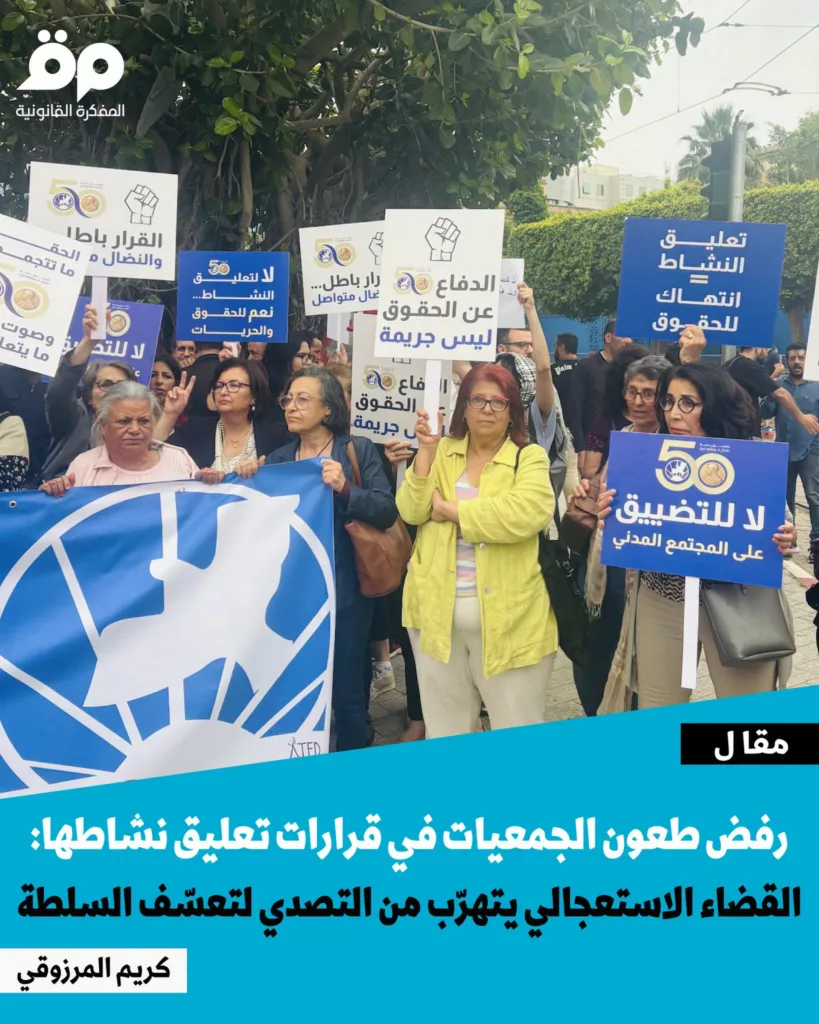
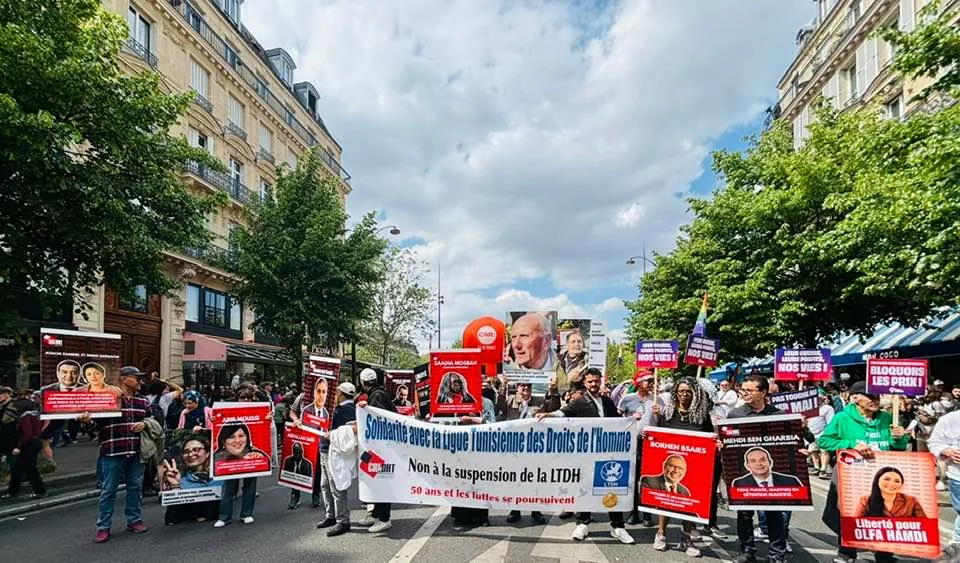
May was also marked by the one-month suspension of the activities of the Tunisian Human Rights League (LTDH), one of the oldest human rights organizations in the Arab world and Africa, founded in 1977 and awarded the Nobel Peace Prize as part of the National Dialogue Quartet in 2015.
This decision has sparked considerable outrage in Tunisia. Numerous associations, professional organizations, academics, journalists, lawyers, and activists have condemned a measure targeting one of the country’s most iconic institutions dedicated to the defense of civil liberties.
The reaction quickly spread beyond national borders. International human rights organizations, Euro-Mediterranean networks, international partners of Tunisian civil society, and numerous prominent figures committed to the defense of fundamental rights expressed their solidarity with the League and their concern over what they view as a further restriction of civic space.
This national and international mobilization was one of the highlights of the month. It served as a reminder of the historic role played by the LTDH in defending prisoners of conscience, denouncing torture, protecting civil liberties, and supporting the democratic transition following the 2011 revolution.
May was also marked by tensions surrounding Lawyers Without Borders (ASF). Administrative measures aimed at restricting certain activities of the organization sparked serious concern among human rights defenders. In response to reactions from Tunisian and international civil society, the authorities were ultimately compelled to reconsider some of these measures.
Taken together, the cases of the O TJM, the LTDH, and Lawyers Without Borders illustrate the growing difficulties faced by independent organizations working in the fields of human rights, justice, health, and civil liberties. But they also attest to the enduring vitality of Tunisian civil society and its ability to mobilize national and international solidarity when it believes that fundamental freedoms are under threat
A political movement that has not gone away
Despite the pressure being exerted on the opposition, several events have shown that the protests are still ongoing.
On May 17, the release of Mohamed Ryane Hamzaoui, the former mayor of Ezzahra (near Tunis) who had been prosecuted in the so-called “Conspiracy 2” case, was met with a remarkable public outpouring of support. Footage of his return was widely shared on social media and interpreted as a sign of solidarity with political prisoners.
A few hours later, during the night of May 17–18, Kaïs Saïed’s nighttime visit to Douar Hicher sparked an unusual scene. Residents reportedly chanted “Get out,” the iconic slogan of the 2011 Tunisian revolution. According to several accounts, two young people were arrested following the incident. This episode illustrates the persistence of popular dissent despite the increasingly tense political climate.
On May 21, an unusual statement from the Ministry of Defense affirming the army’s republican and neutral nature sparked widespread commentary. Against a backdrop of growing polarization, some observers see this as an effort to remind the public that the military must remain above political conflicts.
Social movements, citizen activism, and solidarity with Palestine
May 2026 was also marked by an intensification of social, civic, and political protests in several regions of the country. These protests focused on environmental, social, and economic issues, as well as civil liberties and international solidarity with the Palestinian people.
Among the most iconic protests is the ongoing sit-in by residents of Rouissat, in the governorate of Kairouan (central Tunisia). For over a month, women, men, and children have been rallying to defend their right to a healthy environment and to fair and sustainable development. The protesters are denouncing the consequences of the use of petroleum coke by the SOTACIB cement plant, which is accused of polluting the air, farmland, and the local environment. They are also demanding protection of children’s right to education, denouncing the nuisances and risks associated with explosions that are said to affect homes and schools.
This mobilization illustrates the growing momentum of environmental struggles in Tunisia. It serves as a reminder that human rights are not limited to political freedoms but also encompass the right to health, a clean environment, education, and public participation in decisions that affect their living conditions.
Solidarity with Palestine was another major focus of the month’s protests. Since the start of the war in Gaza, the Palestinian cause has remained one of the main drivers of protest in Tunisia. In 2026, the Soumoud Flotilla emerged as one of the most visible initiatives of this solidarity. Presented by its organizers as a civil action aimed at symbolically breaking the blockade imposed on Gaza, it received significant support from the public, civil society, and labor unions.
However, several members and organizers of the flotilla have been arrested as part of investigations launched by the Economic and Financial Judicial Unit. Those involved include Wael Naouar, Jawaher Channa, Nabil Chennoufi, Mohamed Amine Bennour, and Ghassen Henchiri. Authorities have cited suspicions regarding the management of funds and donations collected for the initiative, while supporting organizations denounce this as an attempt to criminalize advocacy for Palestine.
These arrests have sparked a wide range of reactions. Support rallies, press conferences, social media campaigns, and protests have been organized to demand the release of the activists and to denounce what is perceived as a crackdown on movements in solidarity with Gaza. Several human rights organizations, lawyers, trade unionists, and activists have participated in these demonstrations.
Activities related to the Soumoud Flotilla also included welcoming participants returning from their mission. After several boats were intercepted and Tunisian activists were temporarily detained by the genocidal Israeli authorities, hundreds of people gathered at Tunis-Carthage Airport to welcome the flotilla members back to Tunisia. Palestinian flags, slogans in support of Gaza, and activist chants turned these homecomings into true demonstrations of popular solidarity.
These various protests reflect the diversity of forms of dissent currently sweeping through Tunisian society. Whether they involve environmental struggles in Rouissat (and in Gabès in southern Tunisia), social demands against the high cost of living, protests, or solidarity with Palestine, they all express the same demand: to defend dignity, freedoms, social rights, and justice, both in Tunisia and beyond its borders.
A presidential speech that is increasingly being challenged and ridiculed
The month of May was also marked by several statements from Kaïs Saïed that struck a particularly alarmist tone. Among the most widely discussed expressions is the phrase “بلغ السيل الزُّبَى” (“the limits have been exceeded” or “the cup is full”), used to denounce what he describes as attempts to destabilize the state and maneuvers directed against its institutions.
This statement quickly transcended the political sphere to become a viral sensation on social media. Thousands of users picked up on the phrase and repurposed it in a satirical way. On Facebook, TikTok, and other platforms, “بلغ السيل الزُّبَى” has become a humorous catchphrase associated with soaring prices, the deterioration of public transportation, the purchasing power crisis, shortages, and the cost of Eid sheep.
While the government intended to highlight threats to the state, many citizens chose to reinterpret the phrase to express their own frustration with economic and social hardships. This episode illustrates the growing disconnect between official rhetoric and the day-to-day concerns of a significant portion of the population.
It also highlights the emergence of new forms of protest based on humor, satire, and the subversion of official narratives, which have become, for many, a way to circumvent restrictions on public expression.
A society weakened by the economic crisis
The erosion of civil liberties is unfolding against a particularly challenging social backdrop.
Inflation continues to erode purchasing power. Prices for basic food items are rising sharply, and unemployment remains high, particularly among recent college graduates.
As Eid approaches, the skyrocketing prices of sheep have become a national issue. Social media is flooded with satirical videos highlighting the fact that many families cannot afford this expense. The announcement by “Congresswoman” Cyrine Mrabet of a donation of 150 sheep to needy families has itself sparked a controversy that reveals the prevailing social unease.
The economic crisis is thus fueling a growing sense of injustice and abandonment, which is exacerbating political tensions.
Digital Activism and New Forms of Mobilization
On May 23, 2026, Tunisie Télécom’s MyTT app, used by hundreds of thousands of subscribers to manage their phone and internet services, was the target of a massive cyberattack. The attack enabled the mass sending of politically charged notifications to users’ phones. The messages denounced violations of civil liberties, called for the release of political prisoners and prisoners of conscience, and demanded the repeal of Decree-Law 54, which for many human rights defenders had become a symbol of the suppression of freedom of expression.
The incident immediately sent shockwaves throughout the country. Tunisie Télécom announced the launch of an internal investigation and cited a breach of its computer systems. On social media, the incident sparked thousands of comments, ranging from concerns about the security of digital infrastructure to support for the demands expressed in the messages that were shared.
A few hours after the operation, pages claiming to be affiliated with a collective of young Tunisians claimed responsibility for the action. The perpetrators stated that they wanted to draw attention to the plight of political prisoners and denounce what they consider to be the gradual closure of spaces for public expression. They also declared that further actions could follow as long as prisoners of conscience remain detained and Decree-Law 54 continues to be used against journalists, activists, and opponents.
Beyond the technical aspects, this episode carries significant symbolic weight. For the first time in several years, a protest movement has managed to bypass traditional communication channels and reach a very large number of citizens directly through a public platform. The event reflects the emergence of new forms of digital activism in a context where protests, public meetings, and independent media outlets are subject to increasing restrictions.
The MyTT case also reveals a significant shift in protest tactics. Faced with a shrinking civic space, a segment of Tunisia’s youth now appears to be increasingly turning to digital tools, social media, online campaigns, and high-profile symbolic actions. This shift reflects a growing sense that traditional mechanisms of political participation and public debate no longer allow certain demands to be heard.
Thus, behind what might appear to be a simple cybersecurity incident lies a deeper reality: that of a society where dissent is gradually shifting to the digital sphere as the traditional spaces of democratic life shrink. From this perspective, the MyTT episode stands out as one of the most revealing events of the political climate and the transformations in forms of civic mobilization in Tunisia in 2026.
Culture: A Climate of Increasing Surveillance
The main cultural event of the month is the passage of the law on the status of artists and artistic professions. This reform, which has been sought for many years, recognizes the professional rights of artists and provides for long-awaited social protection measures.
However, this development comes at a time of great concern. Many artists, intellectuals, and cultural figures believe that creative freedom is being undermined by the current political climate. The creation of a professional license issued under administrative oversight is seen as a potential tool for selection or exclusion.
More broadly, several cultural figures are speaking out against the emergence of a veritable “culture under control.” They accuse certain public institutions of favoring mainstream productions and marginalizing critical or politically sensitive works.
Against a backdrop marked by the prosecution of journalists, lawyers, and activists, the cultural world is seeing the resurgence of a phenomenon that many believed had been consigned to history after 2011: self-censorship. The central issue is therefore no longer merely the social protection of artists, but their ability to create freely.
The ordeal of political prisoners and their families
Beyond the trials, press releases, and institutional clashes, May 2026 also served as a reminder of a reality that is often less visible but deeply human: that of political prisoners and prisoners of conscience, and that of their families.
For several years now, dozens of politicians, activists, lawyers, journalists, bloggers, trade unionists, and civil society leaders have been prosecuted or detained in connection with cases involving charges of “conspiracy against state security,” Decree-Law 54, or various offenses related to the expression of opinions.
The month of May was marked by renewed mobilization efforts by the families of detainees, support committees, and human rights organizations. Press conferences, rallies outside courthouses, social media campaigns, and public statements sought to draw attention to the situation of individuals who have been deprived of their liberty—in some cases for several months or even years—while awaiting a final judgment.
The suffering does not affect only the inmates. Behind every prisoner are spouses, parents, children, and loved ones who must endure the waiting, the anguish, and the uncertainty. Many describe a daily life punctuated by trips to prisons, lengthy administrative procedures to obtain visitation rights, repeated postponements of court hearings, and the difficulty of obtaining reliable information about the health or detention conditions of their loved ones.
Several accounts describe particularly severe psychological consequences: constant anxiety, emotional distress, social isolation, and a sense of injustice. In some cases, the detentions have also led to a significant deterioration in the economic situation of families, who have been deprived of their primary source of household income. Children are growing up far from their father or mother, while elderly parents live in anticipation of a release whose date they do not know.
The fate of political prisoners and prisoners of conscience is today one of the most telling indicators of the state of civil liberties in Tunisia. Beyond institutional debates and political clashes, it serves as a reminder that the current crisis has a profoundly human dimension. Behind each case lie lives on hold, families in distress, and citizens whose only “crime,” according to their supporters, is often simply having expressed a critical opinion or exercised their right to political participation.
The plight of prisoners and their families has thus become one of the most poignant symbols of the erosion of civil liberties observed over the past several years. It serves as a reminder that human rights cannot be measured solely by laws or official statements, but also by the daily experiences of those who bear the brunt of political repression.
Racism, dehumanization, and the criminalization of solidarity: the case of Saadia Mosbah
May 2026 highlighted another troubling aspect of the human rights crisis in Tunisia: the rise of racist and xenophobic rhetoric targeting sub-Saharan migrants as well as those working to defend them.
At the center of this story is Saadia Mosbah, founder of the Mnemty association and a leading figure in the fight against racism. Detained for several months and facing charges in a case related to her organization’s funding, she has become, for many Tunisian and international organizations, a symbol of the growing criminalization of solidarity. Her trial, scheduled for June 2, 2026, is seen as a major test for freedom of association and the independence of the judiciary.
This case comes amid a context marked by the ongoing deterioration of the situation for sub-Saharan migrants. For months, Tunisian and international organizations have been documenting mass deportations, arbitrary arrests, violence, abandonment in desert areas, and campaigns of stigmatization targeting particularly vulnerable populations.
The month of May was also marked by a disturbing radicalization of public discourse. Certain posts shared on social media crossed an alarming threshold of dehumanization. Among the most shocking was one by the poet Slaheddine Bouzaiane, calling for the forced deportation of migrant women and children and going so far as to suggest poisoning them. Such remarks constitute a flagrant denial of the most basic principles of human dignity and illustrate the growing normalization of hate speech.
This trend is fueled by the persistent spread of conspiracy theories that portray sub-Saharan migration as a demographic threat to Tunisia. Echoing the ideas of the so-called “Great Replacement”—a theory widely associated with far-right movements—these narratives depict migrants as pawns in a scheme designed to alter the country’s demographic makeup.
At the same time, a great deal of misinformation continues to circulate, including the notion that any child born in Tunisia to sub-Saharan parents automatically obtains Tunisian citizenship. Legal experts have, however, pointed out that Tunisian law does not recognize automatic jus soli and that the acquisition of citizenship remains strictly regulated by law.
A warning sign for the future
Taken as a whole, the events of May 2026 paint a picture of a country where civil liberties are under increasing pressure. Political trials, challenges to judicial independence, restrictions on press freedom, the weakening of checks and balances, economic difficulties, and the rise of self-censorship all contribute to a troubling picture.
Yet, despite the pressure, Tunisian civil society continues to resist. Journalists, lawyers, judges, artists, human rights defenders, and engaged citizens continue to defend the freedoms won through long struggles.
More than fifteen years after the 2011 revolution, the events of this May serve as a reminder that the issue of human rights remains central to Tunisia’s future. It is around this issue that one of the most decisive battles for the country’s democratic future is being fought today.