As Eid al-Adha approaches, the public debate surrounding the prices of sacrificial sheep has revealed much more than just a temporary economic challenge. Behind this controversy lies a deeper reality: that of an economic and social crisis that continues to worsen, but also that of a government whose official narrative is finding it increasingly difficult to convince the public.
For several years now, Tunisians have been facing a steady decline in their living conditions. Eroding purchasing power, rising prices, recurring shortages, the deterioration of public services, and the lack of tangible economic prospects are fueling a widespread sense of anxiety and weariness. This malaise now affects nearly every social group. It also impacts segments of society that had previously managed to cushion the effects of successive crises.
In the face of this situation, however, the official narrative continues to promise an imminent recovery and to attribute the country’s difficulties to the actions of “conspirators,” “speculators,” or “corruption networks.” This framework, repeated for several years, has gradually established itself as the only explanation offered by the government for the country’s difficulties. But as the crisis drags on and deepens, this narrative is losing credibility. It can no longer bridge the growing gap between the promises made and the reality people are experiencing.
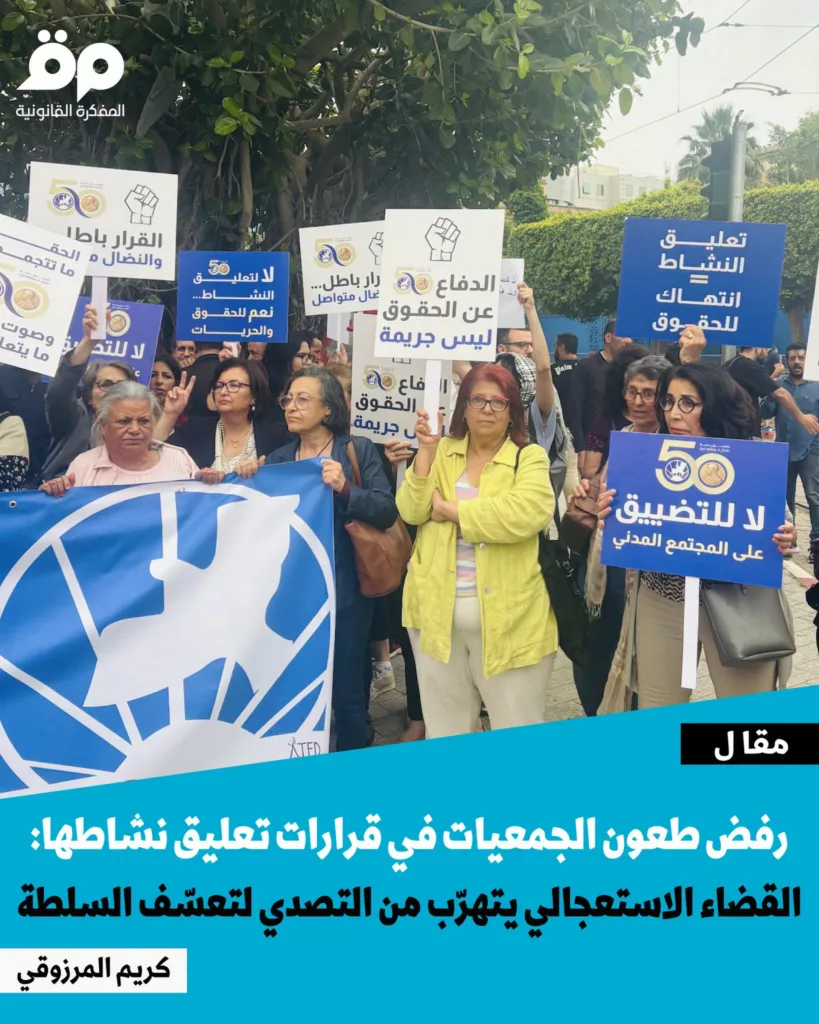
This loss of credibility is not without consequences. When a government can no longer provide a convincing explanation of the situation or outline a path out of the crisis, it tends to intensify its reliance on control, judicialization, and repression. In Tunisia, the expansion of legal proceedings targeting political leaders, journalists, human rights defenders, activists, and business leaders fits into this context. The public sphere continues to shrink, while critical voices are increasingly exposed to legal and political pressure.
For the Committee for the Respect of Freedoms and Human Rights in Tunisia (CRLDHT), this development is particularly troubling. For economic crises, however severe, can be addressed through open public debate, credible institutions, and a rule of law that is upheld. However, when the social crisis is accompanied by a continuous erosion of civil liberties, judicial independence, and fundamental safeguards, it is society’s very ability to collectively develop solutions that is threatened.
The issue at hand today therefore goes far beyond economic indicators. It concerns the relationship of trust between the state and society. A society can endure sacrifices when difficulties are acknowledged and there is hope for the future. It cannot, in the long run, accept having its daily experiences denied or reduced to simplistic, repetitive explanations.
Tunisia is thus facing not only an economic crisis, but also a crisis of confidence and purpose. The growing disconnect between official rhetoric and the reality on the ground is further eroding social and political cohesion. The wider this gap becomes, the more difficult it is to engage in a national dialogue based on shared observations and the search for common solutions.
In this context, the defense of freedoms, pluralism, judicial independence, and the right to criticism is by no means a secondary concern. On the contrary, it is an essential prerequisite for enabling Tunisian society to address its challenges and rebuild a credible democratic, economic, and social future. It is to this principle that the CRLDHT remains committed and intends to continue to champion with determination.