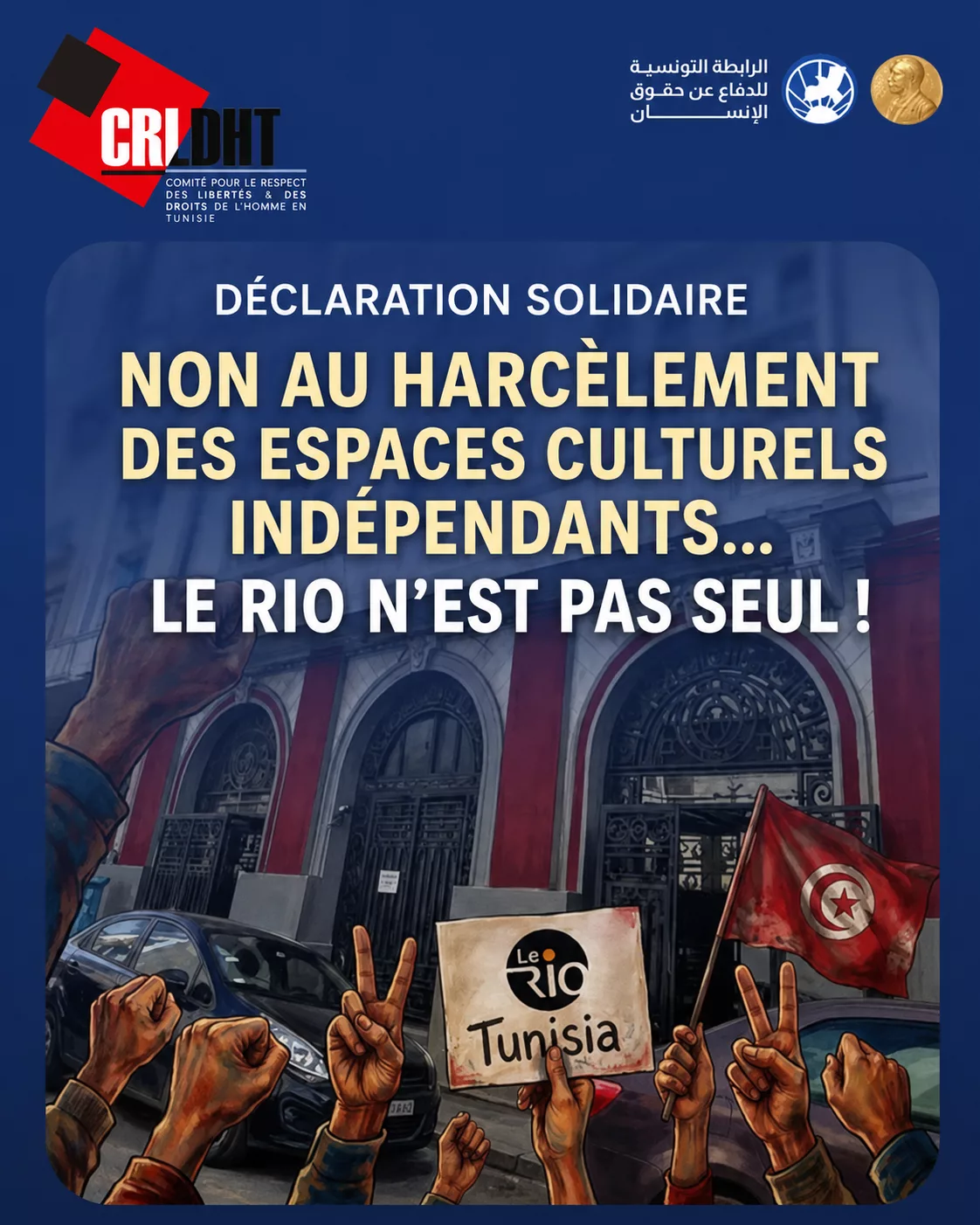
The Committee for the Respect of Human Rights and Freedoms in Tunisia (CRLDHT) expresses its deep concern and full solidarity with the Le Rio cultural center and its director, Habib Belhedi, who are facing a new escalation of administrative and financial measures that directly threaten the survival of this iconic institution of Tunisian cultural life.
According to information released by the Rio’s administration, several successive decisions have been taken against it: the elimination of public operating and capital grants; the closure of the café, which is an essential source of revenue for its financial stability; the proliferation of administrative obstacles; the exclusion or marginalization of certain national cultural events; and a persistent lack of transparency regarding the reasons for these decisions. These measures come on top of a series of pressures that the theater’s management has been denouncing for several years.
The CRLDHT points out that this situation is not an isolated incident. As early as 2023, Le Rio had already denounced its exclusion from the Carthage Choreography Days and reported administrative harassment linked to its director’s public statements. In April 2025, an event organized at its premises in support of political prisoners and prisoners of conscience was prevented from taking place even before it began, illustrating the growing difficulties faced by venues hosting civic debates or independent initiatives.
The CRLDHT considers that all of these measures go far beyond the scope of a mere administrative dispute. Their cumulative effect, their targeted nature, and their economic consequences reflect a clear intent to undermine an independent cultural space that, for many years, has played an essential role in promoting artistic creation, cinema, theater, the exchange of ideas, critical thinking, and dialogue among the various segments of Tunisian society.
The Rio has become one of the last places where artists, intellectuals, academics, journalists, human rights advocates, and civil society activists can still come together to engage in open debates on major political, social, and cultural issues. Undermining its operations amounts to restricting a vital space for the exercise of civil liberties.
The targeting of Habib Belhedi, a well-known figure in Tunisia’s cultural scene, is equally troubling. For several years, his commitment to a free, open, and independent culture has left him publicly exposed to smear campaigns, administrative reprisals, and repeated attempts at marginalization. In a state governed by the rule of law, no one should be subjected to pressure because of the opinions they express or the cultural activities they organize.
The CRLDHT views this case as part of a broader trend of the gradual erosion of civil liberties in Tunisia since July 25, 2021. Following political parties, human rights organizations, labor unions, judges, lawyers, journalists, and independent media outlets, cultural spaces now appear to be the latest targets of a policy of control aimed at all forms of independent expression in society.
Culture is not merely an economic sector. It is a pillar of society, a forum for the peaceful exchange of ideas, and a space for creativity and empowerment. The freedoms of artistic creation, expression, and association, as well as the right to participate in cultural life, are guaranteed by the International Covenant on Economic, Social, and Cultural Rights and the International Covenant on Civil and Political Rights, to which Tunisia is a party. The Tunisian authorities have an obligation not only to respect these rights but also to create the conditions for their effective exercise, without discrimination or reprisals.
The CRLDHT offers its full support to Habib Belhedi, the staff at the Rio, and all independent cultural spaces facing administrative, financial, or political harassment. It also commends the efforts of artists, cultural actors, human rights organizations, and all those who oppose the gradual erosion of spaces for freedom and creativity in Tunisia.
The CRLDHT calls on the Tunisian authorities to:
- immediately put an end to all measures of pressure being exerted against the Le Rio cultural center;
- restore operating conditions that are transparent, fair, and consistent with the principle of equality before public institutions;
- ensure the independence of cultural actors and put an end to all forms of discrimination based on their opinions or activities;
- preserve independent cultural spaces, which are essential to pluralism, democratic debate, and the vitality of Tunisian society.
The CRLDHT reaffirms that the defense of independent cultural spaces is inseparable from the defense of human rights, civil liberties, and the rule of law. A democracy is not measured solely by the existence of institutions; it is also measured by its ability to protect the spaces where citizens freely create, debate, challenge, and envision their future.
Paris, July 3, 2026