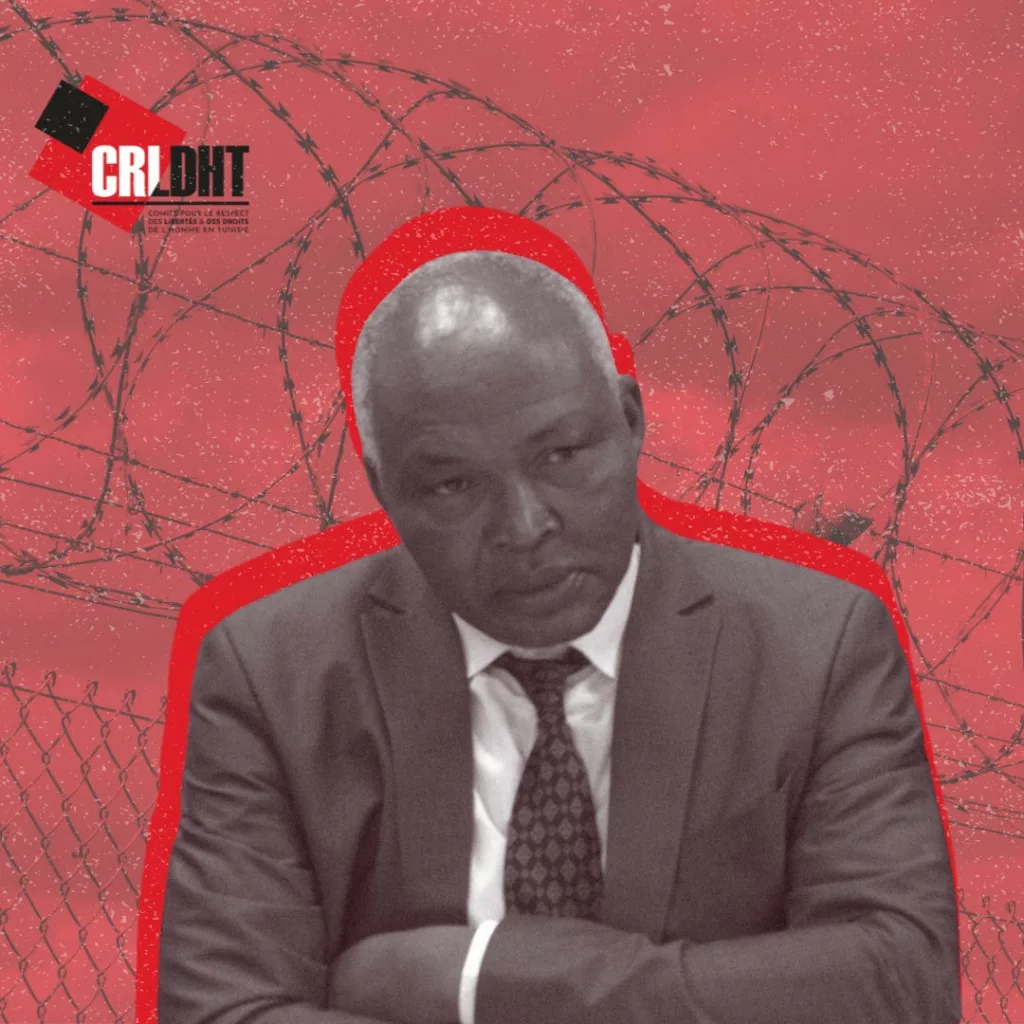
The Committee for the Respect of Freedoms and Human Rights in Tunisia (CRLDHT) condemns in the strongest possible terms the July 3, 2026, ruling handed down by the criminal chamber specializing in terrorism cases at the Tunis Court of First Instance, sentencing Mr. Ajmi Lourimi, secretary-general of the Ennahdha movement, and Mr. Moussab Gharbi to three years in prison.
This conviction marks a new phase in the policy of systematic repression against political opponents in Tunisia and is yet another example of the profound erosion of the rule of law since July 25, 2021.
Ajmi Lourimi is no stranger to Tunisian politics. A historic figure in the Ennahda movement, he belongs to the generation of activists who experienced imprisonment and repression under the regimes of Habib Bourguiba and, later, Zine El Abidine Ben Ali.
After the 2011 revolution, he helped rebuild his movement and held several key positions: member of the Shura Council, head of cultural affairs, member of the executive committee, vice president, and, since 2024, secretary-general of Ennahda.
A former member of parliament, renowned intellectual, and advocate for dialogue, Ajmi Lourimi is regarded—even by many of his political opponents—as one of the movement’s most moderate, open-minded, and conciliatory figures. His unwavering commitment to national dialogue, peaceful solutions, and democratic pluralism stands in stark contrast to the image the authorities are now trying to portray of him.
His case serves as a powerful reminder that the defense of human rights must not depend on the victims’ identity, opinions, or political affiliation. Human rights principles are universal and indivisible; they admit of no exceptions or distinctions.
A case with particularly disputed grounds
Ajmi Lourimi has been in custody since July 2024.
He was arrested in Borj El Amri while he was with Mr. Moussab Gharbi and a third person who was reportedly being sought in connection with a counterterrorism investigation.
The charge against him is based primarily on an alleged failure to report a terrorist offense—that is, on the fact that he allegedly failed to report the presence of a wanted person to the authorities.
However, according to information released by his defense committee, several factors raise serious questions.
The individual in question was unaware that he was the subject of legal proceedings. No accessible wanted notice is believed to have existed at the time of the events. There is no concrete evidence that Ajmi Lourimi was aware of this situation. He is not accused of any act that could be construed as participation in, assistance with, or any form of terrorist activity.
In light of the fundamental principles of criminal law, it seems difficult to conceive of convicting a person for failing to report an act of which they could not reasonably have been aware.
Since his arrest, Ajmi Lourimi has spent nearly two years in pretrial detention. All requests for his release filed by his attorneys were denied before the court handed down this sentence.
In the CRLDHT’s view, this case cannot be viewed in isolation from the broader context of the situation in Tunisia today.
The Ajmi Lourimi case is part of a long series of legal proceedings in recent years targeting political leaders, judges, lawyers, journalists, academics, and human rights defenders, often through charges with particularly broad scope and excessively long periods of pretrial detention.
The CRLDHT :
- condemns the sentencing of Ajmi Lourimi and Moussab Gharbi;
- calls for their immediate release pending the outcome of the appeal proceedings and for the charges to be dropped if violations of the principle of legality are confirmed;
- calls on the Tunisian authorities to put an end to the manipulation of the justice system and the abusive use of anti-terrorism legislation against political opponents;
- calls for respect for the guarantees of a fair trial, the independence of the judiciary, and Tunisia’s international human rights commitments;
- calls on the United Nations, the European Union, the African Commission on Human and Peoples’ Rights, and all international human rights organizations to remain vigilant in the face of the continuing deterioration of civil liberties in Tunisia.
Finally, the CRLDHT reaffirms its full solidarity with Ajmi Lourimi, Moussab Gharbi, and their families, as well as with all prisoners of conscience and those prosecuted because of their opinions, their political, union, or civic activism, or the peaceful exercise of their fundamental freedoms.
FREEDOM FOR AJMI LOURIMI – FREEDOM FOR ALL PRISONERS OF CONSCIENCE AND POLITICAL PRISONERS