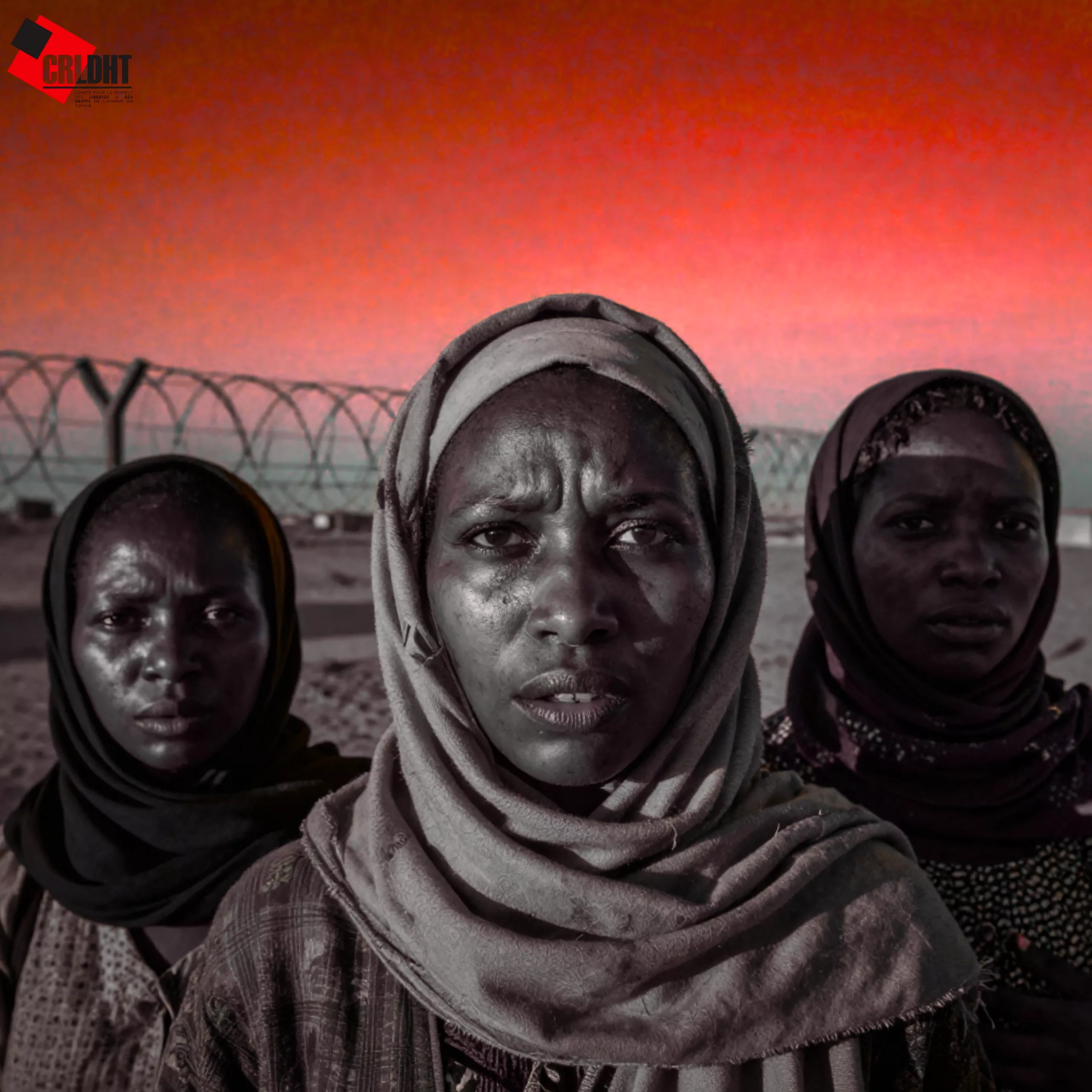
In the middle of the desert, between Tunisia and Libya, women are disappearing without a trace. Some are pregnant. Others are traveling with their babies. Many have fled war, poverty, or political violence. They thought they were crossing a border. In reality, they are entering an organized system of dehumanization, where arrest, deportation, rape, and exploitation have become almost routine stages of a migration journey that has turned into a machine that crushes lives.
From the border to the hell of Libya: an organized chain of violence
For several years, human rights organizations have been raising the alarm about violence against migrants in Tunisia and Libya. But two recently published reports take this a step further: *Women State Trafficking*, by the RR[X] collective https://statetrafficking.net/?utm_source=chatgpt.com , and *The Routes of Torture*, by the World Organization Against Torture (OMCT) and the SOS Torture Network https://www.omct.org/fr/ressources/rapports/les-routes-de-la-torture-vol-5-absence-de-solutions-pour-les-personnes-en-deplacement-en-tunisie . They no longer merely describe isolated abuses or security overreaches. They document the existence of a cross-border system where European migration policies, Tunisian repression, and Libyan detention and exploitation networks are linked in a single chain of violence. The words chosen by the authors are not neutral. RR[X] speaks of state-sponsored trafficking. The OMCT describes a torturous environment. In both cases, it is no longer simply a matter of referring to human rights violations, but of showing how state institutions directly or indirectly participate in creating a space where violence has become structural. The report *Women State Trafficking*, based on 33 testimonies collected between December 2024 and February 2026, describes precisely how this mechanism operates. Migrant women are arrested during raids in Sfax, Tunis, or other Tunisian cities. They are then transferred to border areas or camps controlled by the Tunisian National Guard, before being handed over to armed groups or networks operating in Libya. There, another phase of horror begins: arbitrary detention, sexual violence, ransom demands, forced prostitution, and domestic slavery.
Women's bodies as a site of domination
What is striking about the accounts collected by RR[X] is precisely the systematic nature of the violence. The testimonies describe humiliating body searches, women beaten in front of their children, rapes committed in detention centers, and a total lack of medical care for pregnant or injured women. Women’s bodies become a territory of absolute domination. For those who cannot pay their ransom, sexual exploitation appears to be the only possible way out of Libyan prisons. But this so-called escape is no escape at all: forced prostitution houses are merely another form of captivity. These abuses were brought before the European Parliament during a session organized by Ilaria Salis, MEP for Alleanza Verdi e Sinistra (The Left group), Leoluca Orlando, MEP for Alleanza Verdi Sinistra (Greens/EFA group), and Cecilia Strada, MEP for the Democratic Party (Socialists & Democrats group). The OMCT report complements and expands on this picture. While RR[X] primarily tracks the route of deportations and trafficking to Libya, The Routes of Torture broadens the analysis to encompass the entire Tunisian migration management system. The organization documents arbitrary arrests, forced transfers to desert borders, physical and psychological violence, as well as a proliferation of dehumanizing practices against Black migrants.
The Externalization of Borders: The Hidden Cost of European “Success”
Above all, the report highlights a fundamental point: this violence is not accidental. It is part of a specific political context, marked by the simultaneous tightening of Tunisian and European migration policies. During the first four months of 2026, the number of irregular crossings into the European Union continued to decline, a 40% drop compared to the same period the previous year. According to preliminary data from Frontex, the European agency responsible for coordinating the management of the Schengen Area’s external borders, just over 28,500 crossings were recorded. This trend reflects a combination of factors: enhanced cooperation with partner countries, preventive measures in the main countries of departure, and difficult weather conditions at the start of the year. Arrivals in Italy from Tunisia have also fallen sharply.
European governments present these figures as a security success. But behind the statistics lies another reality: that of an increasingly brutal externalization of Europe’s borders. Since the signing of the memorandum of understanding between the European Union and Tunisia in 2023, Tunis has played a central role in the European strategy for migration control. Logistical support, surveillance equipment, security cooperation: in 2026, the EU confirmed total support of approximately 130 million euros for Tunisia as part of border and migration management programs. Europe is thus strengthening Tunisia’s control capabilities at the very moment when international organizations are denouncing the worsening of human rights violations. The OMCT also points out that Tunisia cannot be considered a “safe third country.” Yet, despite reports from Amnesty International, the Office of the High Commissioner for Human Rights, and the journalistic and academic investigations accumulated over the past two years, European institutions continue to strengthen their cooperation with Tunis. Even more troubling: the Women State Trafficking report reveals that in April 2025, the European Commission refused to open a humanitarian corridor for several witnesses who were victims of trafficking, on the grounds that Tunisia and Libya were not “countries at war.” This response encapsulates the core of the European problem: violence becomes politically acceptable as long as it remains beyond the Union’s visible borders. The Central Mediterranean now functions as a legal exception zone, where practices illegal on European soil become tolerated once they are outsourced to external partners.
Racism, Impunity, and State Responsibility
In this context, the concept of “state trafficking” takes on its full significance. RR[X] is not referring to a mere failure of states, but to a system in which security apparatuses actively participate in human trafficking mechanisms. Collective deportations to Libya do not merely result in refoulement: they directly fuel a market for detention, extortion, and sexual exploitation.
The OMCT goes even further by pointing to the Tunisian state’s indirect responsibility. Even when violence is committed by armed groups, traffickers, or private individuals, the lack of protection, impunity, and institutional tolerance make the authorities liable. This continuity between state violence and criminal violence is one of the most troubling aspects of the two reports. Black migrant women thus find themselves at the intersection of several forms of domination: racial, security-related, patriarchal, and economic. Anti-Black racism in Tunisia, amplified since Kaïs Saïed’s speech in February 2023, has created a climate in which Sub-Saharan Africans have become constant targets of suspicion and hatred. The two reports show how this racialization facilitates arbitrary arrests, police violence, and widespread indifference to abuse.
Europe's borders have shifted southward
As the pages turn, another reality emerges: the gradual collapse of all avenues of protection. Opportunities for resettlement remain extremely limited. Legal pathways to Europe are shrinking. NGOs are criminalized or prevented from operating. Even so-called “voluntary” return programs often take place in a context of pressure, fear, and a total lack of real alternatives. This narrowing of options breeds deep despair. Many of the women interviewed in the two reports are aware of the risks they face. They know what awaits them in Libya. Yet they continue to leave, to cross, to attempt the sea crossing. Not because they are unaware of the danger, but because staying put has become even more dangerous than the journey itself. One of the strengths of these reports is precisely that they place human testimonies back at the center of the debate. Behind the administrative categories of “migration flows,” “border management,” and “the fight against smugglers” lie women giving birth in detention, unaccompanied minors subjected to violence during deportations, mothers separated from their children, and survivors locked away in brothels in Libya. These stories are unsettling because they reveal a truth that governments prefer to keep silent: European borders no longer stop at the Mediterranean. They extend into the camps, prisons, and desert regions of the Maghreb. And the further these borders shift southward, the more invisible the violence becomes to European public opinion.
The reports by RR[X] and the OMCT are much more than mere documentation. They raise a central question for the future of the Euro-Mediterranean region: to what extent are European states willing to delegate the use of force to prevent migration?
For behind the technocratic language of migration agreements lies a border regime based on deterrence, exhaustion, and fear—a regime in which certain lives become expendable, deportable, and exploitable.
Between Tunisia and the trend toward externalizing borders, Black migrant women are paying the heaviest price today.