
March 2026 marks a period in which a multitude of cases—involving a wide range of individuals, including political opponents, judges, lawyers, activists, business leaders, workers, and ordinary citizens—reveal a common pattern: the systematic use of the judicial system to control, neutralize, and deter any form of political, social, or civic dissent.
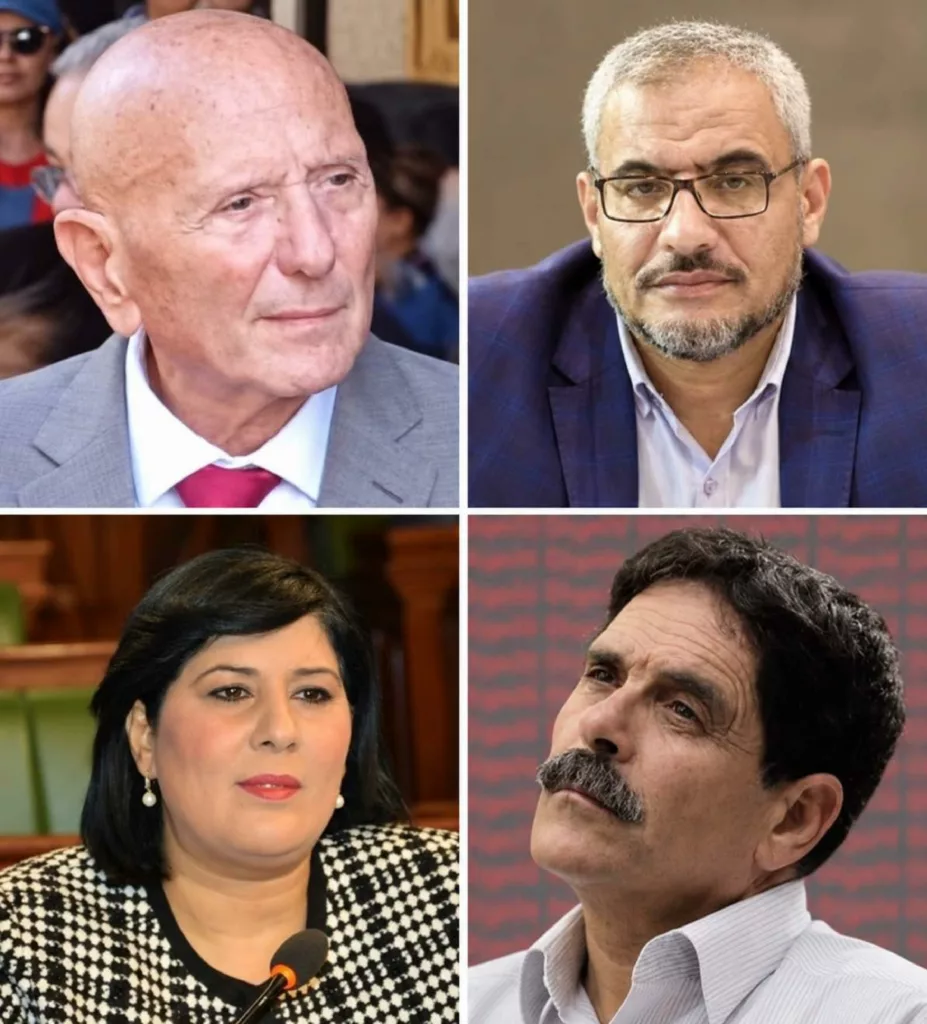
This trend first became apparent in cases targeting prominent political figures. Since 2023—with a notable intensification in 2025 and 2026—several opposition figures from diverse backgrounds have been subjected to harsh legal proceedings, characterized by prolonged detention, repeated trial postponements, and the failure to reach a substantive judgment. Political leaders such as Rached Ghannouchi, Ali Larayedh, Nejib Chebbi, Issam Chebbi, Ridha Belhaj, Ghazi Chaouachi, Abdelhamid Jelassi, Khayem Turki, Jaouher ben Mbarek, Ayachi Hammami, Cheima Issa, and Abir Moussi, Seifeddine Makhlouf, and Samir Dilou have been prosecuted or convicted in cases involving a variety of charges—conspiracy against state security, disruption of public order, and offenses related to political expression—often denounced by their lawyers as flimsy or even politically motivated. In several cases, pretrial detention has been prolonged for extended periods, turning the proceedings themselves into a punishment.
The beginning of March 2026 immediately sets the tone. On March 4, Ali Larayedh is convicted in the so-called “Ettasfir” (“sending of fighters”) case, a charge he strongly contests, reaffirming his commitment to democracy. On the same day, Judge Béchir Akremi is sentenced to heavy penalties in a case marked by profound contradictions: accused of fabricating terrorism cases, even though those same cases were used to convict others, he himself becomes the target of a proceeding widely perceived as political. His case illustrates the deep tensions linked to the restructuring of the judicial system since 2022.
A few days later, on March 6, 2026, the case of Lotfi Issa revealed how this approach had been extended to ordinary citizens. An employee at a hotel in Hammamet, he was sentenced to two years in prison for sharing a post critical of the 2024 elections. Arrested at his workplace, detained, and then fired after fifteen years of service, his case illustrates the use of Decree-Law 54 to criminalize online expression.
On March 14, 2026, the sentencing of Ahmed Nejib Chebbi to 12 years in prison in the so-called “conspiracy” case serves as a reminder that this pattern also affects historic figures of the opposition. At 81 years old, he finds himself at the center of a charge—“undermining state security”—that runs through Tunisia’s political history and has resurfaced today as a central tool of prosecution.
March 16 marked a particularly telling moment. On the one hand, Abir Moussi saw her cumulative prison sentences reach ten years. On the other, Olfa Hamdi, former CEO of Tunisair and president of a political party, was arrested upon her arrival at Tunis airport, with authorities failing to provide clear information for several days regarding the charges against her, raising further questions about the transparency of the proceedings.
At the same time, forms of international solidarity are also being targeted. On March 6, arrests began of activists involved in organizing a new flotilla to support Gaza. On March 16, 2026, seven of them were placed in pretrial detention on charges of money laundering, fraud, and breach of trust. NGOs denounced the abusive use of financial charges to criminalize political and humanitarian activism, in a context marked by external pressure.
On March 18, 2026, the crackdown spreads to social protests. In Gabès, environmental activists, including Khéreddine Debbi, appear in court for their appeal after being sentenced to one year in prison for participating in a peaceful sit-in in 2020 against industrial pollution. On the same day, female workers from the Sfax region see their case reopened on appeal for having participated in a peaceful social protest. Prosecuted for “obstructing the freedom of work,” they exemplify the gradual criminalization of social struggles.
March 20, 2026, marked another turning point with the sentencing of Saadia Mosbah to eight years in prison. An anti-racism activist and president of the Mnemty association, she was arrested on May 6, 2024, and prosecuted for money laundering and illicit enrichment in a case contested by the defense and marred by numerous irregularities. Several members of her inner circle were also convicted. This case comes amid a trend of normalizing racist rhetoric and criminalizing the work of civil society organizations—particularly those defending migrants’ rights—and has sparked an international outcry, notably from UN Special Rapporteur Mary Lawlor.
March 24, 2026, confirms that this trend is continuing. The passport case involving Hamadi Jebali and Noureddine Bhiri, among others, is once again postponed until May 5, prolonging an already lengthy legal process. On the same day, Sahbi Smara’s release is denied despite more than a year of pretrial detention, illustrating how pretrial detention has effectively become a punishment in itself.
Alongside these high-profile cases, other legal proceedings round out the picture. On February 17, 2026, Mohamed Khallouli was sentenced to one month in prison for seven social media posts, under Article 86 of the Telecommunications Code. Lawyers such as Samir Dilou are subject to restrictive measures, such as travel bans and asset freezes. Other cases, particularly those involving former ministers or businessmen, reveal inconsistencies in prosecution criteria and disproportionate financial penalties, as in the case of Ridha Charfeddine, who was sentenced to 11 years in prison on March 14, 2026. On a different note, Wadi Jary, former president of the Tunisian Football Federation, has been in detention for nearly three years on management-related charges that many observers consider disproportionate to the charges brought against him.
The pressure is also spreading within the judiciary. On March 12, 2026, the trial of Judge Anas Hmedi, president of the Tunisian Magistrates’ Association, was postponed until March 26, raising concerns among the International Association of Magistrates, which views this as an attack on judicial independence. At the same time, the dismissed judge Hichem Ben Khaled was sentenced to two years in prison for posts on Facebook.
Lawyers themselves have denounced a significant deterioration in the conditions under which they practice their profession. On February 13, 2026, a nationwide protest outside the Tunis Courthouse highlighted the obstacles they face in their work: restricted access to detainees, rushed hearings, and pressure in sensitive cases.
In addition to these cases, there are numerous less visible prosecutions: citizens sued for online posts, activists summoned for peaceful actions, and community leaders facing financial charges. It should be noted, however, that this list is by no means exhaustive. Many people, often ordinary citizens, choose not to make public the legal proceedings against them, out of fear or exhaustion. This enforced silence is a key part of the overall climate of pressure.
Taken together, these elements reveal converging trends:
– an expansion of criminal law to cover free speech, civic engagement, and social activism;
– a recurring reliance on serious charges—terrorism, conspiracy, money laundering—to justify lengthy proceedings and prolonged detention;
– a gradual erosion of fair trial guarantees, marked by a lack of transparency, delays, and restrictions on the right to a defense.
March 2026 thus emerges as a defining moment. It does not mark a rupture, but rather brings into full view a system in which justice is increasingly becoming a central instrument for regulating politics and controlling society.
What is at stake goes far beyond individual cases. It is the gradual transformation of Tunisia’s public sphere, where dissent, solidarity, and free speech are becoming activities that carry the risk of legal repercussions.