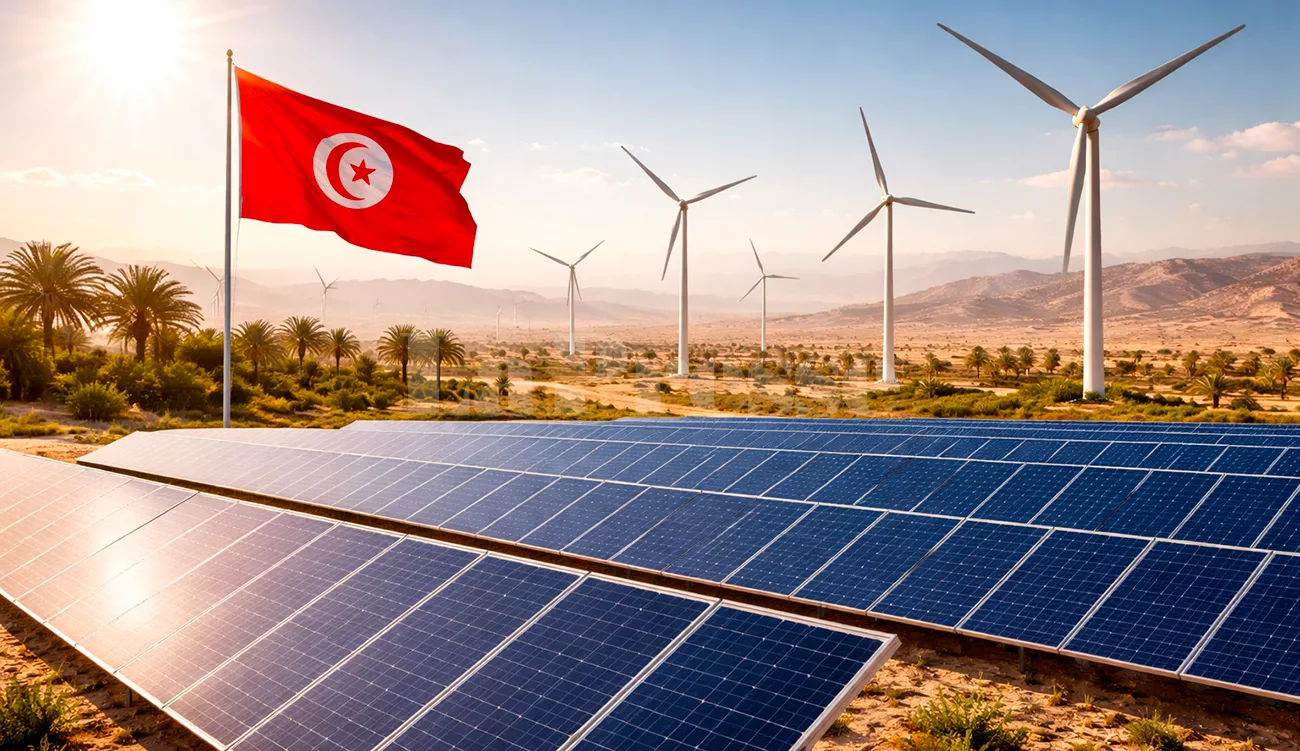
Tunisia wants to make its energy supply greener. The goal: 30% renewable energy by 2030. It’s a necessity. A matter of urgency, even.
But behind the solar power plants and the talk of the ecological transition (when it exists), one question is becoming increasingly pressing: are we succeeding in the energy transition… or are we creating a new breach in the state’s sovereignty?
A transition imposed from above
First red flag: these projects did not emerge from a standard government process. They originated from the Office of the President.
In any normally functioning state, an energy reform of this magnitude requires technical expertise, government decision-making, and an in-depth parliamentary debate—as well as public debate.
Here, everything moves faster. “Parliament” rubber-stamps decisions. It doesn’t shape them. And the faster a decision is made, the less it is debated.
The "members of parliament" voted on legislation that will bind the country for decades.
But they did so without access to key information: the full contracts, the financial provisions, and the arbitration mechanisms.
However, these laws are not merely symbolic. They formalize significant concessions in the energy sector, with major economic, legal, and geopolitical implications.
Voting without looking is not the same as making laws. It’s like signing without reading.
The previous Zenith: a warning no one can ignore
And this is where another, seemingly unrelated case suddenly sheds light on the debate: the Zenith Energy case.
An international dispute. Hundreds of millions of dollars at stake. Arbitration proceedings before international tribunals.
Above all, one thing is certain: when the government makes a bad decision, it pays the price—for a long time, and dearly.
The Zenith case is not an isolated incident. It is a telling sign.
It highlights: the fragility of contract management, the risks associated with international arbitration clauses, and the difficulty the government faces in defending its interests once it has committed to a contract
And it had a direct political consequence: the dismissal of the energy minister.
This departure cannot be dismissed as a mere reshuffle. It comes at a time of heightened tension surrounding energy concessions, international commitments, and the handling of the Zenith case. In other words: at the very heart of the issue of energy sovereignty.
Concessions today, arbitration tomorrow?
The connection between Zenith and renewable energy projects is obvious, even if it is never explicitly stated.
In both cases, the government enters into complex contracts with international entities, incorporating external legal mechanisms. And in both cases, the same question arises: what happens in the event of a dispute? The answer is clear: international arbitration.
In other words: courts beyond national control, binding rulings, and major financial risks. Zenith is not a thing of the past. It is a warning about the future.
The Trap of Concessions
The model adopted is based on concessions: private financing, private operation, and sale to STEG. On paper, it’s efficiency. In reality, it’s dependence.
Because these contracts lock the government into long-term commitments, leave little room for renegotiation, and expose it to international legal risks
In other words: we are trading energy dependence for contractual dependence.
European funding, competitive markets
Another underlying tension: funding comes in part from Europe. But the contracts aren’t necessarily awarded to European companies. Non-European players—particularly Chinese ones—are entering the fray. The result: European expectations, Tunisian decisions, and potential friction
The energy transition thus becomes a battleground. And Tunisia, a venue for arbitration… in the geopolitical sense this time.
Meanwhile: Tunisian companies remain on the sidelines, technology is imported, and the value is uncertain. The transition could have been an industrial opportunity. It risks becoming an outsourced market.
The real issue: contractual sovereignty
The problem isn't solar power. The problem is the approach.
A successful energy transition does not depend solely on production.
It depends on the government’s ability to: negotiate, regulate, monitor, and advocate
However, Zenith has demonstrated one crucial point: when this capability fails, the cost is enormous.
Tunisia is at a turning point. It can successfully navigate its energy transition. Or it can repeat the mistakes of the past on an even larger scale.
Today, the warning signs are mounting: centralized decision-making, opaque contracts, stifling of debate, and troubling legal precedents
And one question remains unanswered: are we building our energy independence… or are we negotiating it in the long term in international courts?
Because, at the end of the day, the real issue at stake here isn’t just solar energy. It’s the government’s ability to remain in control of its own decisions.