The debate over the return of Tunisians detained in camps and prisons in northeastern Syria has returned to the forefront. Should they be left there? Should they be repatriated? The issue divides public opinion, but the law already provides several answers.
The right of return is guaranteed by the Constitution: a citizen may not be deprived of their nationality, nor may they be prevented from returning to their country (Article 25).
Tunisia is also bound by the International Covenant on Civil and Political Rights, which protects the right of every person to enter their own country (Article 12.4), as well as by the African Charter on Human and Peoples’ Rights (Article 12.2).
Legally speaking, therefore, a Tunisian citizen has the right to return to Tunisia.
The Trauma of the "Afghan Arabs"
In recent history, Arab countries and societies have endured the bitter experience of repatriating self-proclaimed “jihadists.” Manipulated and trained by Western intelligence agencies to counter the Soviet invasion of Afghanistan and funded by certain Gulf states, these extremists set out for “holy war.”
Seasoned in guerrilla warfare but deeply radicalized, they contributed to the emergence of terrorist organizations, notably Al-Qaeda, founded by Osama bin Laden. With Western logistical support, these elements played a role in the Soviet defeat in the late 1980s, but also in turning Afghanistan into a hotbed of Islamist terrorism.
The return of some of them has been a deeply troubling experience for their countries and societies. These networks have spread a violent ideology that advocates fighting the “near enemy” (their own societies, which they view as deviant) before confronting the “far enemy.”
A series of violent incidents in several Arab countries has made this return a deeply traumatic experience. The regimes have responded with uncompromising security policies, often accompanied by serious violations of human rights and the principles of the rule of law.
Some of these fighters later joined other fronts (Iraq, the Sahara, Syria) under even more radical organizations, notably ISIS.
Terrorists: The Unwelcome Surprise of the Tunisian Revolution
Lured by the clichés often used to highlight the modernity of Tunisian society and by the notion that the terrorist threat was supposedly under control under Ben Ali, Tunisia discovered a very different reality after the revolution. The fall of the authoritarian regime not only opened up the political arena; it also revealed the existence of radical Salafist networks, which had long been contained, monitored, or exploited, but never truly addressed at their root.
In the post-2011 context, several radical Salafist groups emerged into the open and began to occupy the public sphere. Some took over mosques, working-class neighborhoods, so-called charitable organizations, and social media. Ansar al-Sharia, founded after the revolution around Abu Iyadh, quickly became the symbol of this Salafist-jihadist surge. The movement organizes rallies, conducts preaching activities, mentors young people who are socially and ideologically disengaged, and helps create an environment conducive to recruitment for conflict zones.
The group was designated a terrorist organization by Tunisian authorities in August 2013, while Ali Larayedh was Minister of the Interior, after being accused of involvement in major political and security-related violence, including the assassinations of Chokri Belaïd on February 6, 2013, and Mohamed Brahmi on July 25, 2013. These two political assassinations marked a turning point: they revealed that the jihadist threat no longer targeted only the security apparatus, but also opposition figures, political life, and the democratic process itself.
At the same time, armed cells established themselves in border and mountainous areas, particularly at Mount Chaambi in Kasserine, where the Okba Ibn Nafaâ Katiba, linked to Al-Qaeda in the Islamic Maghreb, carried out attacks against the army and internal security forces. Starting in 2012 and especially in 2013–2014, clashes intensified: ambushes, improvised explosive devices, targeted assassinations, and attacks on security posts. The internal security forces, the National Guard, and the army suffered heavy losses during this period.
The available figures confirm this escalation. According to a study published on the post-revolutionary period, terrorist attacks reportedly rose froma single incident in 2011 to 4 in 2012, 18 in 2013, 23 in 2014, and then to about 30 between 2015 and 2016. The cumulative toll for the 2012–2016 period is estimated at nearly 300 casualties among law enforcement and military personnel, more than 100 deaths among armed groups, and more than 350 wounded.
The year 2015 marked a particularly bloody turning point. The attack on the Bardo Museum on March 18, 2015, left 22 people dead, including 21 foreign tourists and a Tunisian security guard. On June 26, 2015, the attack in Sousse-Port El-Kantaoui killed 38 people. On November 24, 2015, an attack on a presidential guard bus in Tunis claimed the lives of 12 officers. These attacks demonstrate a shift in terrorist strategy: targeting the state, the armed forces, and political symbols, as well as the tourism industry and the country’s international image.
In March 2016, the attack in Ben Guerdane, carried out by a commando unit linked to the Islamic State, underscored the scale of the threat. The attackers targeted security facilities and attempted to establish a jihadist stronghold along the Libyan border. Tunisian forces repelled the attack, killing 49 suspects and arresting nine others.
In this context, the number of people openly displaying a radical ideology—long beards, qamis, radical rhetoric, and rejection of civil society—is becoming increasingly visible and prominent in public spaces. But the crux of the matter is not limited to these outward signs: the most serious issue lies in the establishment of networks for recruitment, financing, smuggling, and indoctrination.
Statistics on departures to conflict zones remain approximate, but they give an idea of the scale of the phenomenon. Estimates range from 3,000 to 6,000 Tunisians who left for Syria, Iraq, or Libya between 2011 and 2014; a figure of 5,500 was notably cited by the UN in 2015 and repeated by the Tunisian Ministry of the Interior in 2016, before being revised downward.
This massive mobilization ranks Tunisia among the top countries in the world in terms of the number of foreign fighters relative to its population. It reveals a profound crisis—social, political, religious, security-related, and institutional. The revolution did not, therefore, create the terrorist phenomenon, but it did expose its scale, its networks, and the fragility of the state’s responses.
A phenomenon that remains hidden
Indoctrination and radicalization alone cannot explain this phenomenon. Poverty, social exclusion, ignorance, and exploitation by organized networks are also key factors.
The large number of people leaving for Libya and Syria, often via Turkey, raises questions about possible internal failures. Suspicions have been raised that certain parts of the government may be facilitating these movements, though no serious investigation has yet established the truth.
No parliamentary committee or thorough judicial investigation has been able to shed full light on these events. Kaïs Saïed, who claims he wants to “save” Tunisia, has also failed to provide a clear answer to this question, allowing a sense of impunity to persist.
A delegation from the Ministry of Justice was reportedly sent to Damascus before the fall of the former Syrian regime and interviewed certain detainees. However, since the statements did not match the expected accounts, no extradition request was reportedly made.
Under these circumstances, with political authority under challenge and the judicial system weakened, the return of Tunisians from Syria offers little hope for an impartial resolution of this case through fair trials.
But returning does not mean impunity: The right of return does not absolve one of criminal responsibility
The Tunisian Anti-Terrorism Law (Law No. 26-2015) penalizes, among other things:
- membership in a terrorist organization,
- participation in terrorist activities,
- traveling abroad for terrorist purposes.
The legal framework is therefore in place. Neither the extraterritorial nature of the acts nor the statute of limitations stands in the way of prosecution.
The main challenge is procedural in nature, particularly with regard to evidence. Many individuals were detained under unclear circumstances, sometimes without due process, without official records, and without usable physical evidence.
They have often been detained without access to due process, which makes it considerably more difficult to establish accountability, particularly for the most serious crimes.
The Tunisian courts have already tried some returnees as well as detainees extradited from Guantánamo. However, due to a lack of transparency, it is impossible to say with certainty that all cases will be handled consistently.
A purely punitive approach is not enough to eradicate the problem.
Some are calling for the revocation of citizenship. However, the Constitution prohibits the revocation of Tunisian citizenship. Turning these individuals into stateless persons solves nothing: it protects neither Tunisia nor the international community, particularly in an unstable regional environment (Libya, the Sahel).
The concept of deradicalization has attracted the interest of many organizations and researchers, but the results remain limited. The Algerian example can be cited, but it arises from a specific civil war context that is difficult to compare. An effective strategy would require significant resources for monitoring, oversight, and prevention—resources that the Tunisian government does not appear capable of fully mobilizing.
The case of women and children
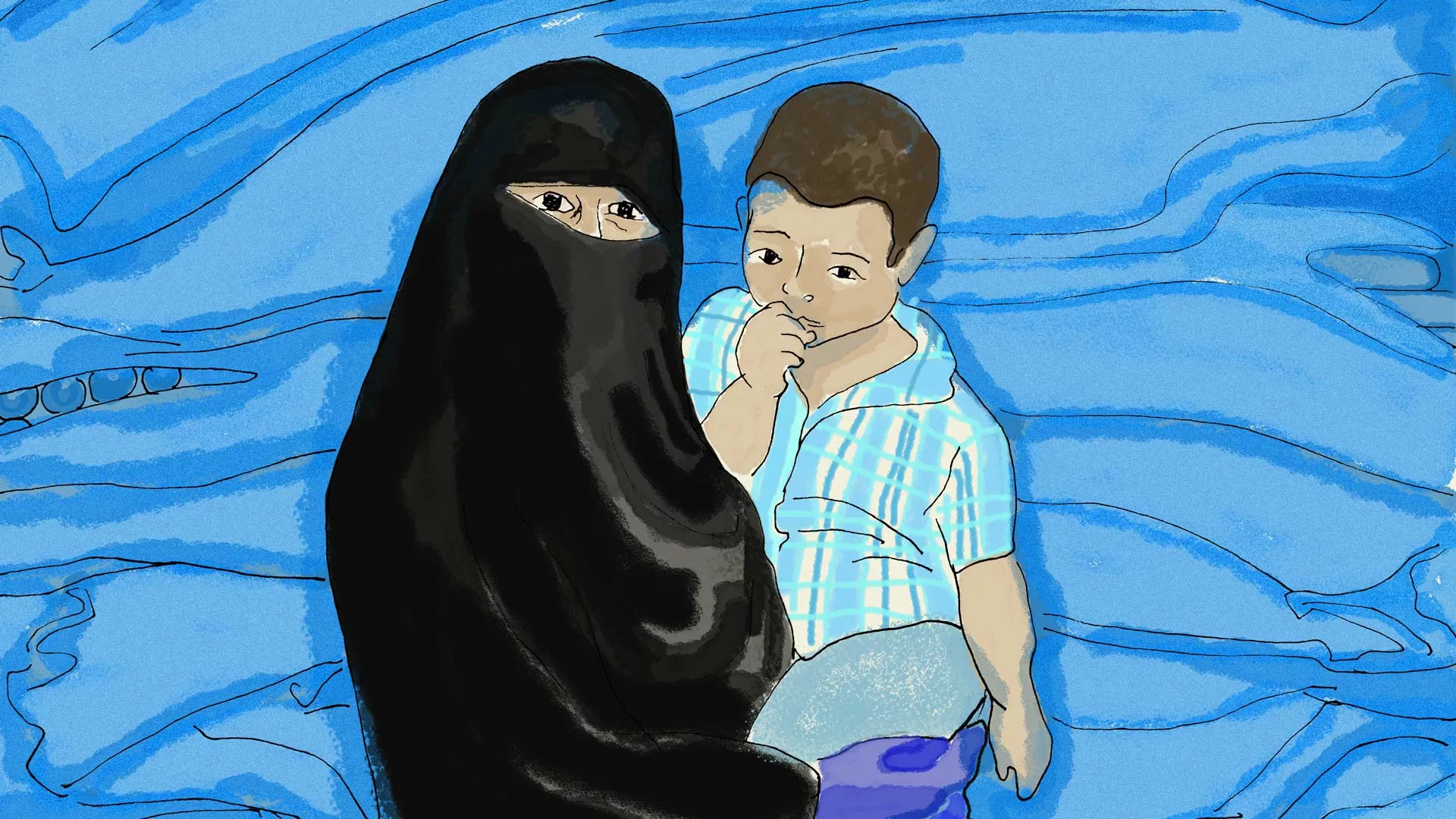
Dozens of Tunisian women and more than a hundred Tunisian children are reportedly still in Syrian camps, particularly in Al-Hol and Roj, living in extremely precarious humanitarian conditions marked by insecurity, a lack of medical care, and constant exposure to various forms of violence and radicalization.
Tunisian law enshrines the fundamental principle of individual criminal liability: each person is responsible for their own actions. This principle, enshrined in constitutional and criminal guarantees, excludes any form of collective liability. Children can under no circumstances be held responsible for the choices or actions of their parents. They must be considered first and foremost as victims—victims of armed conflict, forced displacement, but also of an ideological and social environment that has deprived them of their fundamental rights.
As such, the Tunisian government is legally obligated to take action. By ratifying the Convention on the Rights of the Child, Tunisia has committed to ensuring that every child within its jurisdiction receives protection, assistance, and care, including when the child is abroad. These obligations entail not only their repatriation but also the establishment of appropriate support systems: psychological counseling, reintegration into school, social follow-up, and protection against the risks of stigmatization or marginalization.
The situation of women, however, appears to be more complex and calls for a differentiated approach. Some have been able to play an active role within the organization’s structures, whether in logistical support, indoctrination, or, in some cases, activities directly linked to the security or ideological apparatus. Others, however, have followed their spouses under conditions of social, family, or psychological coercion, without any proven involvement in criminal acts.
Consequently, a one-size-fits-all approach would be legally inappropriate and politically risky. Only a case-by-case assessment, based on evidence and respecting the guarantees of a fair trial, can determine who is responsible. This approach must combine judicial responses, social support, and, where possible, programs for disengagement and reintegration.
Beyond security considerations, the handling of this matter therefore entails the government’s responsibility in a broader sense: that of protecting its most vulnerable citizens and upholding fundamental principles of justice.
The risk of further exploitation
Even though the official line appears to oppose radical views, the risk of political exploitation remains.
Kaïs Saïed has not hesitated to tolerate certain radical groups, such as the “Ettahrir” party, which advocates a return to the caliphate. There is no guarantee that the return of these fighters will not be exploited for political purposes, or even to fuel internal tensions.
Ultimately, the choice is a political one, but it is limited by law:
- The right of return exists.
- Terrorist acts are punishable by law.
- Children must be protected.
- A deradicalization strategy must be developed.
The real question, then, is this: Does the state prefer to leave its citizens in an unstable area or to repatriate them and try them under its own laws?
This remains a sensitive issue. But one thing is certain: under the law, refusing to allow a citizen to return is not a permissible punishment. Bringing them to trial, on the other hand, is— but with all the necessary safeguards of a fair trial.Top of form
Bottom of the form