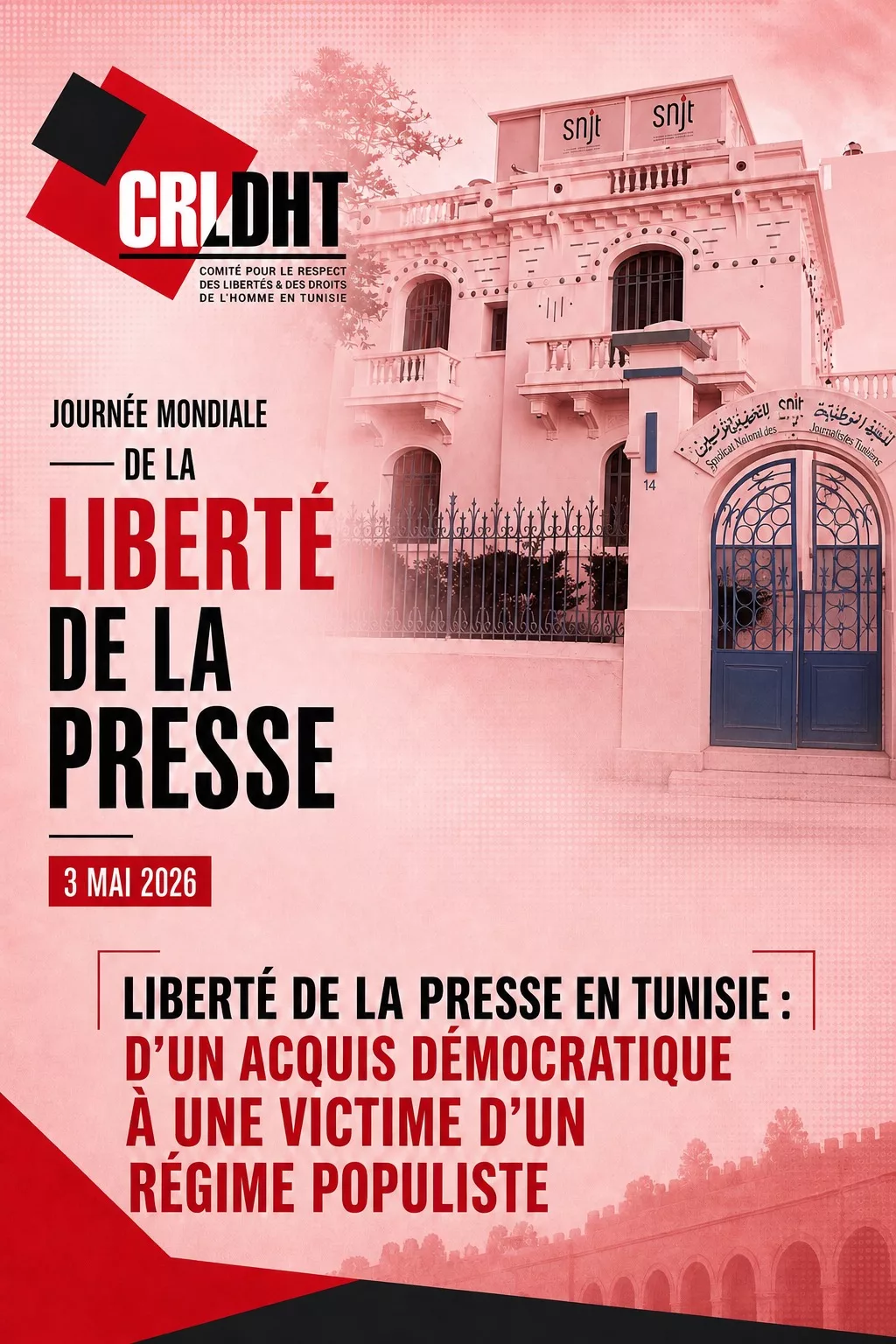
On World Press Freedom Day, the Committee for the Respect of Freedoms and Human Rights in Tunisia expresses its deep concern. The situation of the press in Tunisia is deteriorating at an alarming rate. Yet it was one of the most significant achievements of the revolution.
The press and freedom are always the first targets of repressive regimes. Kaïs Saïed’s regime is no exception. It is part of a regional and global wave of authoritarian regimes that are attacking fundamental freedoms, and first and foremost, press freedom.
Since Kaïs Saïed came to power, there has been a sharp decline. Tunisia has fallen from 75th place in 2020 to 137th place in 2026 in press freedom rankings. Since then, the prisons have never been empty of journalists. They are being prosecuted simply for doing their jobs. Among them are Khélifa Guesmi, Chadhia Belhadj Mbarek, Mourad Zghidi, Borhen Bsaies, Zied Hani, Salah Attia, Amer Ayad, Sonia Dahmani, and Mohamed Boughalleb. A picture that brings to mind times we thought were long gone.
This targeting is systematic. It relies on several tools. Legally speaking, regulatory mechanisms have been stripped of their substance. HAICA has been sidelined. Decree 115, which guaranteed freedom of the press, has been abandoned. It has been replaced by repressive legislation. Decree 54 has become the primary weapon against journalists.
Beyond the legal sphere, a climate of intimidation has taken hold. It is not limited to legal proceedings. Prominent media figures are the targets of organized smear campaigns aimed at discrediting them and silencing them. Khaoula Boukrim is a striking example: she has been the target of relentless campaigns seeking to tarnish her reputation. Others face legal intimidation: Noureddine Boutar, director of Mosaïque FM, was prosecuted in connection with the so-called conspiracy case. These methods, whether through the courts or through defamation, have a single objective: to discourage all independent journalism.
As a result, many journalists have left the country. Independent media outlets face constant administrative and legal pressure, threatening their financial survival. The situation has reached a critical point: the Al-Khatt association, which runs the Inkyfada website, is facing dissolution by court order.
The public media, too, have undergone profound changes. Structurally, institutions such as Dar Assabah have been reorganized. Appointments are now based on loyalty. In substance, the public media have become a platform for discourse that promotes exclusion, incitement, racism, and misinformation. Their role as a public service has been betrayed.
In this context, the regime communicates differently. It relies on the president’s unilateral statements. It draws on the accounts of those close to him. It allows rumors to spread, in the absence of reliable sources. This system has no need for a free press. It thrives on its absence.
The erosion of press freedom is not merely a professional concern. It reflects a general decline in civil liberties. It signals the dismantling of the democratic foundations of the state. Press freedom is a fundamental right of every society. It is an indispensable prerequisite for any true democracy.
In light of this situation, we call for:
● Put an end to legal proceedings against journalists and immediately release all those detained for their professional activities.
● Revise Decree 54 and any other legislation that infringes upon freedom of expression.
● Restore the independence of public media and the HAICA to ensure pluralism and prevent the manipulation of information.
The Committee for the Respect of Freedoms and Human Rights in Tunisia May 3, 2026