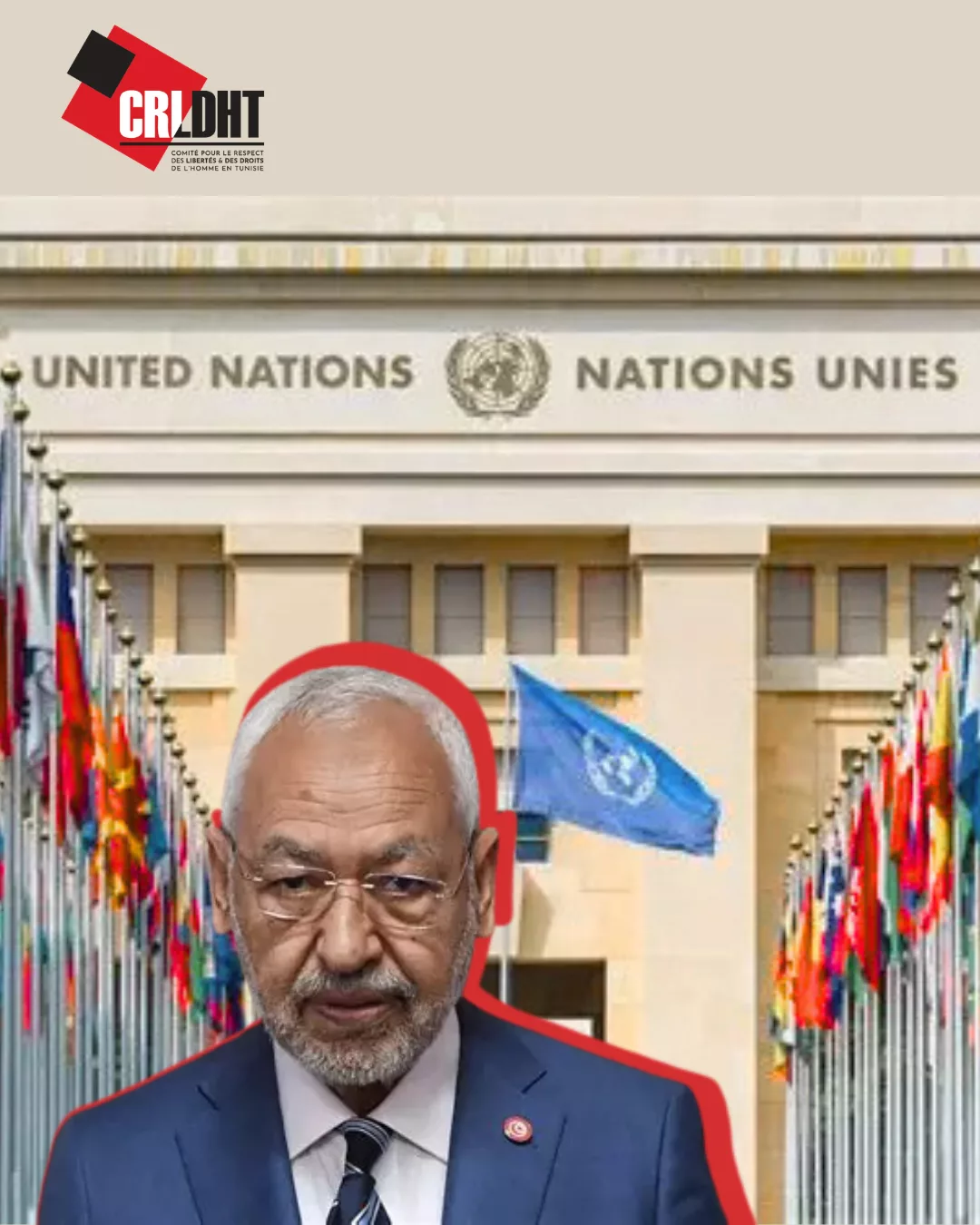
UN Working Group sides with Rached Ghannouchi and condemns Tunisian authorities
Once again, the UN experts of the Working Group on Arbitrary Detention have unequivocally condemned the practices of the Tunisian regime.
Following Ghazi Chaouachi, Ridha Belhaj, and Jaouhar Ben Mbarek in the so-called “conspiracy against state security” case, and following the president of the Free Destourian Party, attorney Abir Moussi, and magistrate Béchir El Akremi, it is now Ennahda Party President Rached Ghannouchi Khriji whom the independent United Nations experts have found to be in the right.
A damning report from the UN panel
Opinion No. 63/2025, adopted at the 104th session of the Working Group on Arbitrary Detention in November 2025 and recently published, concerns the case of the former president of the Assembly of People’s Representatives, who was removed from office following the coup d’état of July 25, 2021.
This latest statement is part of what has now become a long series of international condemnations that, case by case, demonstrate the systemic nature of human rights violations in Tunisia.
A refusal to cooperate that speaks volumes
Contrary to the repeated statements by the Tunisian Minister of Foreign Affairs, who asserts the authorities’ willingness to cooperate with UN mechanisms, the Tunisian government neither responded nor reacted to the Working Group’s communication within the specified timeframe.
As in previous cases, this silence reflects both a lack of legal arguments and a refusal to acknowledge before international bodies practices that have now been documented.
This negative and irresponsible attitude, however, must not hinder the processing of cases or the identification of violations.
An arrest marred by serious irregularities
The Working Group identifies several serious violations:
- The arrest on April 17, 2023, took place without any explanation of the reasons and without the presentation of a warrant or arrest order
- The location of detention has not been disclosed, a situation equivalent to enforced disappearance
- No grounds for detention—which is exceptional under the law—have been established
On this basis, the detention is classified as arbitrary under Category 1.
The criminalization of free speech
UN experts make it clear that prosecutions for “glorifying terrorism” are in fact the result of the exercise of the right to freedom of expression and opinion.
The detention is thus also classified as arbitrary under the second category, confirming a strong trend toward the misuse of criminal law to punish political opinions.
A justice system under control
Based on the systemic violations of judicial independence in Tunisia, the Working Group concludes that there has been a violation of the right to a fair trial.
Detention is therefore also arbitrary within the meaning of the third category, which confirms the collapse of fundamental judicial safeguards.
Political detention
The political nature of the detention is explicitly acknowledged, leading to its classification as arbitrary under the fifth category.
This observation reinforces the view that the justice system is being used as a tool to neutralize opponents.
An alarming humanitarian situation
Experts have expressed serious concern about:
- Rached Khriji’s advanced age (over 84)
- the deterioration of his health
- prison conditions
- inadequate and inconsistent care
They remind the Tunisian government of its international obligations, particularly under Article 10.1 of the International Covenant on Civil and Political Rights and the Nelson Mandela Rules.
A regime that openly defies international law
The monitoring procedures recommended by the Working Group are unlikely to be followed by a regime that systematically and brazenly violates its international obligations.
This development marks a turning point: whereas the regimes of Ben Ali and Bourguiba sought to maintain a semblance of legality, the current government is embracing an unprecedented drift toward authoritarianism.
The regime’s lawless behavior is part of a consistent political strategy:
- violation of the 2014 Constitution
- failure to comply with the 2022 Constitution, which was drafted by the president himself
- absolute concentration of power
In this context, violations of fundamental rights are no longer isolated incidents.
Arbitrary detention as a form of governance
Arbitrary detention, violations of the right to a fair trial, and, more broadly, the undermining of the rule of law are becoming a policy in and of themselves.
They appear to be a key tool for:
- make up for the failure of the policies implemented
- neutralize any opposition
- to ensure the continued existence of unchallenged power;
In light of the seriousness of the violations observed and their now systemic nature, the CRLDHT makes the following recommendations:
- The CRLDHT calls for the immediate and unconditional release of all political detainees, prisoners of conscience, and all those arbitrarily detained in Tunisia, including Rached Ghannouchi Khriji and all individuals mentioned in the reports of the United Nations Working Group.
- It calls on the Tunisian authorities to:
- to fully comply with the recommendations of the Working Group on Arbitrary Detention
- to cooperate effectively with United Nations mechanisms
- to implement the recommendations issued by the special procedures
3. It calls for:
- the immediate cessation of legal proceedings related to the exercise of the freedoms of expression, opinion, and association
- strict adherence to the guarantees of a fair trial
- an end to the use of the justice system as a tool of political repression.
4. Pending their release, the CRLDHT calls for:
- immediate access to appropriate and regular care, especially for the elderly or those who are ill
- respect for the dignity of detainees in accordance with the Nelson Mandela Rules
- effective access to lawyers and families.
5. The CRLDHT calls for:
- the restoration of judicial independence
- an end to pressure and interference by the executive branch in the functioning of the judiciary
- a review of proceedings conducted in violation of international standards.
Paris, March 26, 2026