The Committee for the Respect of Freedoms and Human Rights in Tunisia (CRLDHT) strongly condemns the sentences handed down in the so-called Saadia Mosbah case, which reveal a troubling trend characterized by the manipulation of the justice system, the normalization of racism, and the growing repression of civil society.
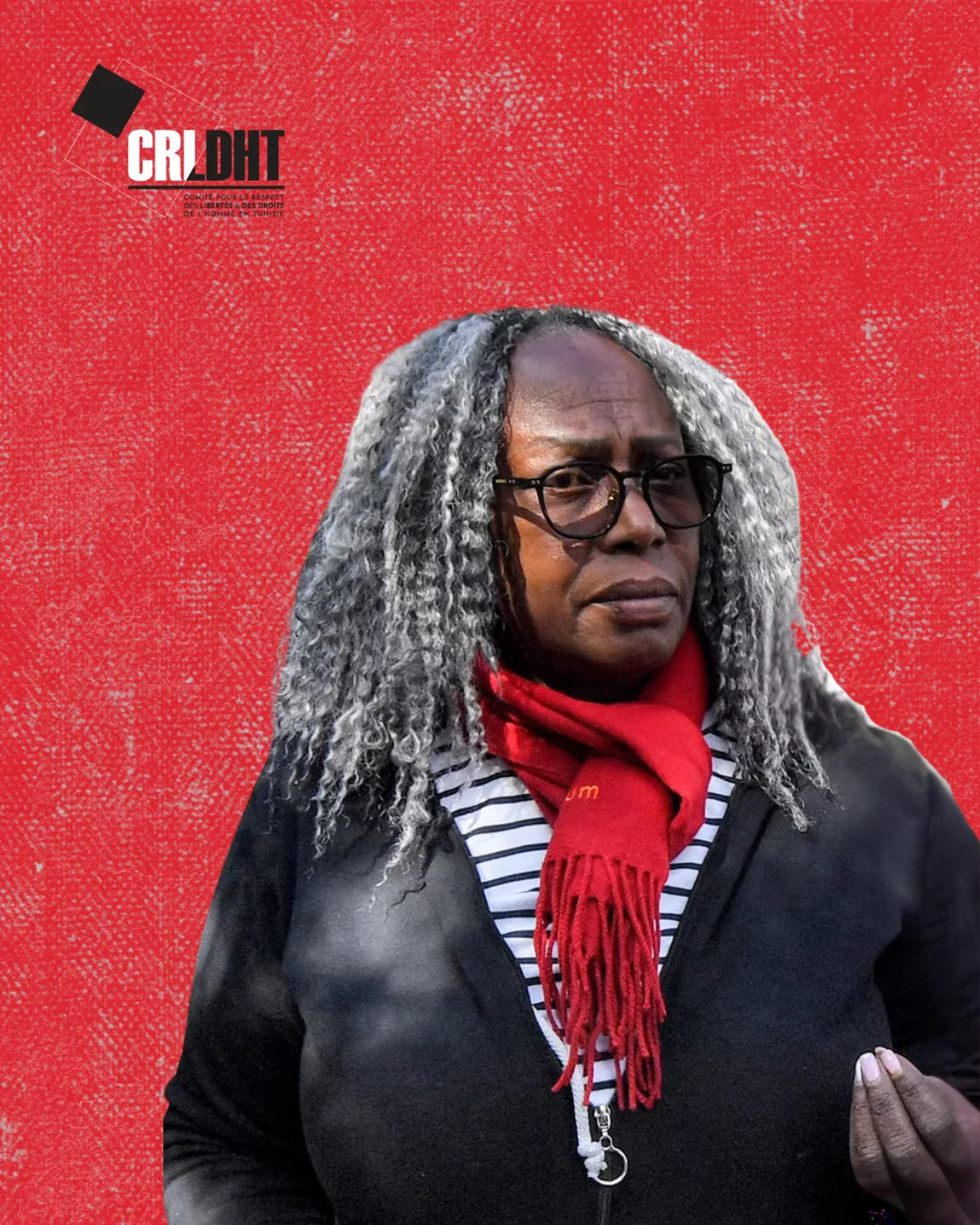
It was only after three days that the defense teams were finally able to review the details of the first-instance judgment handed down by the Criminal Chamber of the Tunis Court. As reported as early as Thursday evening by pro-government outlets and media, Saadia Mosbah, an anti-racism activist and president of the Mnemty association, was sentenced to a total of eight years in prison, as well as heavy financial penalties:
The court ruled in the first instance, issuing a judgment after a full hearing against Saadia Mesbah, Ziad, Rim Al-Garfi, Slim, Amina, Fares, and Ilham, and by default against Ghofrane. It found Saadia, Ziad, Ghofrane, and Fares guilty of money laundering committed as part of a criminal enterprise, by exploiting the opportunities afforded by their association’s activities.
He sentenced Saadia to five (5) years in prison and a fine of 50,000 dinars, and Ziad, Ghofrane, and Fares each to two (2) years in prison and a fine of 20,000 dinars.
The court also found Saadia, Ziad, Ghofrane, Fares, and Amina guilty of illicit enrichment. It sentenced Saadia to three (3) years in prison and a fine of 61,719 dinars and 500 millimes, Ziad to one (01) year in prison and a fine of 34,113 dinars and 500 millimes, Ghofrane to one (01) year in prison and a fine of 10,200 dinars, Fares to one (1) year of imprisonment and a fine of 23,665 dinars, and Amina to one (1) year of imprisonment and a fine of 12,691 dinars and 709 millimes.
The court also found Saadia, Fares, Ziad, and Ghofrane guilty of failing to maintain accounting records and sentenced each of them to a fine of 10,000 dinars, in addition to ordering them to pay court costs.
He dismissed the charges against Hiba and Amina Boukmesh regarding the remaining allegations, as well as against Ilham Kaouachi, Slim Soukni, and Rim Al-Garfi. He ordered that all documents, checks, and invoices seized in connection with the case be retained, and that the seized funds be forfeited to the State.
The court also imposed a five-year ban on the right to vote and to hold office on Saadia, Fares, Ziad, Ghofrane, and Amina.
Total fines per person:
• Saadia: 121,719.500 dinars
• Ziad: 64,113.500 dinars
• Ghofrane: 40,200 dinars
• Fares: 53,665 dinars
• Amina: 12,691.709 dinars
Total amount of fines (all convicted individuals):
,322,389.209 dinars
- Condemns in the strongest terms these judicial decisions, which were handed down in a context that undermines the guarantees of a fair trial and the independence of the judiciary
- Calls for the immediate release of Saadia Mosbah and Abdallah Saïd
- Calls for respect for fundamental rights, including freedom of association and the protection of human rights defenders
- Calls for a peaceful mobilization in defense of the rule of law and civil liberties
These convictions bring to a close a legal proceeding that was marked, at every stage, by serious violations of the guarantees of a fair trial—from the preliminary investigation through the prosecution phase—violations that were upheld without correction by the Court of Cassation.
These events are taking place against the backdrop of a deeply deteriorating political climate, characterized by the spread of xenophobic and racist rhetoric at the highest levels of government, particularly since February 2023. In this context, civil society actors committed to defending human rights have gradually been singled out as targets, made scapegoats of a policy based on fear, stigmatization, and the fabrication of an internal enemy.
This narrative was built in particular around the theme of an alleged “change in the country’s demographic composition”—a claim widely contradicted by the facts but used to justify increased criminalization of community initiatives, particularly those supporting sub-Saharan migrants.
In this climate, the crackdown on civil society organizations has intensified, in an environment described by numerous international bodies as one marked by a rollback of freedoms and increasing pressure on human rights defenders.
At the same time, migration policies implemented under agreements with the European Union have contributed to reinforcing this trend. The outsourcing of border control has led to increased pressure on humanitarian organizations and solidarity initiatives, which are now subject to prosecution and repressive measures.
In this context, the Saadia Mosbah case stands as emblematic of a broader trend toward the criminalization of solidarity and community organizing, in which political rhetoric, security-driven logic, and the instrumentalization of the justice system converge.
The CRLDHT further notes that the situation of Saadia Mosbah and Abdallah Saïd, who remain in detention, stands in stark contrast to that of other defendants in similar cases, the vast majority of whom have been granted provisional release. This disparity raises serious questions regarding respect for the principle of equality before the law and the absence of any form of discrimination.
The international dimension of this case is now clear. The United Nations Special Rapporteur on human rights defenders has expressed concern and called for the release of Saadia Mosbah, noting the peaceful nature of her work in the fight against racism and in support of migrants’ rights.
Beyond the facts, this case reveals a troubling trend: that of a system in which the judiciary is ceasing to act as a check on power and is instead becoming an instrument of political control, against a backdrop of the normalization of racist rhetoric and the curtailment of civil liberties.
In light of this situation, the CRLDHT:
The CRLDHT reiterates that the fight against racism, solidarity, and the defense of human rights must not be criminalized.
Paris, March 25, 2026