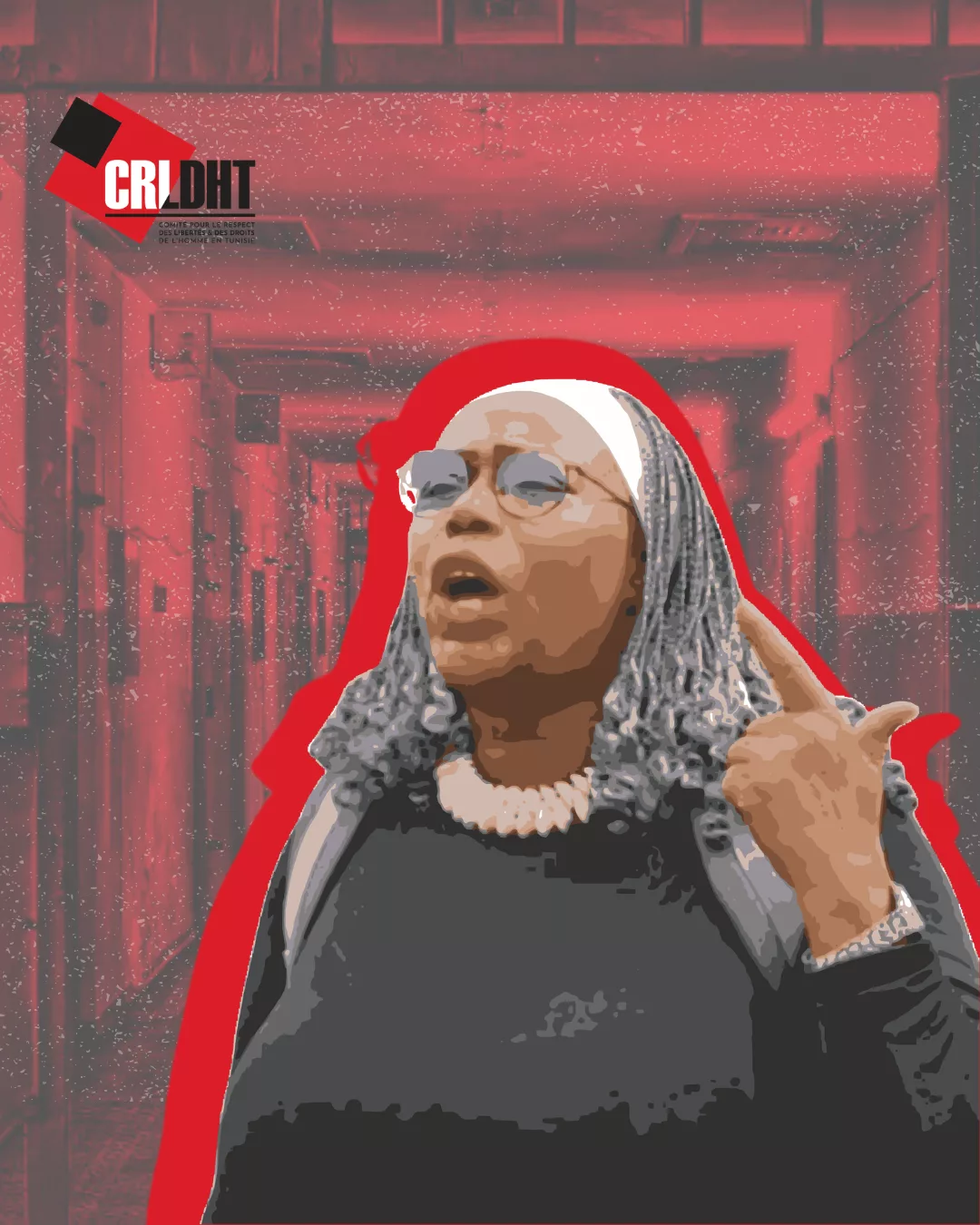
The Committee for the Respect of Freedoms and Human Rights in Tunisia (CRLDHT) strongly condemns the sentencing of Saadia Mosbah to eight years in prison, as well as the sentence imposed on her son Fares (three years).
This decision amounts to a political conviction, in a context marked by authoritarian abuses, the normalization of racism, and a troubling manipulation of the justice system. While we welcome Salwa Ghrissa’s release, it highlights discrepancies that are difficult to understand in the handling of comparable situations. Under these circumstances, it is impossible to ignore the context in which these convictions occur or to disregard the reality surrounding them.
Saadia Mosbah, a prominent anti-racism activist and founder of the Mnemty association, was arrested on May 6, 2024, following a campaign of hate and defamation targeting her activism. The charges against her—money laundering, illicit enrichment, and criminal conspiracy—have been widely contested and undermined by the evidence in the case, particularly the financial analyses.
Since then, she has been held in prolonged detention; her requests for release have been systematically denied; the proceedings have been marked by inconsistencies and delays; and the defense has consistently argued that the case lacks evidence.
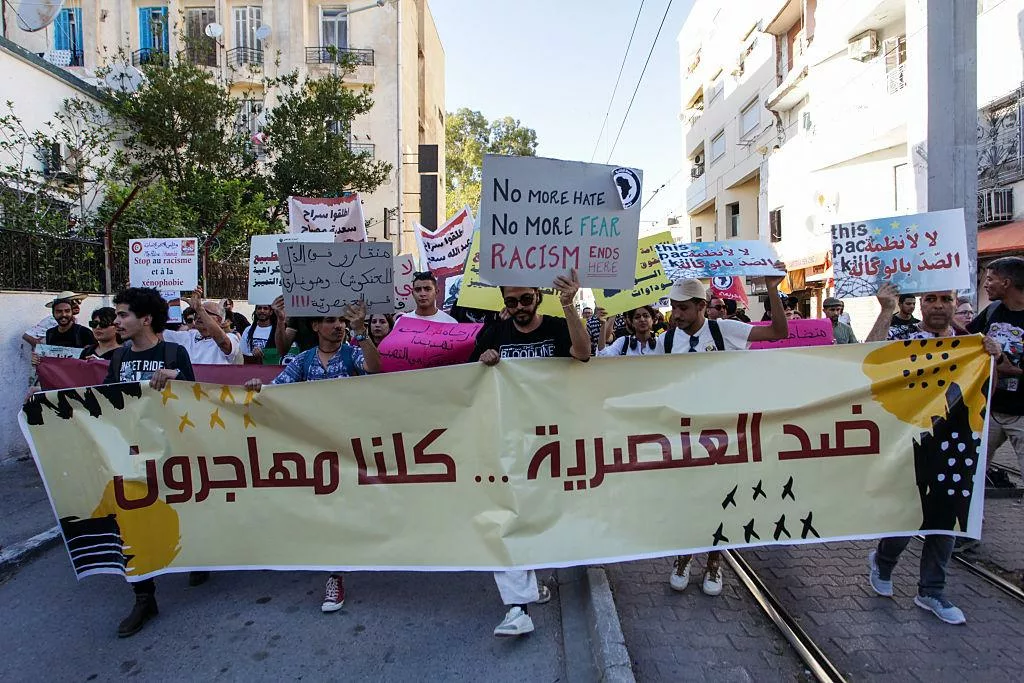
This case comes amid a climate in which official discourse refers to a so-called “demographic threat,” sub-Saharan migrants are portrayed as a danger, and racist rhetoric has become so commonplace that it has escalated into calls for violence. In this climate, the conviction of an anti-racist activist—and those around her—cannot be viewed as separate from the political and ideological environment.
On the eve of March 21, the International Day for the Elimination of Racial Discrimination, this conviction highlights a stark disconnect between stated principles and reality. Although Tunisia enacted a law in 2018 criminalizing racial discrimination, the law has now been largely rendered ineffective: racist rhetoric is becoming commonplace without any response, victims remain inadequately protected, and those who speak out against racism are now being prosecuted.
The CRLDHT also condemns the complicity of European partners. Even as civil liberties are eroding in Tunisia, racist rhetoric is becoming commonplace, and human rights defenders are being persecuted, Europe continues to legitimize the Tunisian authorities in the name of migration control.
This official Europe, which turns its back on its own principles, effectively condones policies of exclusion, repression, and stigmatization. With one hand, it condemns such practices, but with the other, it funds and reinforces the mechanisms that contribute to the climate in which such condemnations become possible.
The Saadia Mosbah case is not an isolated incident. It is part of a broader trend: the criminalization of community work, the suppression of critical voices, the manipulation of the justice system, and the normalization of racism.
In light of this situation, the CRLDHT:
- calls for the immediate and unconditional release of Saadia Mosbah
- demands that the verdict handed down against his son Fares and all those prosecuted in this case not be enforced
- calls for an end to the manipulation of the justice system
- calls on international partners, particularly European ones, to cease any support that contributes to these abuses
The CRLDHT calls for a clear and unambiguous mobilization.
Solidarity is not a crime. Racism is a crime.
Paris, March 20, 2026