Tunisia: The heat wave is turning prisons into an imminent threat to the lives of prisoners. Immediate action is needed to protect the lives and health of detainees in Tunisia
The Committee for the Respect of Freedoms and Human Rights in Tunisia (CRLDHT) expresses its deepest concern over the growing number of consistent and alarming reports indicating an extremely serious deterioration in detention conditions in Tunisian prisons, exacerbated by the exceptional heat wave currently affecting the country.
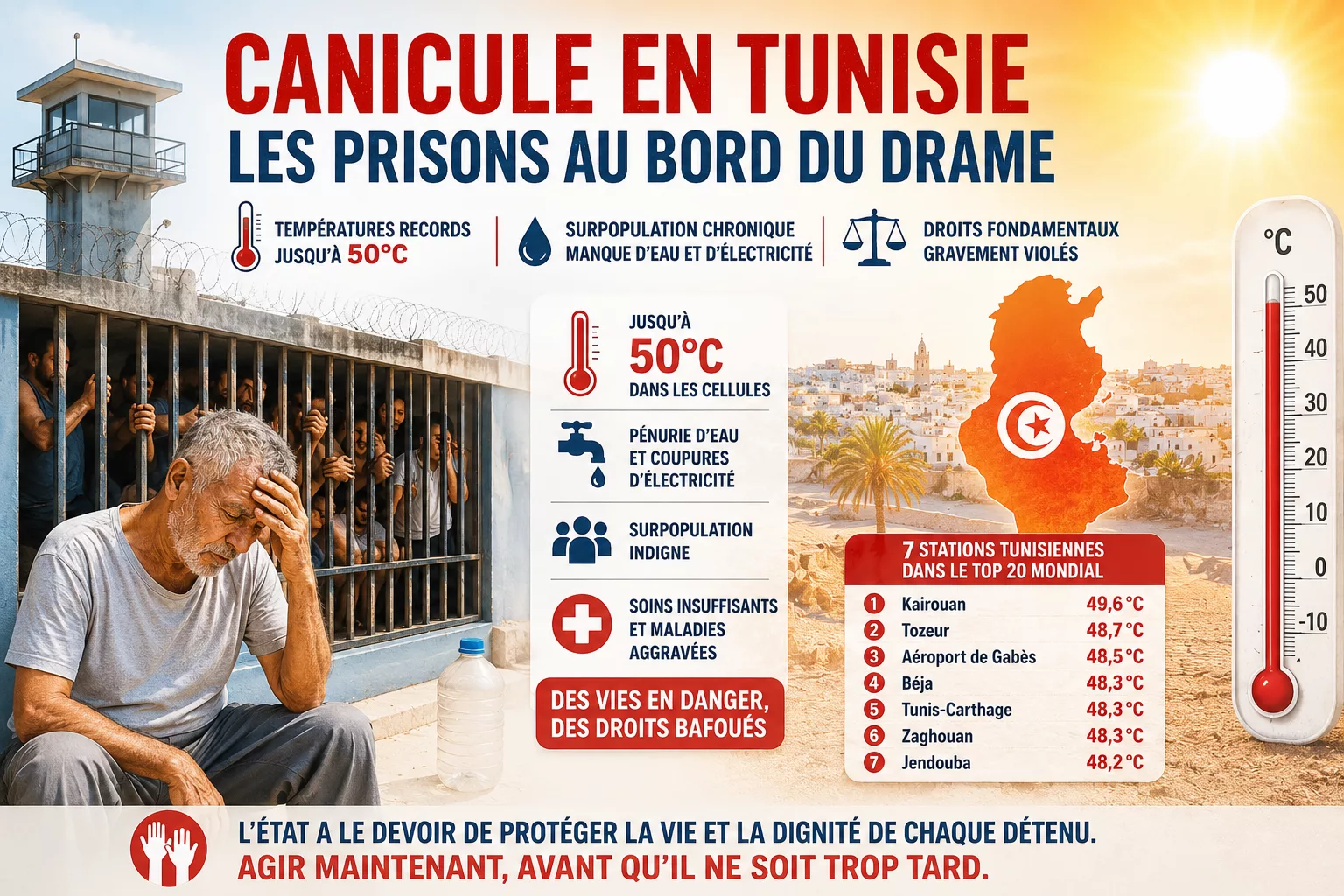
With temperatures exceeding 50°C in several regions, water shortages and power outages having a lasting impact across the entire country, and correctional facilities suffering from chronic overcrowding, Tunisian prisons are becoming places of real suffering where the health, physical well-being, and sometimes even the lives of inmates are directly threatened.
Accounts gathered from families, lawyers, former detainees, and human rights organizations paint a picture of an intolerable situation: cells turned into ovens, a lack of ventilation, water shortages, suffocating heat, limited access to medical care, delays in following medical orders, and restrictions on visits by family members and lawyers.
The CRLDHT believes that these factors point to an extremely alarming humanitarian situation that could have irreversible consequences for the most vulnerable people.
A particular concern for elderly and sick prisoners
The CRLDHT expresses its deepest concern over the extremely alarming reports regarding Mr. Rached Ghannouchi, 85, who has been detained for more than three years. According to information released by his defense committee, several of his lawyers have reported that he suffered a medical episode, accompanied by fainting and severe exhaustion, amid sweltering heat. His defense committee also condemns the refusal to allow his lawyers and family members to visit him, thereby depriving his loved ones of any opportunity to assess his health and fueling legitimate concerns about his conditions of detention. For a man of his age, subjected to the combined effects of the heat wave, prison overcrowding, water shortages, and power outages, this situation poses a particularly serious risk to his physical well-being and could have irreversible consequences.
The CRLDHT also expresses its deep concern regarding the situation ofAhmed Néjib Chebbi, Chawki Tabib, Mondher Ounissi, Lotfi Mraïhi, Issam Chebbi, Abdelhamid Jelassi, Chaïma Issa, Ghazi Chaouachi, Abir Moussi, Ridha Belhaj, Sahbi Atig, Jaouhar Ben Mbarek, Ayachi Hammami, as well as numerous other political prisoners whose families and lawyers regularly raise concerns about the effects of extreme heat, difficulties in accessing medical care, restrictions on visits, and the gradual deterioration of their health.
The Committee emphasizes that many of these detainees are elderly, suffer from chronic illnesses —including diabetes, cardiovascular and rheumatic conditions, or other ailments requiring ongoing medical care—or are particularly vulnerable and unable to cope with current detention conditions. In prisons plagued by overcrowding, poor ventilation, power outages, water shortages, and inadequate medical services, the heat wave is a major aggravating factor that could directly endanger their lives.
The case of Chawki Tabib illustrates the serious shortcomings in medical care while in detention. According to information released by his family, he continues to be denied the treatments prescribed by medical specialists, despite his chronic conditions and a recent medical emergency that required his transfer to a hospital. Similarly, Dr. Mondher Ounissi’s health is reported to have deteriorated significantly since his conviction, to the point that the prison doctor recommended his transfer to a specialized hospital. Testimonies from the families of Khayam Turki,Issam Chebbi,Abdelhamid Jelassi, andAhmed Néjib Chebbi—describing visiting rooms turned into veritable “ovens,” with temperatures exceeding 50°C, grueling visiting conditions, and constant anxiety about the health of their loved ones, confirm that these situations are no longer isolated cases.
For the CRLDHT, the accumulation of these accounts—from different families regarding inmates held in several prisons—reveals a structural problem that goes far beyond individual cases. It highlights a general deterioration in detention conditions and healthcare provision in Tunisian prisons, at a time when the exceptional heat wave is exposing all persons deprived of their liberty—and particularly elderly, sick, or vulnerable inmates—to a real risk to their lives and physical well-being. Under these circumstances, any failure or negligence in providing the necessary care and protective measures could result in the authorities responsible for their custody being held fully liable.
A crisis affecting the entire prison population
The CRLDHT points out that this situation does not affect only political prisoners. Tunisian prisons house tens of thousands of people deprived of their liberty, the vast majority of whom are common-law prisoners. All face severely deteriorated conditions of detention: chronic overcrowding, stifling heat, water shortages, power outages, inadequate sanitation facilities, and difficulties accessing medical care.
Older adults, inmates with chronic illnesses, people with disabilities, pregnant women, people with mental health conditions, and all of the most vulnerable inmates are currently exposed to particularly high risks. The CRLDHT reiterates that deprivation of liberty can under no circumstances justify the deprivation of the right to life, the right to health, or the right to dignity.
The Committee also emphasizes that prison staff lack the human, material, and medical resources, as well as the necessary capacity, to address chronic prison overcrowding. Despite their best efforts, they are unable to remedy the structural shortcomings of the prison system. In the current context of an exceptional heat wave, these shortcomings seriously jeopardize the safety, health, and living conditions of prisoners.
For the CRLDHT, this situation highlights the urgent need for a thorough overhaul of criminal justice and prison policy. It is essential to reduce the excessive use of incarceration, develop alternatives to detention, and ensure that deprivation of liberty is a truly exceptional measure, in accordance with the fundamental principles of justice.
Finally, the CRLDHT points out that the current prison overcrowding is not solely the result of a lack of infrastructure. It is also the consequence of repeated violations of fair trial guarantees, excessive use of pretrial detention, and breaches of the principle of the presumption of innocence. These practices have contributed to an alarming rise in the prison population, affecting in particular many political prisoners, but also a large number of other individuals facing criminal charges.
The humanitarian crisis currently threatening Tunisian prisons is therefore not solely the result of the heat wave. Rather, the heat wave serves to highlight and exacerbate the problems of a prison system weakened by criminal and judicial policies that call for profound and urgent reforms.
The Obligations of the Tunisian Authorities
The CRLDHT points out that Tunisian authorities are legally obligated to ensure the protection of persons in their custody.
This obligation arises, in particular, from:
- of the Tunisian Constitution;
- legislation governing the prison system;
- of the International Covenant on Civil and Political Rights;
- of the International Covenant on Economic, Social, and Cultural Rights;
- of the Convention Against Torture;
- as well as the Nelson Mandela Rules, which require States to ensure that detainees have access to health care equivalent to that available to the general population and to ensure that their dignity is respected.
No exceptional circumstances, including a climate crisis or material hardships, can exempt the government from this responsibility.
The CRLDHT is calling for immediate action
In light of this emergency, the CRLDHT calls on the Tunisian authorities to take immediate action to:
- the immediate implementation of a national public health emergency plan in all correctional facilities to address the consequences of the heat wave;
- ensuring a continuous supply of drinking water to prisons, the ongoing restoration of power, and the installation of appropriate ventilation or cooling systems;
- reducing prison overcrowding, in particular by making use of the alternative measures provided for by law for the most vulnerable individuals and inmates whose health condition is incompatible with current detention conditions;
- immediate access to all medical care, prompt fulfillment of prescriptions issued by medical specialists, and transfer to hospitals whenever the detainee’s condition warrants it;
- enhanced protection for elderly, sick, or disabled inmates, who must receive constant medical supervision during this period of exceptional heat;
- the immediate lifting of restrictions on visits by family members and attorneys, in order to ensure transparency, prevent mistreatment, and allow for independent monitoring of detainees’ health;
- the organization of independent medical examinations for all detainees whose condition raises legitimate concerns;
- the regular publication of reliable information on health conditions in correctional facilities, in order to put an end to rumors and the growing concerns of families;
- authorization for independent prison visits by the competent judicial authorities, national preventive mechanisms, human rights organizations, and authorized international bodies.
The government bears full responsibility
The CRLDHT strongly reiterates that any person deprived of liberty is under the exclusive responsibility of the Tunisian State. Once an individual is detained, the authorities have an absolute obligation to guarantee that person’s life, physical integrity, dignity, and access to appropriate medical care. This obligation stems from the Tunisian Constitution, national legislation, international conventions ratified by Tunisia, and the Nelson Mandela Rules, which require States to ensure that detainees receive a level of care equivalent to that enjoyed by the general population.
Given the exceptional circumstances the country is currently facing, this responsibility is even more pressing. The combined effects of the heat wave, water shortages, power outages, prison overcrowding, and failures in medical care are creating a situation of foreseeable danger for people deprived of their liberty, particularly elderly, sick, or vulnerable inmates.
In this regard, the CRLDHT considers that the President of the Republic, Mr. Kaïs Saïed, in his capacity as Head of State and the principal holder of executive power, as well as Ms. Leïla Jaffel, Minister of Justice, under whose authority the prison administration falls, bear direct responsibility for protecting the lives, health, and fundamental rights of all detainees. This responsibility also falls on the heads of the prison administration and all authorities responsible for the custody of persons deprived of their liberty.
The authorities can no longer claim ignorance. For several weeks now, the families of detainees, their lawyers, human rights organizations, and numerous civil society actors have been issuing repeated warnings. There are now numerous, consistent, and well-documented accounts of temperatures exceeding 50°C, cases of people feeling unwell or fainting, denial of medical care, delays in following medical orders, water and electricity outages, and detention conditions that are incompatible with respect for human dignity.
Keeping elderly, sick, or particularly vulnerable people in such conditions, without immediately taking all necessary protective measures, could constitute a serious breach of the Tunisian government’s obligations to protect them.
The CRLDHT solemnly warns that if the health of one or more detainees were to deteriorate irreversibly, or if a death were to occur despite the authorities having been alerted on multiple occasions and having had the means to act, Kaïs Saïed and Leïla Jaffel would be held directly responsible.
Faced with the very real risk of a humanitarian crisis in Tunisian prisons, the CRLDHT is issuing an urgent appeal to the United Nations, the Office of the United Nations High Commissioner for Human Rights, the International Committee of the Red Cross,the African Union,the European Union, the United Nations Special Rapporteurs, international human rights organizations, and all institutions committed to the protection of fundamental rights.
The protection of the lives and dignity of persons deprived of their liberty cannot be delayed. Every hour that passes without an appropriate response increases the risk of irreversible consequences.
Paris, July 24, 2026