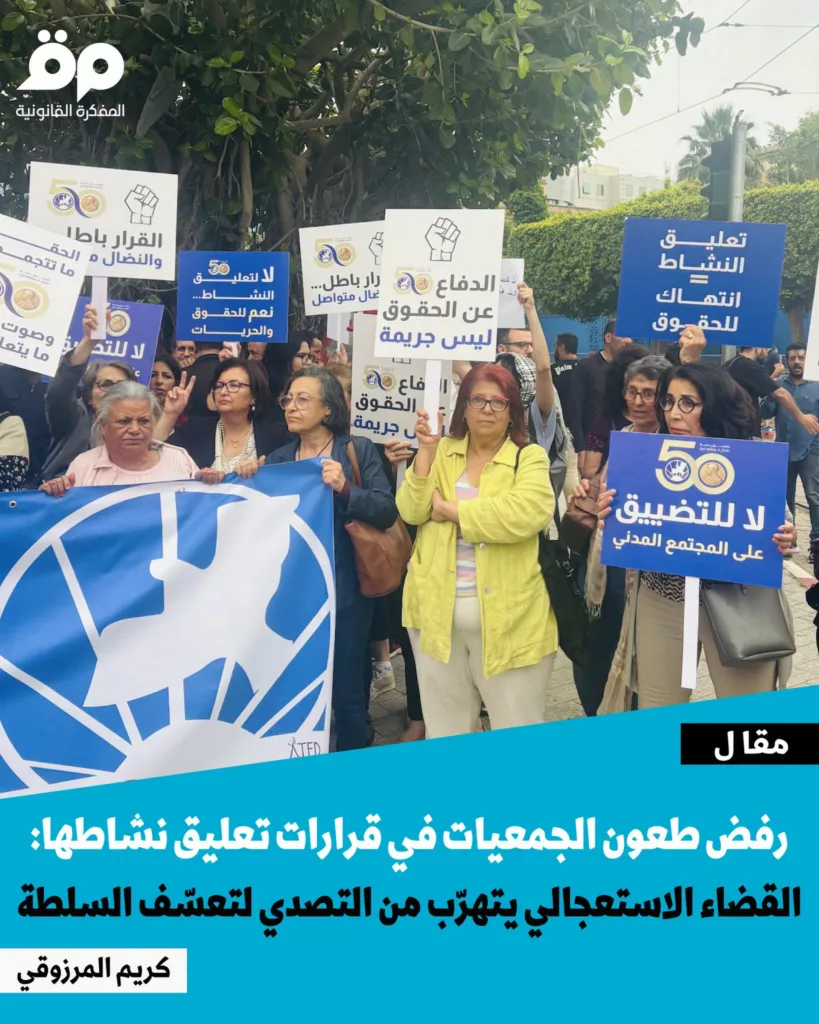
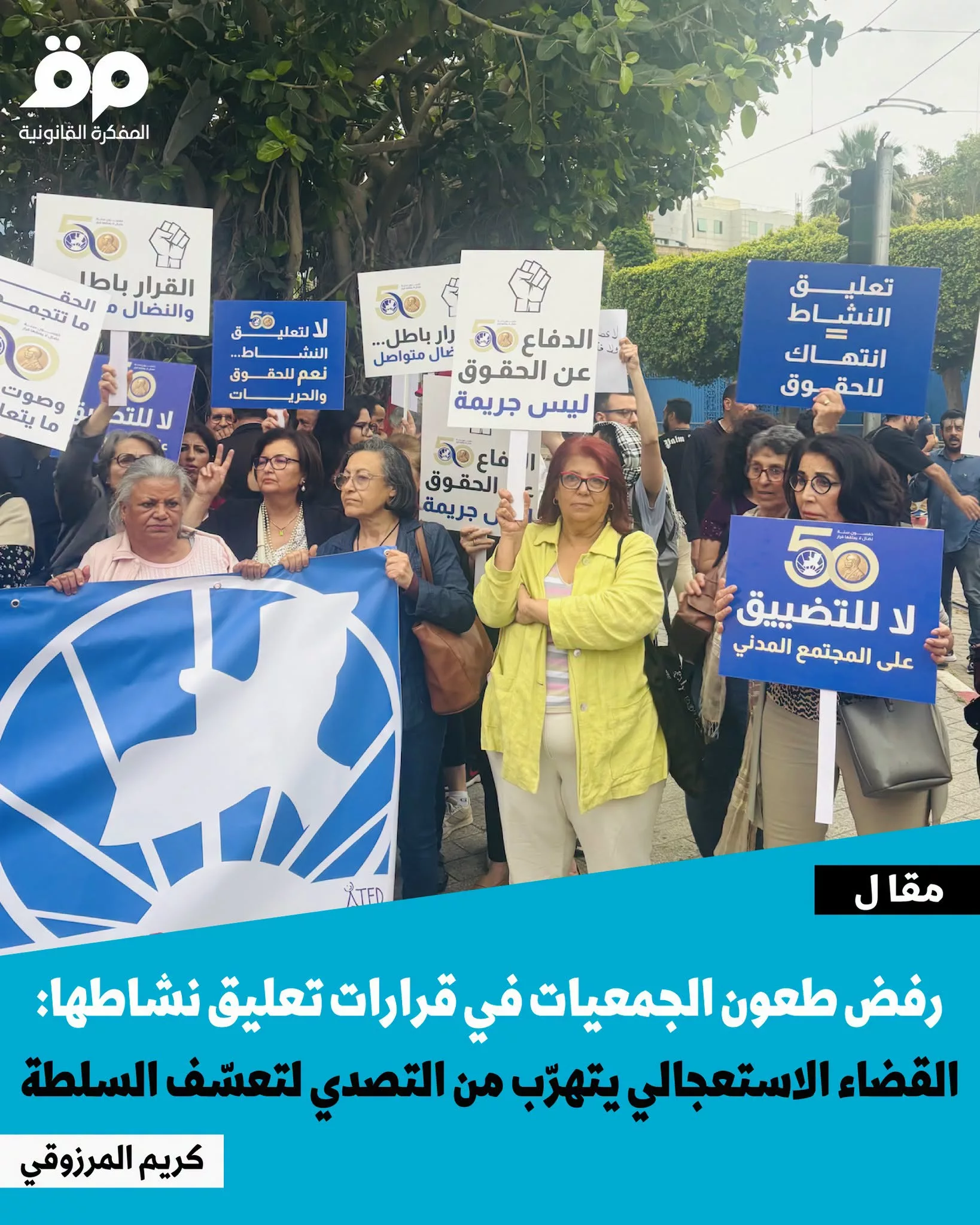
The crackdown on civil society organizations in Tunisia is no longer a series of isolated incidents. It has become a coherent policy: stigmatizing rhetoric, financial investigations, bank account freezes, criminal prosecutions, arrests of organization leaders, suspensions of activities, and demands for dissolution.
Under the pretext of defending national sovereignty, combating money laundering, or controlling foreign funding, the authorities are working to weaken independent organizations that document human rights violations, defend vulnerable people, combat racism, support women who are victims of violence, investigate corruption, or provide independent news coverage.
A well-documented offensive
In its report published on September 2, 2026, “We Are Living on Borrowed Time: Repression of Civil Society in Tunisia, ” Human Rights Watch describes a systematic campaign waged since 2024 against organizations and their members. The organization has documented at least 47 people prosecuted in connection with their civic activism, at least 14 prison sentences, as well as pretrial detentions that in some cases exceeded the maximum duration of 14 months provided for under Tunisian law.
Amnesty International had already warned, on May 11, 2026, that at least 25 organizations had been suspended for 30 days. Among them are the Tunisian Human Rights League (LTDH), the Tunisian Association of Democratic Women (ATFD), the Tunisian Forum for Economic and Social Rights (FTDES), Mnemty, Lawyers Without Borders (ASF), Aswat Nissa, Nawaat, the World Organization Against Torture, and the International Commission of Jurists.
The report by the Intersection association, published in March 2026, titled “Civil Society: From a Space of Freedoms to a Arena of Prosecutions, ” also highlighted the rise in legal proceedings against civil society actors, particularly through the extensive use of charges of money laundering and aiding irregular immigration.
To this must be added the work and warningsof I Watch. The anti-corruption organization, which specifically advocates for transparency and public accountability, was itself targeted by the financial investigations launched against civil society organizations in late 2024, and then by the wave of suspensions in the summer of 2025. The case of I Watch is politically revealing: an organization that works to combat corruption finds itself treated as a suspect, just like organizations that defend civil liberties, women’s rights, the rights of migrants, or the independence of the press.
From Suspension to Dissolution
The 30-day suspension provided for in Article 45 of Decree-Law No. 88 of 2011 on associations has become a tool for forcing compliance. However, this law does provide for certain safeguards: a written notice of violation, a specific description of the alleged violations, and a period of time allowing the association to respond.
In practice, these safeguards have been rendered meaningless. Several organizations have received vague warnings that did not clearly specify the alleged irregularities. Others provided the requested documents, but this did not prevent the suspension.
An article by Karim Marzouki, published on September 18, 2026, by Legal Agenda, shows that the appeals filed against the suspension orders were dismissed by the Tunis courts for interim relief. In several cases, the judges refused to consider the merits of the case, ruling that the dispute fell within the jurisdiction of the trial court or that the suspension, having already been in effect for thirty days, was no longer relevant.
This line of reasoning deprives associations of an effective remedy against a measure that specifically paves the way for their dissolution. If one considers that the passage of time renders the remedy useless, then all that is needed is to let the thirty days pass for judicial review to become a mere illusion.
The threat is already very real for Mnemty, which is committed to fighting racism and defending the rights of migrants, and for Al Khatt, the organization that publishes the independent news outlet inkyfada. The Office of the Prime Minister requested the dissolution of Al Khatt on April 21, 2026, following its suspension, without disclosing the specific reasons for this request.
Abdallah Saïd: Criminalizing Solidarity
The case ofAbdallah Saïd, president of the “Enfants de la Lune” association in Médenine, is one of the most serious examples of this criminalization of nonprofit work.
Abdallah Saïd was arrested on November 12, 2024. His organization provides social and health services in Médenine to vulnerable people, particularly migrants. Along with the organization’s secretary-general and treasurer, he was summoned and then questioned as part of an investigation into the organization’s activities and funding.
After more than a year in pretrial detention, the Médenine Court of First Instance sentenced him on April 21, 2026, to one year in prison in a financial case. The public prosecutor’s office filed an appeal. On September 28, 2026, the Médenine Court of Appeals increased his sentence to two years in prison.
In practical terms, this harsher sentence means that his release will be postponed, even though he has been in custody since November 2024. It prolongs an already unbearable punishment: the imprisonment of a nonprofit leader whose work was dedicated to supporting vulnerable people.
The case of Abdallah Saïd cannot be separated from that of Saadia Mosbah, president of Mnemty, who has been detained since May 2024 and was sentenced on March 19, 2026, to eight years in prison in a financial case. Both embody the troubling trend of turning aid, solidarity, and the defense of rights into subjects of criminal suspicion.
The financial weapon and widespread suspicion
Foreign funding—which is legal under Decree-Law No. 88 and subject to transparency requirements—has become the main pretext for the crackdown.
Nonprofit organizations are already required to report foreign funding within one month of receiving it. But the authorities and certain media outlets now portray all foreign funding as evidence of dependence, treason, or money laundering.
The facts reveal a different reality: delays in wire transfers, frozen funds, closed or frozen accounts, refusals to process foreign-currency transactions, repeated summonses of association leaders, and travel bans. For example, the FTDES treasurer was prevented from leaving the country on April 19, 2026, even though he was scheduled to attend an international conference on migration.
A report of suspected wrongdoing is neither an indictment nor a conviction. It requires a thorough, adversarial, and independent investigation. Turning it into a tool for public stigmatization perpetuates the conflation of lawful nonprofit activities with financial crime.
Defending nonprofit organizations means defending society
The fight against money laundering and corruption is necessary. But it cannot justify the criminalization of organizations that operate openly, disclose their resources, report on their activities, and carry out missions that the government no longer always guarantees.
Tunisia cannot accept that Decree-Law 88, one of the major achievements of the revolution, be circumvented and then gradually dismantled. It cannot accept that the justice system be used to rubber-stamp arbitrary administrative decisions, without any real oversight of their legality and proportionality.
We must demand:
- an end to the suspensions and dissolution proceedings targeting independent associations;
- the discontinuation of abusive legal proceedings against their leaders, employees, and volunteers;
- the immediate release ofAbdallah Saïd, Saadia Mosbah, and all those detained because of their legitimate civic engagement;
- an end to the banking and administrative obstacles that are paralyzing civil litigation;
- full compliance with Decree-Law No. 88 and the freedom of association;
- an independent judiciary, capable of protecting civil liberties against arbitrary action by the executive branch.
Behind each targeted organization lie specific rights that are being violated: the right to organize, to seek information, to defend a victim, to combat discrimination, and to hold those in power accountable. Silencing these organizations means seeking a society without checks and balances, without organized solidarity, and without independent voices.