
In a Tunisia where public space is becoming increasingly restricted, where freedoms are curtailed, where civil society organizations are being weakened, where the media are under constant pressure, and where so many political leaders, union leaders, civil society activists, and citizens are being prosecuted or imprisoned, the establishment of a common framework by the UGTT, the ONAT, the LTDH, and several civil society organizations is of particular importance.
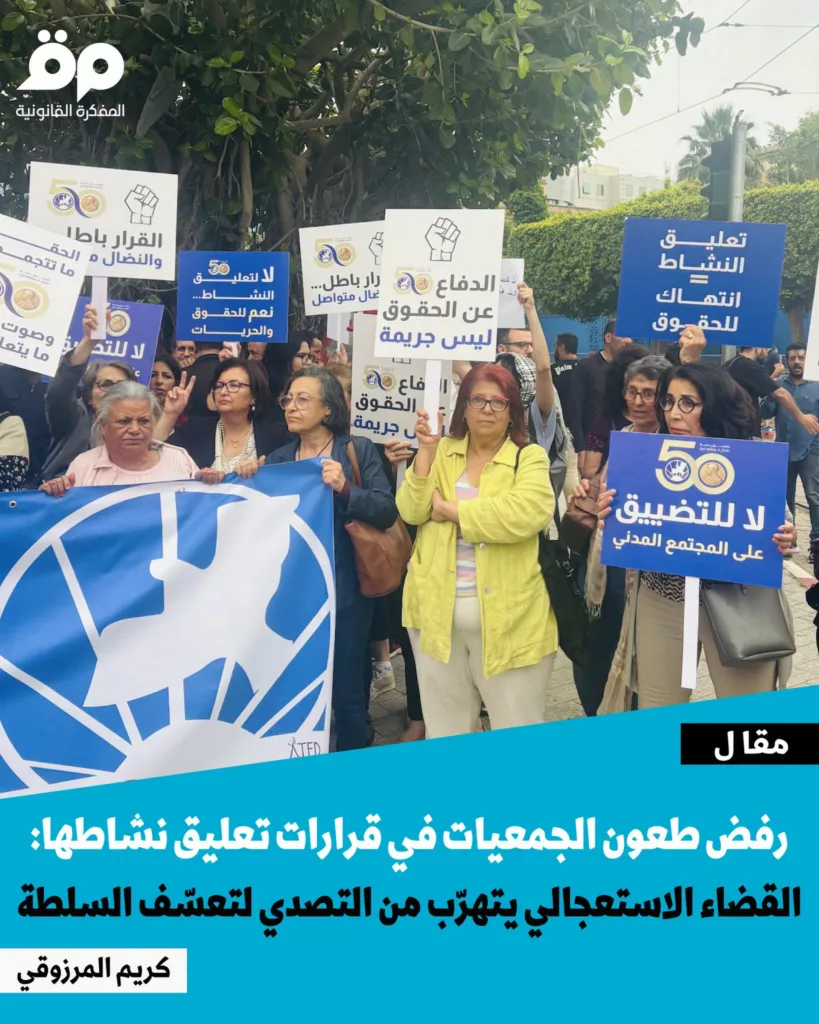
The September 29 meeting, held at UGTT headquarters, and the call for a national march in Tunis on October 17 under the slogan “Tunisia First… the People Above All Else,” constitute a major political and civic event. Joining the UGTT, the National Bar Association of Tunisia, and the Tunisian League for Human Rights are the SNJT, the FTDES, the UGET, the Tunisian Organization of Young Doctors, the ATFD, and the Union of Unemployed Graduates.
This initiative has the essential merit of linking what those in power are specifically seeking to separate: the defense of civil liberties and that of social rights; freedom of association and the right to work; the independence of the judiciary and the right to a dignified life; and freedom of association and the defense of public services.
It expresses a simple truth: we will not address precariousness, unemployment, the collapse of purchasing power, or the crises in education, health care, or transportation by stifling collective speech, criminalizing criticism, or closing the door to dialogue. Social rights and democratic freedoms are not two separate issues. They are the two conditions for the dignity of the Tunisian people.
This common framework does not claim, on its own, to encompass the full political and social diversity of the country. That is not its purpose. It brings together independent organizations—each with its own history, mandate, and perspective—around a set of immediately necessary principles: freedoms, justice, labor, public services, dignity, and the rejection of exclusion.
At this juncture, it is also the responsibility of all forces committed to freedom to set aside, for the time being, the differences that divide them. Not to deny those differences, nor to abandon their convictions, but to recognize that there is a more urgent common cause: defending freedoms, protecting social rights, rejecting arbitrary rule, and restoring the people’s ability to express themselves and take action.
This holds true even when we recognize that certain intentions, calculations, or practices may remain exclusive and sectarian. This is neither a matter of being naive nor of turning a blind eye to attempts at hegemony or exclusion. But we must refuse to allow these abuses—whether real or feared—to become a pretext for paralyzing any joint action. They must be combated through vigilance, pluralism, and democratic standards, not through withdrawal and fragmentation.
Unity does not require uniformity. It presupposes the maturity to set aside, for a time, minor differences in favor of what can rally a broad coalition. Those who turn every nuance into a cause for division, every absence into a condemnation, and every imperfect initiative into a reason to withdraw, objectively contribute to the very deadlock they claim to be fighting against.
That is why the criticism already seeking to undermine the initiative on the grounds that it does not align with this or that partisan perspective, or that it does not bring together every conceivable force, is both unfair and counterproductive. Such criticism stems less from a democratic imperative than from the resentment of those who prefer to focus on what is missing rather than acknowledge the courage of those who are taking the responsibility to stand up today.
No organization should be forced to give up its autonomy or become the tool of a political force. But neither should any democratic force presume to undermine an initiative that seeks to reopen a space for debate, mobilization, and solidarity in a country under an unprecedented lockdown.
On the contrary, we must support this coordination, strengthen it, and expand it while respecting its independence. Citizens, activists, workers, young people, women, journalists, lawyers, human rights defenders, and all victims of arbitrary treatment must see it as a space worth protecting.
The march on October 17 must be a moment of collective dignity. Not against some Tunisians, but for all Tunisians. Not to revive old divisions and past feuds, but to affirm that no resolution to the crisis will be possible without freedoms, without social justice, without genuine dialogue, and without recognition of the diversity of Tunisian society.