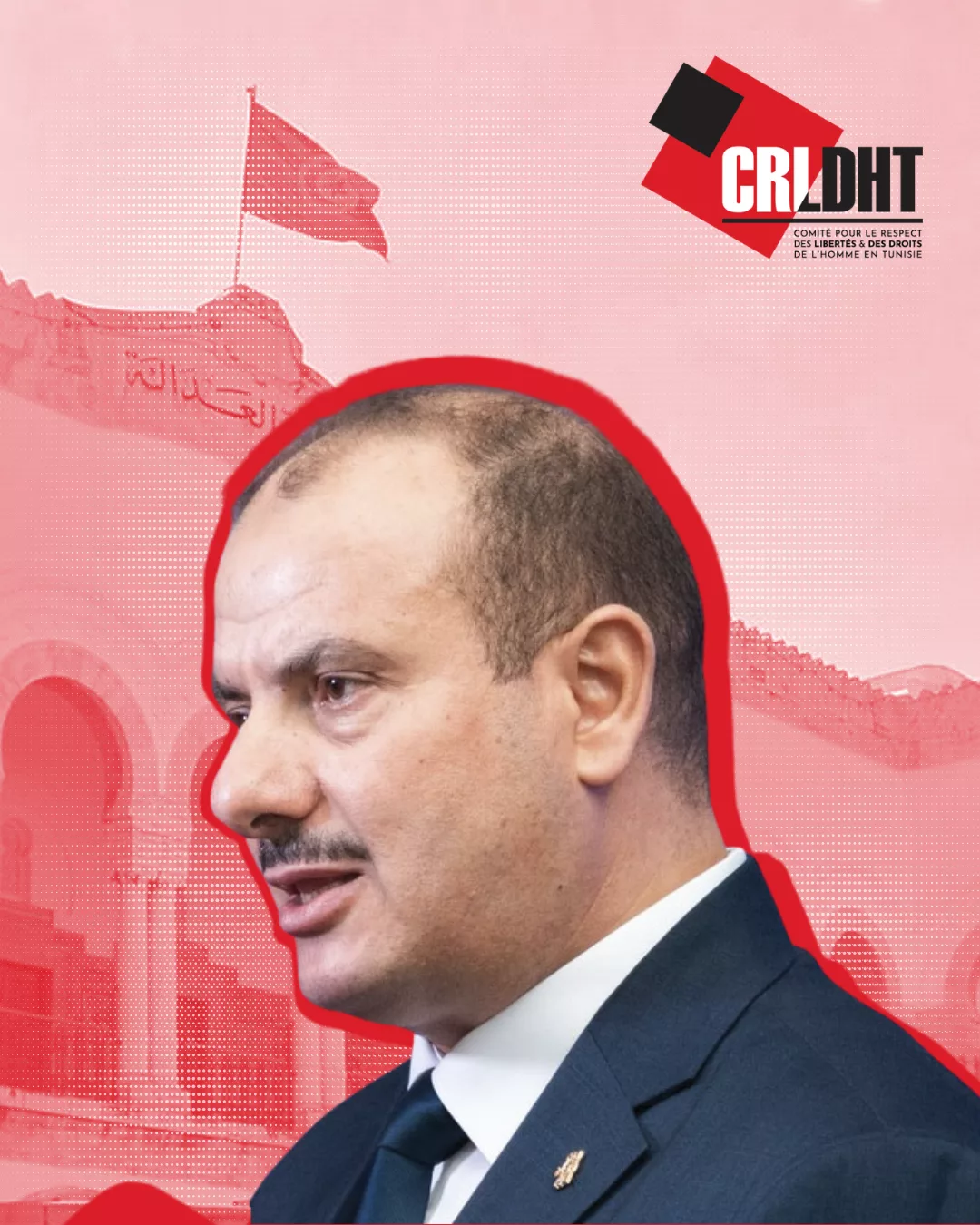
Anas Hmaidi, the Tunisian judge who has been an activist for years within the Association of Tunisian Judges (AMT) and was recently re-elected as its president, has been the target of a prolonged judicial campaign. The latest development is his appearance before the criminal division of the Tunis Court of First Instance.
Background
In June 2022, the Association (AMT) called for a strike to protest violations of judicial independence committed by the President of the Republic, Kaïs Saïed, notably through Decree-Law No. 35-2022, by which he assumed the authority to dismiss any judge without cause or prior proceedings that would respect the right to a fair hearing or the rights of the defense. The dismissed judge is automatically brought before a criminal court and cannot challenge his dismissal until a final criminal judgment is rendered.
The judges' strike was also intended to protest and call on the President of the Republic to reverse some fifty dismissals issued that same evening by Presidential Decree No. 516-2022.
A veritable massacre that continues to this day for the dismissed judges, but whose repercussions still hang like a sword of Damocles over the other judges, even though Kaïs Saïed has since developed other methods to control the judiciary.
It should be noted that since July 2022 and the enactment of the 2022 Constitution, judges—who are treated as members of the internal security forces—have been prohibited from striking. Article 41.2 of the Constitution states: “Judges, members of the internal security forces, and customs officials do not have the right to strike.”
The Facts
During the June 2022 strike, a judge decided to hold a summary proceeding hearing at the Monastir Court of First Instance.
Judge Anas Hmaidi, in his capacity as president of the Association, immediately intervened to remind the presiding judge of the AMT’s decision and the importance of solidarity among judges, given the unprecedented threat posed by the president’s decrees, which deny the judiciary any independence.
Mr. Hmaidi simply urged his colleague to adopt an attitude that better respects the independence of the judiciary. Indeed, subsequent events have proven the AMT and its president right. It should be recalled that the African Court on Human and Peoples’ Rights, to which dismissed judges had appealed, ordered the suspension of the application of Decree-Law No. 35/2022 and Decree No. 516/2022 as a provisional measure in Case No. 08/2024, Hamadi Rahmani et al. v. the Republic of Tunisia.
The Charge
The public prosecutor’s office took up the matter. Unable to argue that the strike was illegal, it sought to charge the president of the AMT—who dared to openly and publicly criticize the president’s decisions—with violating Article 136 of the Penal Code, which states: “Anyone who, through violence, assault, threats, or fraudulent means, causes or maintains, or attempts to cause or maintain, an individual or collective work stoppage shall be punished by three years’ imprisonment and a fine of seven hundred twenty dinars.”
Beyond the shocking notion of treating legal proceedings as mere work and the judge as an ordinary employee, the prosecutor’s office’s reaction is clearly disproportionate. The failure to respect the principle of prosecutorial discretion clearly shows that the proceedings serve extrajudicial objectives.
’s proceedings The Provisional High Council of the Judiciary—appointed by President Kaïs Saïed following the dissolution of the elected High Council by Decree-Law No. 11-2022—lifted the defendant’s judicial immunity on September 6, 2022, at the request of the public prosecutor’s office, on charges of disrupting the court proceedings.
Mr. Anas Hmaidi appeared before the Sixth Criminal Chamber of the Tunis Court of First Instance for an initial hearing on March 12, 2026, which was adjourned to the hearing on March 26, and then to the hearing on April 2, 2026.
The hearings are scheduled at very short intervals, which are insufficient to meet the defense team’s requests; in particular, the team wishes to present, in support of its defense, the outcome of several proceedings related to the case, in particular an action for annulment before the administrative court challenging the decision to lift immunity, as well as the memorandum from the Minister of Justice appointing the investigating judge of Office No. 35, who was assigned to the judicial investigation. The latter closed the investigation without even hearing Mr. Hmaidi or collecting his defense and documents.
The prosecution’s stubborn refusal to grant a postponement, despite the defense’s well-founded request, as well as the very short intervals between hearings, do not bode well for the outcome of the case. Unfortunately, this is part of a reality marked by the lack of judicial independence in Tunisia and by the stance taken by the all-powerful President of the Republic, who has repeatedly threatened judges who refuse to follow the instructions of his Minister of Justice, accusing them of being accomplices of his enemies in his so-called war of liberation.
National and international reactions:
As always, the reprisals against the AMT and its president have sparked outrage and condemnation from Tunisian civil society, notably from human rights organizations and associations, as well as from the international civil society community, particularly the United Nations Human Rights Council’s Independent Special Rapporteur on the Independence of Judges and Lawyers, and the International Association of Judges. These bodies have expressed their deep concern and solidarity with President Anas Hmaidi, as well as with the AMT and Tunisian judges, who are the targets of this prosecution that disregards the right to a fair trial.
The CRLDHT :
- Reiterates its unwavering support for AMT President Anas Hmaidi and calls for the resolution of all violations of his right to a fair trial.
- Considers that, in this case, the authorities in Tunisia are pursuing extrajudicial objectives aimed at restricting the AMT’s activities and intimidating judges to deter them from exercising their rights to freedom of expression, association, and peaceful assembly, and to force them to abandon their demands for judicial independence and resign themselves to the executive branch’s control.
- Calls on judges, lawyers, and civil society activists to continue and intensify their efforts to ensure the independence of the judiciary, which is an essential prerequisite for the rule of law.