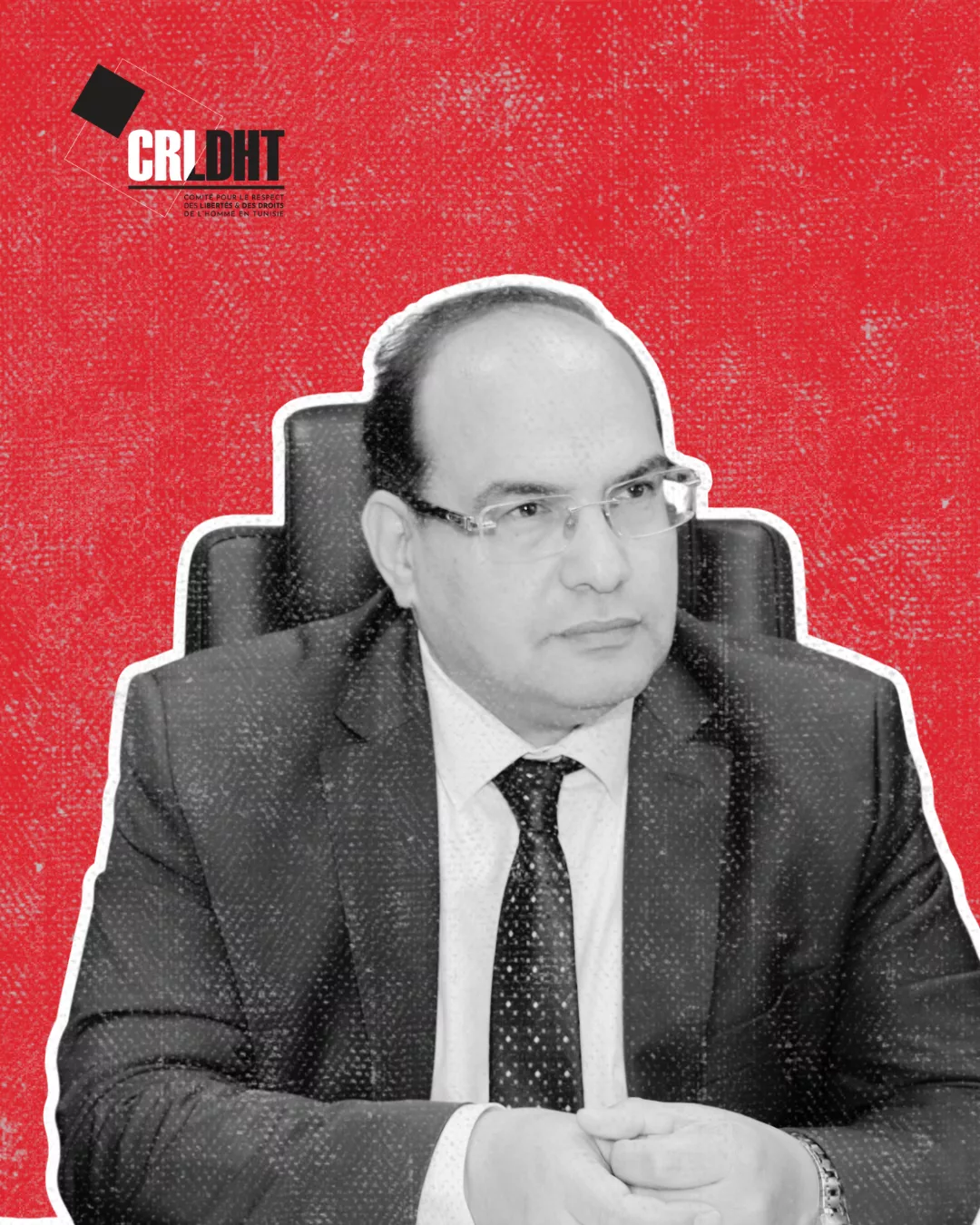
Daring to enforce the law against Prime Minister Kaïs Saïed comes at a price. The case of Bar Association President Chawki Tabib illustrates a troubling trend in which resentment and arbitrariness go hand in hand. It is part of a broader context in which checks and balances are being undermined and those engaged in the fight against corruption are being weakened.
The facts
The matter dates back to 2020, when a company executive claimed to have been wronged by a letter sent by Bar Association President Tabib, in his capacity as chairman of the National Anti-Corruption Authority (INLUCC), to the President of the Assembly of the Representatives of the People, to inform him, as required by law, of a legal suspicion of conflict of interest and abuse of influence allegedly committed by Prime Minister Elyes Fakhfekh, after he failed to respond to the body’s requests. Noting that the Prime Minister had illegally dismissed Bar Association President Tabib from the INLUCC on August 20, 2020.
This correspondence was strictly within the scope of the body’s legal authority, which is responsible for investigating and reporting instances of corruption or conflicts of interest.
The complainant, who is the manager of one of the companies in which Mr. Fakhfekh is a shareholder, alleges that, through this letter, the president of the court committed the crimes of forgery, use of forged documents, and unauthorized disclosure of the contents of a letter, as defined in Articles 172, 173, 176, 177, and 253 of the Penal Code. However, these acts were committed in the exercise of public duties, which immediately raises the issue of functional immunity.
Procedures
From the very outset, the tone was set. The case was assigned to the Economic and Financial Crimes Division, even though nothing in the case file justified its jurisdiction. However, according to legal criteria, this division has jurisdiction over cases involving particular complexity, a high degree of technicality, or transnational dimensions—conditions that are clearly absent in this case.
From the moment legal proceedings are initiated, there is an attempt to sensationalize the case and give the impression that it is complex. But it is the arbitrary procedures, above all, that betray the relentless pursuit. This questionable procedural approach helps to lend an air of gravity to a matter that is, in reality, a routine administrative matter.
In August and September 2021, following the coup d’état on July 25, an official from the Ministry of the Interior placed Bar Association President Tabib under house arrest without a court order.
In January 2024, the investigating judge barred him from traveling in connection with another case without first questioning him.
These cumulative measures—dismissal, house arrest, and a travel ban—reflect the ongoing and disproportionate pressure being exerted on a public figure who held a sensitive position.
Denial of immunity
Like any head of a body or agency responsible for combating corruption, the president of the INLUCC enjoys immunity that is both logical, necessary, and inherent to the performance of his or her duties.
Article 26 of Framework Decree-Law No. 2011-120 of November 14, 2011, on the fight against corruption, expressly provides: “The chairperson and members of the prevention and investigation body shall enjoy immunity from prosecution in connection with the performance of their duties. Immunity may be waived following deliberation by the Prevention and Investigation Body and after the person concerned has been summoned for a hearing.”
Despite the clarity and mandatory nature of this provision, the investigating judge and the indictment division ruled out its application on the grounds that the preventive body had not been established. Such an interpretation is manifestly unfounded: no provision of Article 26 makes the president’s immunity contingent upon the actual existence of such a body. In any event, the absence of such a body cannot be attributed to the person concerned nor justify the questioning of a legal guarantee.
However, in this case, that immunity was simply ignored. The interpretation adopted by the courts amounts to introducing a condition that does not exist in the law, in violation of the principle of legality, and undermines both the principle of legal certainty and the independence of institutions.
Furthermore, such an approach is inconsistent with applicable international standards, notably Article 14 of the International Covenant on Civil and Political Rights, as well as the principles governing the protection of those involved in the fight against corruption enshrined in the United Nations Convention against Corruption, which require States to ensure a protective framework against abusive prosecutions targeting officials acting in the course of their duties.
Failure to comply with legal guarantees
Tunisian law provides lawyers with specific safeguards for the practice of their profession, including special provisions in the event of criminal proceedings.
Article 46 of Decree-Law No. 79/2011 establishes this procedure, specifically in its second paragraph, which provides: “The attorney must be brought before the investigating judge by the Attorney General, who must conduct the interrogation in the presence of the president of the competent regional division or a person designated by him.”
The case files reveal that Bar President Tabib was referred to the court by a deputy public prosecutor without any specific details regarding the charges against him. No judge was even appointed to conduct the preliminary investigation, which amounts to circumventing all legal safeguards. Such a situation would render the proceedings null and void under the same article. This, however, did not prevent the Indictment Division from validating these clear violations of a procedural text that is nevertheless clear.
This violation constitutes a substantial irregularity that could undermine the validity of the entire proceeding. It also contravenes the Basic Principles on the Role of Lawyers adopted by the United Nations in 1990, which guarantee the independence of lawyers and protect them from any prosecution related to the performance of their duties.
One-way traffic
The investigating judge and the indictment division appear to have been driven by a genuine obligation to achieve a specific outcome: to bring the president of the bar association before the criminal division of the economic and financial section of the Tunis Court of First Instance.
To that end, they admitted the complainant’s statements as evidence for the prosecution, in violation of Article 63 of the Code of Criminal Procedure, which permits the complainant to be heard only for informational purposes.
They also failed to specify the elements constituting each of the offenses with which the president of the court is charged, thereby conflating the charges—in violation of the requirements of the Code of Criminal Procedure—while omitting the grounds for them. Yet these grounds are an essential element of both the order closing the investigation and the decision of the Indictment Division.
For example, according to settled case law, forgery, as defined in Articles 172 and 173 of the Criminal Code, is an act that creates or establishes a right or a legal situation. This is clearly not the case with the letter at issue in this matter.
It was precisely in the context of this criminal investigation that the investigating judge did not seek to obtain the documents from the body that had been taken over by the executive branch.
The president of the bar association and his defense team have, however, repeatedly requested that the court obtain the original documents in the case, which conclusively establish his innocence, since they correspond to the information that Mr. Elyes El Fakhfekh himself submitted to the court and that the court’s president merely incorporated into his proceedings.
An absurd accusation
If the intended purpose of all these absurdities is to exonerate former Prime Minister Fakhfekh, such a scenario would necessarily be illogical, since the former head of government admitted his failure by submitting his resignation.
If this were a case of manipulation or false claims, as the executive branch is so determined to prove, Mr. Fakhfekh would not have resigned; on the contrary, for politicians, it is a dream scenario to be the victim of a conspiracy or such a blatant forgery, as the complainant alleged, which reduces all this persecution of Bar President Tabib to vile retaliation, precisely for having done his duty.
This glaring contradiction between the official account and the facts themselves highlights the lack of credibility of the prosecution and reinforces the notion that the justice system is being exploited for political ends. It also reveals a troubling shift: one in which the normal exercise of public duties—particularly in the fight against corruption—can expose those involved to criminal prosecution intended to serve as a deterrent.
Such a development undermines legal certainty and discourages any independent institutional action.
On the occasion of the first hearing in the case before the Criminal Chamber of the Economic and Financial Division of the Tunis Court of First Instance on April 6, 2026, the CRLDHT wishes to:
1. To once again express solidarity with Bar Association President Chawki Tabib in the face of this arbitrary judicial persecution, which is aimed at tarnishing his image and reputation.
2. Call for justice to be served and for the law to be upheld, including the annulment of these flawed proceedings and the dismissal of the case, as well as the lifting of the travel bans imposed on the president of the bar association.
3. Make the INLUCC archives available to the courts and put an end to the manipulation of the Tunisian judiciary for the purpose of political retaliation.