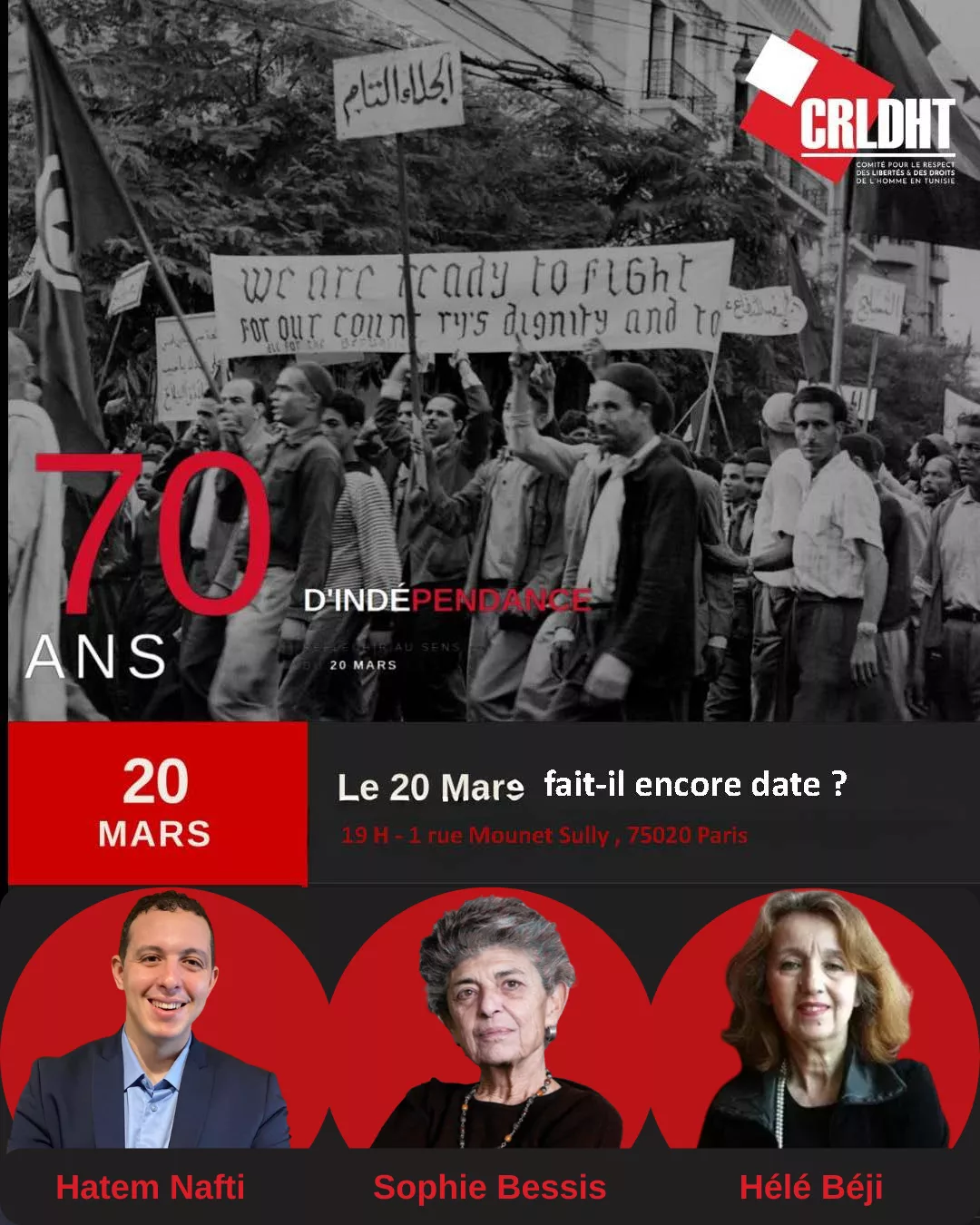
March 20, 1956. A date etched in Tunisia’s collective memory. Seventy years later, it continues to be celebrated—but what does it still tell us about the present?
To mark this anniversary, an initiative by the CRLDHT brought together intellectuals and activists to address a deliberately provocative question: Does March 20 still hold any meaning? Or has it been so exploited, twisted, and stripped of its substance that it no longer allows us to reflect on the present?
The discussion, conducted with rigor and without complacency, was not intended to mark an anniversary, but to examine what seventy years of independence have brought about—and the promises that these decades have failed to fulfill.
Independence without the promise of freedom
One thing is clear: to speak of a betrayal of independence implies that a promise of freedom was made. Yet that promise was never made.
In the prevailing discourse of the time, under Habib Bourguiba, independence did not signify the advent of a free political life. It embodied, first and foremost, the restoration of national sovereignty, development, and the assertion of a collective identity in the face of colonial power. Individual freedoms, civil rights, and democracy were not at the heart of the project. While the promise of nation-building existed ( “from a handful of individuals, I have built a nation”—Habib Bourguiba), the promise of freedoms was absent, despite the fact that the 1959 Constitution guaranteed all freedoms.
In this respect, Tunisia follows a path shared by many countries that gained independence in the late 1950s and early 1960s. A fundamental distinction then becomes apparent: national liberation does not necessarily imply freedom. Tunisian political history provides constant evidence of this (Sophie Bessis).
The national narrative as a matter of power
From the very first years of independence, the national narrative became a battleground. Under Bourguiba, a dominant narrative took hold, marginalizing certain figures of the national movement and, in particular, relegating the memory of Salah Ben Youssef to the sidelines.
This narrative has been constantly rewritten ever since. It is invoked, transformed, and exploited according to the needs of the moment. In the early years of his rule, Zine El Abidine Ben Ali revived certain themes—particularly those surrounding Ben Youssef, Islam, and Arab identity—in order to distinguish himself from Bourguiba and legitimize his seizure of power.
The 2011 revolution marked a moment of reclaiming our destiny (“In 2011, we achieved a second independence ,” saidMoncef Marzouki). March 20 thus took on a new meaning: that of an independence that would finally lead to freedom and democracy.
More recently, under Kaïs Saïed, another shift has taken place. The decision not to commemorate this date is part of an effort to construct a narrative centered on an individual trajectory presented as unique, at the expense of collective history and its protagonists.
The seeds of a power grab began to emerge as early as 1963 with the banning of the Tunisian Communist Party (PCT) and the exploitation of “emergency” courts.
Continuities of the Postcolonial State
“While independence broke with the colonial order, it also perpetuated certain aspects of it ” (Héla Beji : “Liberators have slipped into the colonialists’ shoes” ). The national elites have adopted structures, methods, and an authoritarian approach to power inherited from the colonial period.
The repressive apparatus established under Bourguiba did not need to undergo any major overhaul under Ben Ali. It was already in place, ready for use. This continuity is one of the blind spots in the official narrative, which tends to emphasize the breaks rather than the continuities.
This does not negate the significant changes that took place after independence: improvements in the status of women, expanded access to education, and the emergence of a middle class. But these advances have always been accompanied by strict restrictions on freedoms, which have been limited and controlled.
Citizenship Denied
Tunisian political history is also marked by a strong personalization of power. Under Bourguiba, and later under Ben Ali, the nation, freedom, and independence came to be progressively embodied in the figure of the leader—a monarch, or even an enlightened despot.
In this context, any opposition could be viewed as a form of treason.
Kaïs Saïed follows in this tradition while emphasizing its key features. His messianic rhetoric portrays him as the one who has come to “save” the people. The repeated use of the phrase “the people want” raises questions: does it reflect a genuine public will, or a simplified notion of popular sovereignty?
From this perspective, the political turning point of 2021 appears less as an accidental rupture than as a sign of a structural weakness: that of a political class incapable, over the long term, of resisting authoritarian tendencies.
The paradox of sovereignty without sovereignty
The current period is strongly marked by forceful rhetoric centered on sovereignty. This is accompanied by a discourse of rejection that successively targets sub-Saharan migrants—as evidenced by the eight-year prison sentence handed down to activist Saadia Mesbah for providing them with assistance—as well as the West and international institutions.
However, this stance is more of a claim than an actual reality. It does not translate into a concrete strengthening of sovereignty; on the contrary, it tends to mask its erosion. Sovereignist rhetoric thus becomes a smokescreen that obscures the actual ways in which sovereignty is being relinquished or undermined.
On the contrary, it tends to isolate the country and undermine its capacity for action. True sovereignty requires something else: the ability to redefine our relationship with others, to negotiate our place in the world, and to foster a pluralistic domestic political landscape.
However, this space is now largely stifled. In this context, March 20 risks becoming merely a tool for legitimizing power, rather than an opportunity for critical reflection.
Reinvest on March 20
The initiative led by the CRLDHT is precisely in line with this stance. The aim is not to celebrate a date in a formal manner, but to make it a subject of political reflection.
Seventy years after independence, the question is not so much whether March 20 should be celebrated, but rather what we want to make of it: a critical tool for reflecting on the present, or a meaningless ritual serving a dominant narrative.
From this perspective, independence appears less as a completed event than as an ongoing process. It points to a collective responsibility and a political vision: that of a society in which citizens truly have the means to govern themselves freely.
In this regard, the fact remains: seventy years later, the struggle continues.