The Tunisian government recently implemented a new pay raise for civil servants. Presented as a measure designed to bolster purchasing power, it translates into increases ranging from 61 to 104 dinars per month for several categories of civil servants and retirees.
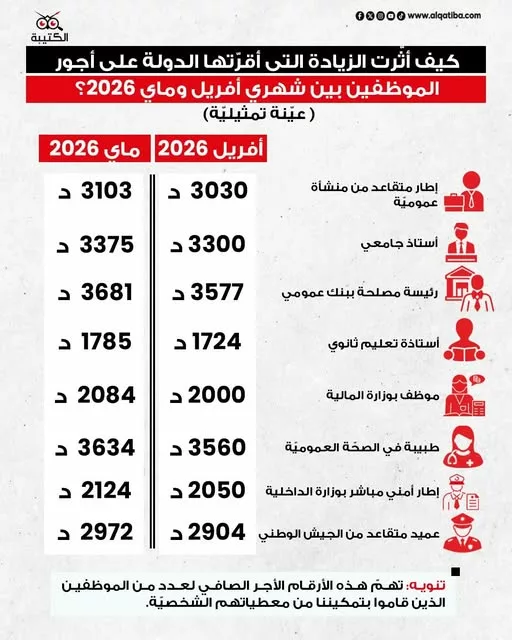
Data collected by the independent media outlet Alqatiba from a sample of employees and retirees illustrates the real impact of this measure. https://www.facebook.com/share/p/18VYtC1TMx/
| Category | April 2026 (DT) | May 2026 (DT) | Increase (DT) | Increase (€) |
| Retired from a public company | 3 030 | 3 103 | +73 | +21,6 € |
| University professor | 3 300 | 3 375 | +75 | +22,2 € |
| Manager of a public bank branch | 3 577 | 3 681 | +104 | +30,8 € |
| High school teacher | 1 724 | 1 785 | +61 | +18,0 € |
| Civil servant at the Department of Finance | 2 000 | 2 084 | +84 | +24,9 € |
| Public Health Physician | 3 560 | 3 634 | +74 | +21,9 € |
| Security Framework (Ministry of the Interior) | 2 050 | 2 124 | +74 | +21,9 € |
| Retired Army colonel | 2 904 | 2 972 | +68 | +20,1 € |
Exchange rate used: 1 euro ≈ 3.38 Tunisian dinars.
At first glance, these increases seem substantial. However, a closer look reveals a much more nuanced reality. The raises amount to between 18 and 31 euros per month, or the equivalent of a few dozen euro cents per day.
Specifically, a high school teacher’s salary rises from 1,724 dinars (about 510 euros) to 1,785 dinars (528 euros), an increase of just 18 euros. A public health doctor’s income rises from 1,053 to 1,075 euros, while a civil servant at the Ministry of Finance earns about 25 euros more per month. Even the largest increase recorded in this sample—that of a public bank branch manager—does not exceed 31 euros.
These figures become even more telling when compared to the cost of living.
As Eid al-Adha approaches, the price of a kilogram of lamb has settled between 60 and 80 dinars in several regions of the country, or between 18 and 24 euros. In other words, the monthly raise granted to a high school teacher is practically equivalent to the price of a single kilogram of lamb. For most of the categories listed, the raise amounts to barely one to one and a half kilograms of meat.
This simple yet telling comparison sums up the sentiment widely expressed by citizens: the announced wage increases are quickly eroded by inflation and rising prices. Food expenses, energy bills, transportation costs, and school fees immediately eat up those few dozen extra dinars.
The infographic also highlights persistent disparities within the civil service. The majority of reactions concern the teaching profession. Many are surprised that a high school teacher, after years of study and experience, earns a salary lower than that of many other categories of public sector managers. For some observers, this situation reflects the gradual decline of a profession that was once emblematic of the Tunisian middle class.
It should be noted, however, that these figures are not official statistics. They are based on personal information voluntarily provided to the media by the individuals concerned. The sample remains limited and does not reflect the entire civil service or the lowest-income segments of the population, particularly those earning minimum wage or retirees receiving small pensions.
But beyond the methodological debates, a single image sums up how a large portion of Tunisians feel: when a monthly pay raise is barely enough to cover the cost of a kilogram of meat bought for Eid, it becomes difficult to speak of a real improvement in purchasing power.
With a monthly increase of between 18 and 31 euros for incomes ranging from 500 to 1,100 euros, the measure appears to be more of an accounting adjustment than a response to the ongoing decline in the standard of living of the Tunisian middle class.