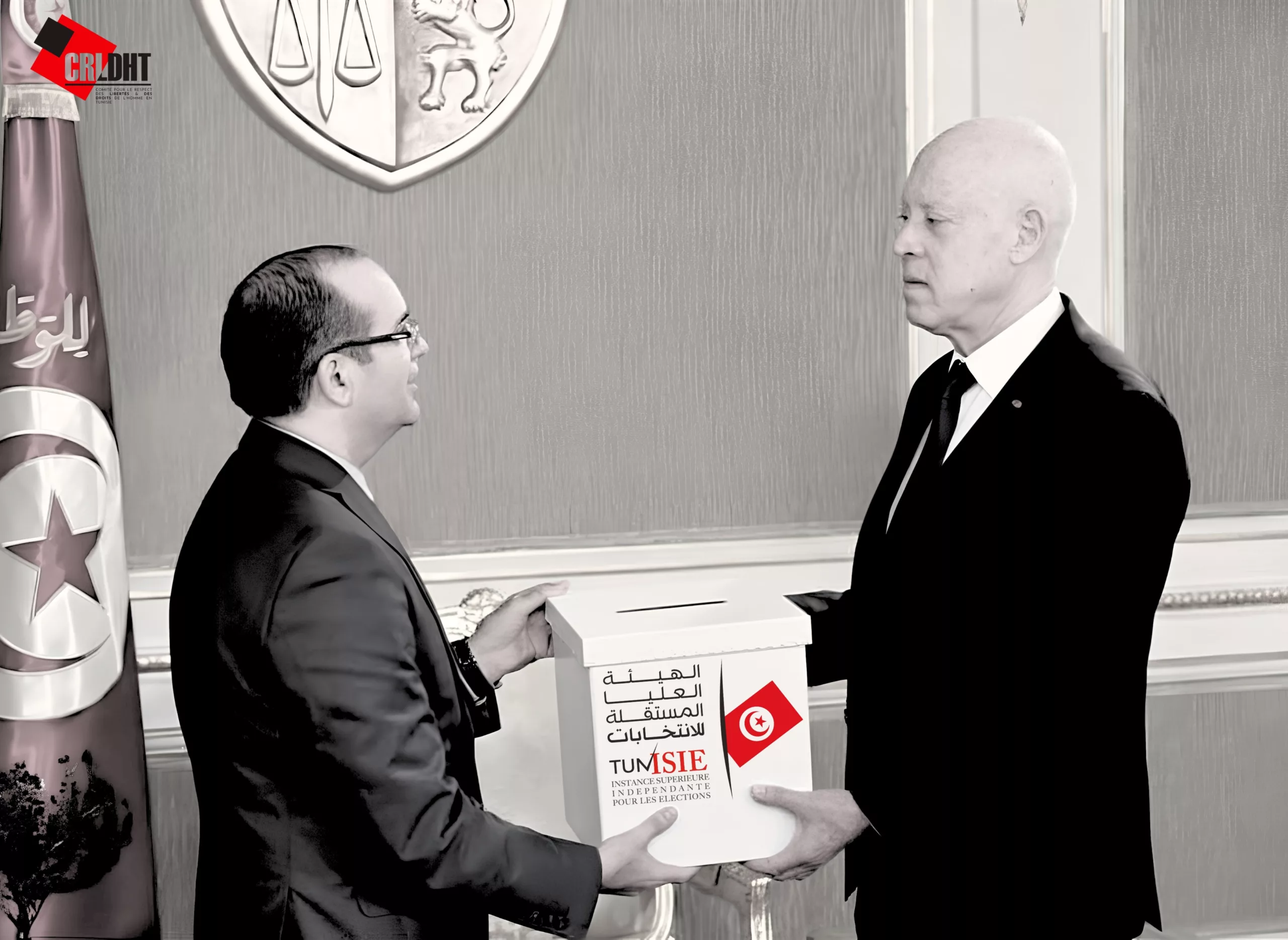
In May 2026, several voices—notably from President Kaïs Saïed’s political and media inner circle—are calling for a reshuffle of the “Independent High Authority for Elections” (ISIE), on the grounds that its members’ terms have expired. Behind this sudden commotion lies less a sincere institutional concern than a new manifestation of the power struggles that constantly agitate the president’s supporters. These supporters, at heart, have no problem swallowing bitter pills of all sizes and colors whenever the leader’s arbitration or whim demands it, even when this means renouncing positions they themselves presented, just the day before, as inviolable principles.
This controversy surrounding the mandate of the “ISIE” once again reveals the deeply unstable and personalized nature of Tunisia’s current political system, where the law is no longer a supreme norm that binds those in power, but merely a malleable tool at the service of the president’s will.
According to those calling for the immediate renewal of the body, the term of office of the current members of the “ISIE” was set to expire on May 9, 2026. They base their argument on Article 9 of Organic Law No. 23/2012 establishing the “Independent High Authority for Elections,” as amended by Decree-Law No. 22/2022 of April 21, 2022, which provides:
“The term of office for each member of the board of the Independent High Authority for Elections is four years and is not renewable.”
However, since the current members were appointed by Presidential Decree No. 459/2022 of May 9, 2022, their terms would, by that logic, have expired on May 8, 2026.
At first glance, the issue seems relatively straightforward if one limits oneself to these two texts. But as soon as this issue is placed within the broader context of Tunisian electoral law and applicable constitutional norms, the situation becomes legally complex and politically unpredictable. For in Tunisia today, the difficulty lies not in interpreting the texts but in the very existence of a coherent legal framework.
A surreal legal framework
Electoral law is, by its very nature, one of the areas of law where formal requirements should be most stringent. Given its procedural nature and the democratic safeguards it is intended to ensure, it is fundamentally based on compliance with general legal principles: the hierarchy of norms, constitutional supremacy, the principle of formal equivalence, legal certainty, and the independence of institutions.
However, since July 25, 2021, Tunisia has been living under a regime in which these principles have been gradually stripped of their substance, giving way to a veritable regulatory free-for-all.
The starting point for this breach is Presidential Decree No. 117/2021 of September 22, 2021. This text, which is clearly supra-constitutional in nature, effectively suspends large sections of the 2014 Constitution under the guise of applying Article 80. However, this article in no way permitted such an unlimited concentration of powers or the implicit repeal of the existing constitutional order.
The gravity of this situation was, in fact, noted by the African Court on Human and Peoples’ Rights, which, in its Judgment No. 017/2021 of September 22, 2022, ordered the Tunisian State to repeal this decree.
But the problem does not end with the violation of the Constitution. Decree 117/2021 has primarily served as the basis for a whole series of presidential decree-laws that are themselves fundamentally flawed. Indeed, in accordance with the principle of the hierarchy of norms, a presidential decree cannot legally serve as the basis for the adoption of texts of higher legal standing in defiance of the Constitution. Such a normative construct constitutes a clear violation of the most basic principles of the legal order and constitutional supremacy.
Decree-Law No. 22/2022 on the ISIE is a particularly telling example in this regard. This text encroached upon an area—electoral law—that the Constitution expressly reserved for organic laws. It thus violates not only Article 65 of the 2014 Constitution but also Article 80 itself, since the measures adopted clearly did not pursue “the objective of ensuring, as soon as possible, a return to the regular functioning of public authorities.”
What is more, these changes had never been announced to the Tunisian people at the time of the supposed invocation of Article 80.
The End of the ISIE’s Independence
In addition to being formally unconstitutional, Decree-Law No. 22/2022 has profoundly transformed the very nature of the ISIE.
Organic Law No. 23/2012 established this institution as a truly independent authority whose members were elected by the Assembly of People’s Representatives through mechanisms designed to ensure pluralism and neutrality.
With the 2022 decree-law, this approach was abandoned. The members of the body are no longer elected but are appointed directly by the President of the Republic. The ISIE has thus lost its defining characteristic: its independence.
And this loss is not merely political or symbolic; it is also legal. Even though it officially retains its name, “Independent High Authority for Elections,” in practice it has become a presidential election body.
This dependence will be demonstrated in a particularly blatant manner during the elections held under his supervision, notably the presidential election on October 6, 2024. The incumbent president-candidate will have organized an election overseen by a body whose members he himself appointed and whom he can dismiss at any time.
The blurring of lines between the executive branch and the electoral administration will thus reach a level unprecedented in Tunisia’s modern history.
The 2022 Constitution: A Standard Ignored by Its Own Author
The adoption of the 2022 Constitution, drafted under the direct authority of Kaïs Saïed, could have led to a clarification of the legal framework governing the ISIE. However, this will not be the case.
Once again, the president will demonstrate a deeply instrumental approach to the constitutional norm, even when he is the one who drafted it.
Article 134 of the 2022 Constitution provides as follows:
“The Body consists of nine independent, impartial, competent, and ethical members. They serve a six-year term, which is not renewable. One-third of its members are replaced every two years.”
This provision fundamentally alters the legal framework of the ISIE:
- the number of members increases from seven to nine;
- the term of office is extended from four to six years;
- A biennial rotation of one-third of the members becomes mandatory.
Logically, the entry into force of this Constitution should have led to a comprehensive revision of Organic Law No. 23/2012 in order to ensure that electoral law complies with the new constitutional provisions.
But nothing has been done.
The Parliament established under the 2022 Constitution has not undertaken any serious reform of the electoral law. This inaction is obviously no accident. It reflects a reality that has become central to the functioning of the current Tunisian system: it is no longer the Constitution that determines how institutions operate, but the shifting will of the President of the Republic.
Complete legal uncertainty
As a result, it has become virtually impossible to predict the legal outcome of the current dispute.
Is the term of office for ISIE members four years, in accordance with Decree-Law No. 22/2022?
Or is it six years, in accordance with Article 134 of the 2022 Constitution?
Is the legal number of members seven or nine?
The issue is far from theoretical. For if the current composition of the ISIE is deemed unconstitutional, this could affect the validity of all actions taken by the body, including the elections it organizes—provided, of course, that the judiciary is truly independent.
This issue was also raised in the legal proceedings regarding the 2024 presidential election candidacies. The plaintiffs challenged the constitutionality of the ISIE’s composition, arguing that:
- the insufficient number of its members under Article 134;
- the lack of a biennial renewal;
- and the clear contradiction between the Constitution and the 2022 decree-law.
In its submissions, the ISIE—bolstered by the sense of impunity afforded by the current political climate—implicitly acknowledges the contradiction with the Constitution while challenging the Administrative Court’s jurisdiction to rule on this matter.
This situation perfectly illustrates the collapse of constitutional review in Tunisia, exacerbated by the continued absence of a Constitutional Court.
The law suspended at the president's discretion
As with almost all institutional issues in Tunisia today, the final outcome will depend less on legal texts than on the unpredictable whims of the President of the Republic.
In theory, Kaïs Saïed could decide:
- or to implicitly extend the term of office of the current members;
- or to replace them;
- or to amend the legal framework yet again by means of a simple decree-law.
But it seems unlikely that he would change a team that has served him well politically, particularly during the 2024 presidential election, which will go down as one of the most contested elections in the country’s recent history.
This election, held against a backdrop of political gridlock, the exclusion of candidates, and the marginalization of judicial oversight, took on the appearance of an electoral farce designed to ensure the incumbent president’s reelection.
And to achieve this result, the following were successively overcome:
- the 2022 Constitution;
- organic and ordinary laws;
- Kaïs Saïed’s own decree-laws;
- as well as the decisions of the highest competent court.
Thus, the issue of the ISIE’s mandate goes far beyond a mere procedural dispute. It reveals the deep crisis in the rule of law in Tunisia and the gradual transformation of institutions into tools directly subject to the will of the president.