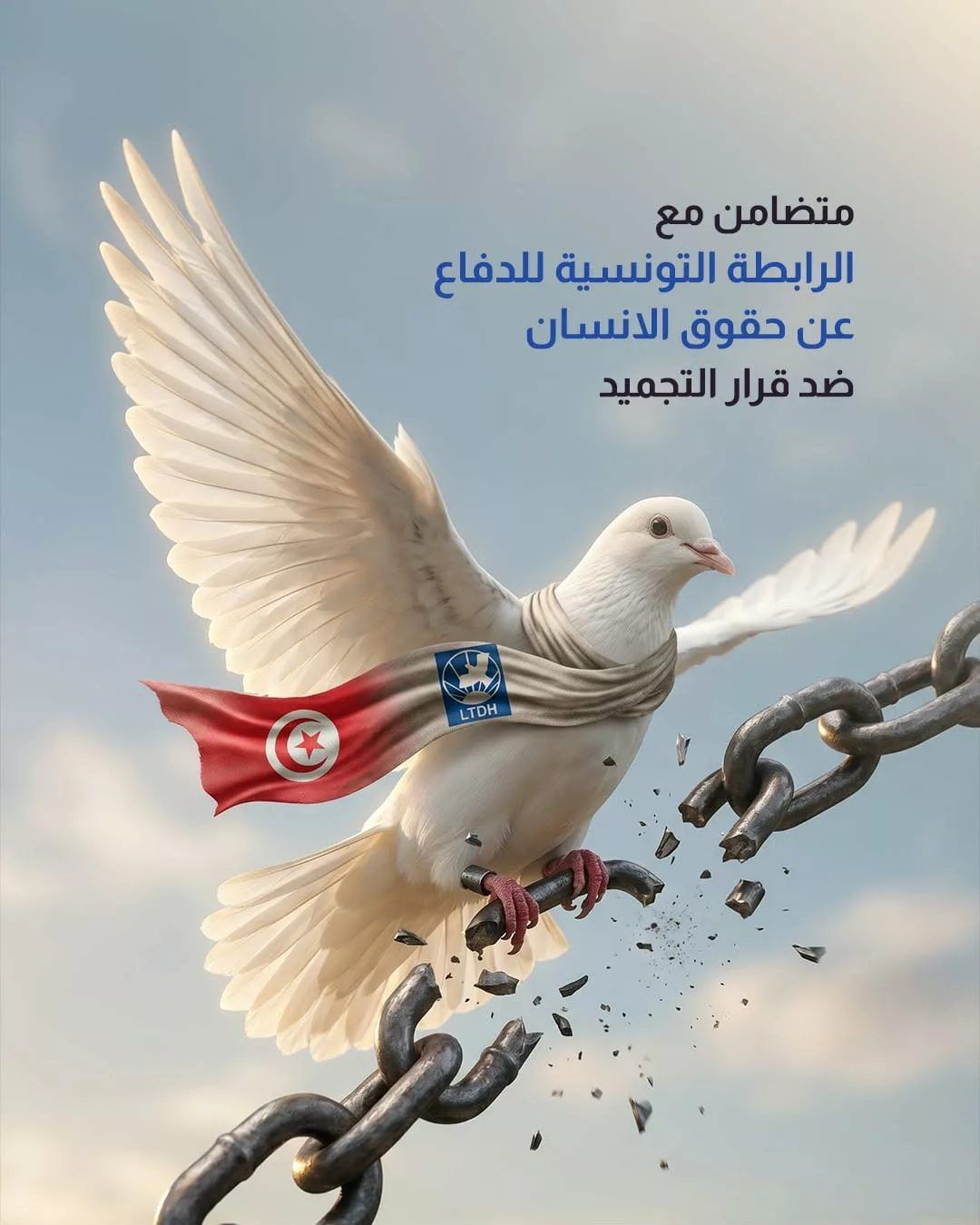
On April 24, 2026, a court order (issued by the Tunis Court of First Instance) suspended the activities of the Tunisian League for the Defense of Human Rights (LTDH) for one month.
This measure targets one of the oldest human rights NGOs in the Arab world, founded in 1976 and a member of the 2015 Nobel Peace Prize Quartet.
The suspension of the Tunisian Human Rights League (LTDH) is not merely a questionable decision. It marks a serious turning point. By targeting one of the oldest, most legitimate, and most iconic institutions in Tunisia’s civil society landscape, the government did not merely set its sights on a single organization: it sent an unequivocal political warning and redefined the rules of the game.
For the LTDH is not just another NGO. It is a living memory of the struggles for freedom, a central player in times of crisis, and a landmark in political history. Suspending it, even temporarily, amounts to crossing a dangerous symbolic threshold: one where historical legitimacy no longer offers protection, where moral capital no longer serves as a bulwark, where no voice is beyond reach.
But to understand the true significance of this decision, it must be viewed within a broader context—one that encompasses three levels: political discourse, administrative and judicial practice, and the ongoing legislative reform.
For several months now, official rhetoric has gradually fostered a pervasive sense of suspicion toward the nonprofit sector. The terms are now recurring and hammered home: “abuses,” “suspicious funding,” “foreign agendas.” This rhetoric is not neutral. It is laying the groundwork. It is constructing a convenient internal enemy: a civil society that needs to be “cleansed,” “supervised,” or even brought to heel.
It is against this backdrop that the study day on April 15, 2026, at the Assembly of the People’s “Representatives”—dedicated to reforming the legal framework for associations—takes place. Behind the technical vocabulary—transparency, good governance, oversight—lies a shift with far-reaching consequences: the transition from a declaratory system, based on freedom, to a regulatory system, based on surveillance and submission.
Decree-Law No. 88 of 2011 was based on a clear principle: freedom of association is the rule, and state intervention is the exception. The bill under discussion reverses this logic. Prior authorizations, oversight of funding, administrative discretion, and the classification of associations: these are all mechanisms that transform a fundamental right into a tolerated, conditional, and revocable activity.
At the heart of this transformation lies the issue of financing, particularly foreign financing—which is repeatedly portrayed as a security concern linked to money laundering or terrorist financing. But behind this argument, what is taking shape is a system of widespread oversight, notably through the increased involvement of the Central Bank, the banking system, and administrative authorities, which grants the executive branch decisive power over the very existence of associations.
However, contrary to official statements—which are often biased— the vast majority of foreign funding received by organizations is traceable, reported, and subject to existing transparency mechanisms — such as audits, accounting requirements, and public disclosures. These funding flows are most often part of structured and regulated international cooperation frameworks.
In reality, the problem lies elsewhere. By tightening prior approval requirements, extending deadlines, and increasing administrative and banking hurdles, these measures not only allow for monitoring but, more importantly, enable the blocking, delaying, or deterring of access to resources. Yet controlling funding means controlling the very existence of organizations: it means deciding who can act, when, and under what conditions.
This observation is all the more critical given that local funding sources—both public and private—remain extremely limited, unevenly distributed, and often directed toward organizations that are close to the government or lack a critical stance. They do nothing to address the actual needs of the independent civil society sector. In reality, the majority of active organizations—particularly in the fields of human rights, social issues, and migration—step in precisely where the state is absent, failing, or disengaged.
Restricting their access to international funding, without offering a credible alternative, therefore not only undermines them but also weakens entire sectors of social and civic action that the government itself does not support. This is no longer merely a matter of regulation: it is a mechanism for placing them under control.
This shift is not limited to legislation. It is already underway, with brutal force, on the ground. Since 2025, several organizations have been suspended or hindered: the Tunisian Association of Democratic Women, the Tunisian Forum for Economic and Social Rights, and many other less visible but equally essential groups. The decision targeting the LTDH is no accident: it is an escalation.
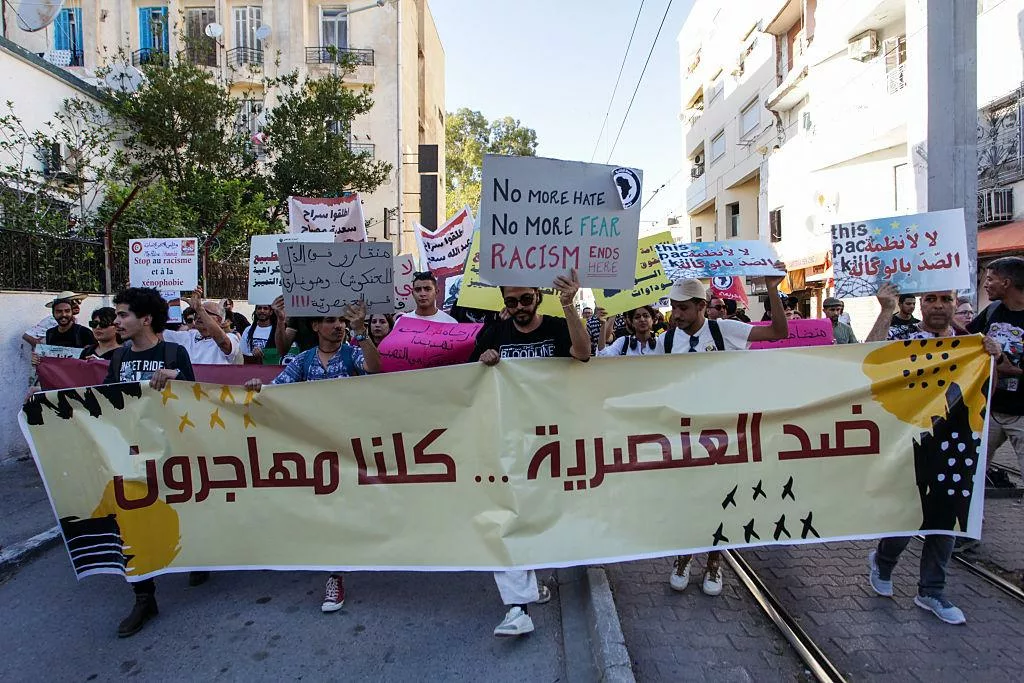
But there is another, even darker front where the cost of activism is particularly high: that of organizations supporting sub-Saharan migrants and those fighting against racism.
Organizations such as the Tunisian Forum for Economic and Social Rights (FTDES), Terre d’asile Tunisie, and grassroots groups working with migrants have seen their activities hindered, and their members exposed, monitored, and intimidated. The Mnemty association, which advocates for the rights of migrants and fights against racial discrimination, has been subjected to vicious smear campaigns and persistent harassment.
In some cases, the pressure has reached a new level: legal action, arrests, administrative harassment, and smear campaigns. Activists are being criminalized for their activism. Their work is distorted, discredited, and publicly attacked. And all of this is taking place in a climate where stigmatization is not only tolerated but encouraged.
For let’s be clear: Tunisia is currently witnessing an alarming rise in racist rhetoric, particularly against sub-Saharan migrants. Hate speech, generalizations, and the scapegoating of certain groups: anti-Black racism is now being expressed openly, without restraint, without shame, and without consequence.
The most troubling aspect remains this untenable paradox. Since 2018, Tunisia has had a pioneering law against racial discrimination. But this law is largely ineffective in the face of current realities. Worse still: those who try to enforce it—activists, organizations, and human rights defenders—become targets themselves.
In this context, the pressure being exerted on organizations is no longer merely a matter of administrative oversight. It is part of a more troubling trend: the political screening of legitimate causes. Defending migrants, fighting racism, documenting human rights violations—these are all commitments that are becoming risky, viewed with suspicion, and sometimes criminalized.
The suspension of the LTDH, a long-standing organization, thus marks the culmination of a trend that was already evident: the shrinking of civic space, where criticism is tolerated as long as it does not cause a stir, but is punished as soon as it becomes audible.
What is at stake today goes far beyond the issue of associations’ rights. It is a transformation of the relationship between the state and society. A transformation in which autonomy is viewed with suspicion, independence is perceived as a threat, and civil society is no longer a countervailing power but a space to be controlled.
A weakened, intimidated, and dependent civil society can no longer protect the most vulnerable. And when organizations that defend migrants, victims of racism, or marginalized groups are themselves under attack, the entire system for protecting rights collapses.
Tunisia is not experiencing a sudden crackdown on freedoms. It is experiencing something more insidious—and perhaps more dangerous—: their gradual and progressive erosion.
The suspension of the LTDH is the most striking example of this. But it is only the tip of the iceberg of a deeper trend—a trend toward the normalization of control, where the exception becomes the rule and silence begins to replace freedom.
And in this enforced silence, it is always the same people who disappear first: those who speak their minds.