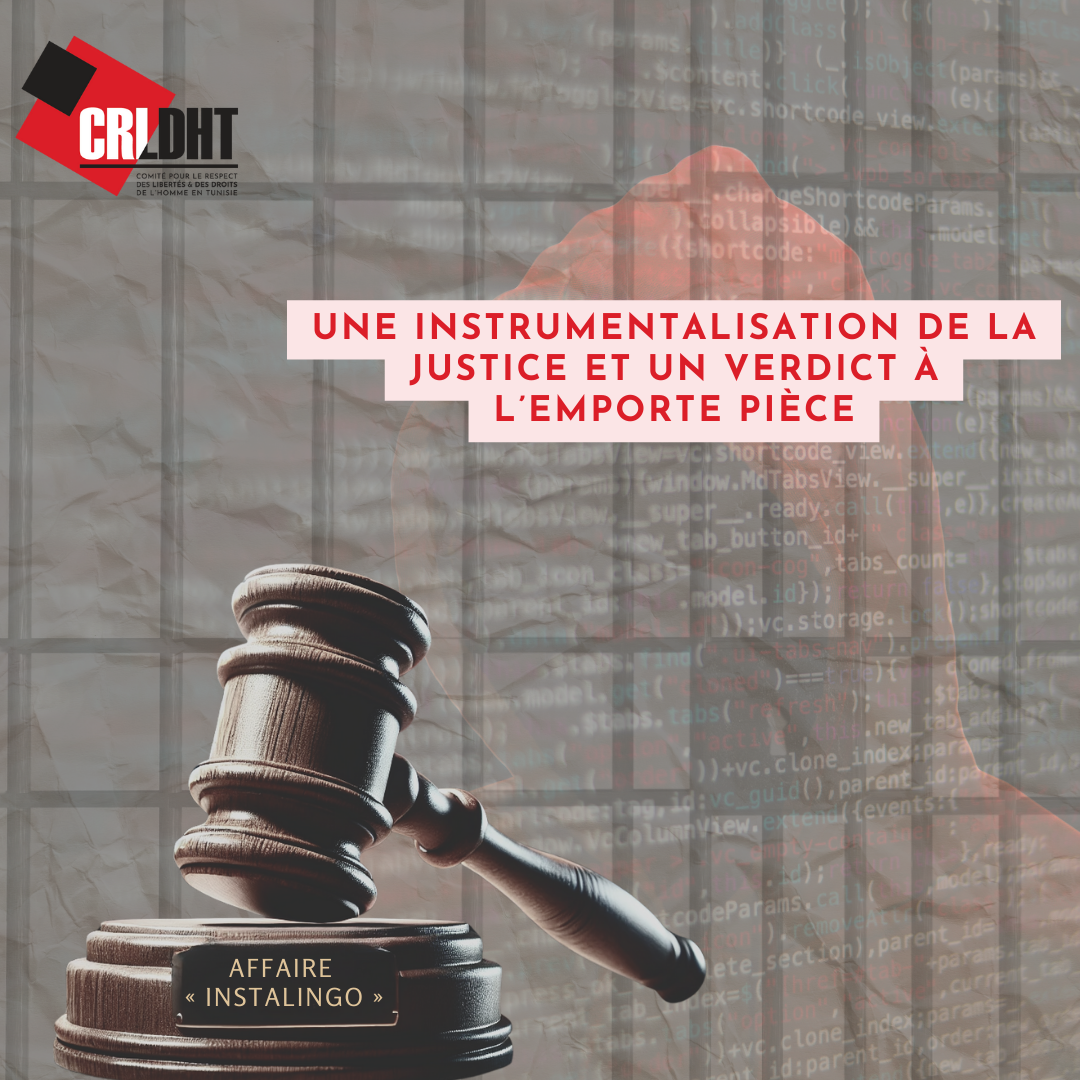
On February 5, 2025, the Second Criminal Chamber of the Tunis Court of First Instance handed down cumulative sentences totalling over 700 years' imprisonment to the defendants in the "Instalingo" case, a veritable judicial saga marked by grotesque twists and turns. This trial seems to foreshadow a series of fabricated "conspiracy against state security" trials aimed at repressing the peaceful opposition, now massively embattled. Immediately after the announcement of this expeditious verdict, Kaïs Saïed broadcast a long video in which he parades through the ministries, multiplying his fiery diatribes against the "traitors" he accuses of plotting against him.
A verdict that effectively means the death of political prisoners
Rached Ghannouchi, president of the Ennahdha movement and former president of the Assembly of People's Representatives, was sentenced to 22years in prison and fined 80,000 dinars.
This sentence, added to those already handed down, virtually amounts to a slow death for this 83-year-old political figure, deprived of proper medical care and subjected to harsh prison conditions. It is becoming increasingly clear that this decision is not simply punitive, but part of a strategy of gradual elimination, far from the spotlight and international support. This conviction is a blatant illustration of Kaïs Saïed 's desire to carry out a calculated act aimed at politically and physically finishing off the former Ennahdha leader.
Sentences imposed on the other defendants :
Achraf Khadhraoui: 17 years, Achraf Barbouch: 6 years, Achraf Omar: 6 years, Bachir Youssefi: 27 years, Taoufik Sebaï: 8 years, Habib Seboui: 6 years, Hamdi Boumiza: 18 years, Haykel Khili: 38 years, Rami Ben Afia: 25 years, Rafiq Abdessalem: 35 years, Riadh Bettaieb: 8 years, Salem Khili: 48 years, Samia Sbabti: 10 years, Slim Jebali: 12 years, Soumaya Kheriji: 25 years, Saïd Ferjani: 13 years, Chadha Haj Mbarek: 5 years, Sabrine Atiri: 25 years and 1 month, Safinaz Ben Ali: 6 years, Adel Daâdaâ: 38 years, Abdelkrim Arnous: 32 years, Abdelkrim Slimane: 15 years, Lotfi Hidouri: 27 years, Lotfi Zitoun: 35 years, Lamia Daâdaâ: 6 years, Majoul Ben Ali: 25 years, Mohamed Hachfi: 25 years, Meriam Daâdaâ: 6 years, Moadh Kheriji: 35 years, Mehdi Jmal: 6 years, Haythem Khili: 38 years, Hilel Korchi: 38 years, Yahia Khili: 18 years.
The forty or so convictions include former ministers and senior officials of the Ennahdha movement, as well as young bloggers and influencers. Also on the list are Hichem Mechichi, former head of government, sentenced to 35 years; Chahrazade Akacha, journalist, sentenced to 27 years; Ouadhah Khenfar, journalist with El Jazeera TV, sentenced to 32 years; Mohamed Ali Al-Aroui, former spokesman for the Ministry of the Interior, sentenced to 13 years in prison; and Lazhar Longo, former Director General of the Special Services, sentenced to 15 years in prison, accompanied by a fine of 300,000 dinars and the confiscation of a property linked to the case.
Instrumentalization of justice
The Instalingo case concerns a media company set up in 2015 and based in Sousse (central Tunisia), specializing in the creation of digital communication content and the management of pages and production of content for social networks. Its executives have been charged with plotting against state security in connection with accusations of destabilizing Tunisian institutions via digital campaigns.
Initially launched in 2020, the investigation made no reference to Rached Ghannouchi or the Ennahdha movement. However, following Kaïs Saïed's coup on July 25, 2021, a prosecutor in the Sousse region reopened the case on the same charges, but this time adding Rached Ghannouchi as well as several politicians and businessmen opposed to Kaïs Saïed's July 25, 2021 coup.
On November 11, 2022, the investigating judge at the Sousse 2 Court of First Instance interrogated Rached Ghannouchi for 12 hours. In view of the obstinacy and irregularity of the proceedings, he refused to leave his place of detention and did not appear at the hearing on May 9, 2023. In his absence, the examining magistrate decided to charge him and keep him in detention.
The defendants are charged with money laundering, plotting against state security with the aim of changing the form of government. They are accused of using the prerogatives of their office or profession to incite disorder, destabilize the state and launder money.
In March 2022, an examining magistrate decided to take over the case on behalf of the anti-terrorist judicial unit, due to suspicions of financing subversive activities via digital campaigns.
The authorities have extended the proceedings to several political figures and businessmen. Adel Daâdaâ, a businessman considered essential, is accused of coordinating funding to Ennahdha.
Chadha Haj Mbarek, a double victim of repression and the instrumentalization of justice
Journalist Chadha Haj Mbarek was arrested in early October 2021 in connection with the Instalingo case. A simple employee of the company, she was accused of plotting against state security, undermining public order and insulting the President of the Republic. These charges have become commonplace against journalists and activists since Kaïs Saïed imposed a state of exception on July 25, 2021.
- Chadha Haj Mbarek's family was harassed: her father and two brothers were arrested and then released.
- She herself was released after the charges were dropped in summer 2022, but the Public Prosecutor's Office appealed and the Minister of Justice appointed three successive investigating judges to keep her in custody.
- Suffering from kidney disease and hearing loss aggravated by prison treatment, his case alarmed his lawyers and the Tunisian Journalists' Union.
Unfounded charges against a backdrop of repression
The sentences handed down in the Instalingo case bear witness to a "cookie-cutter" approach to judging, characterized by rash decisions with no basis in fact or evidence:
- The charges of conspiracy and money laundering are based on suspicions of foreign financial flows, without the Chamber having taken the trouble to argue or specify the elements that enabled it to characterize the abstract allegations of the prosecution witnesses in an adversarial process and with an intelligible logic that complies with the law.
- The explicit targeting of figures opposed to Kaïs Saïed, such as Rached Ghannouchi, illustrates a political desire to neutralize the opposition under cover of legal proceedings.
- Judicial remedies have been limited, and investigating judges have often acted expeditiously to prolong detentions without guaranteeing a fair examination of the cases.
- Disproportionate prison sentences of up to 35 years have been handed down to journalists, politicians and activists, without any causal relationship suggesting a goal of repression rather than justice.
- The case is part of a systematic campaign of repression aimed at muzzling critical voices and creating a climate of terror conducive to self-censorship and complicity in the crimes of the regime in place since the coup d'état of July 2021, which corroborates the conclusion of arbitrary convictions.
These elements show that convictions are more the result of political instructions than of judicial procedures that comply with national and international constitutional standards.