Decree-Law no. 2025 of October 2, 2025 on community companies
Published in the JORT on October 3, 2025, this new decree-law amends decree-law no. 2022-15 of March 20, 2022 on community companies.
The decree-law has been substantially overhauled (II), but the formal aspects also reveal a certain unconstitutional approach to government, typical of the Kaïs Saïed era (I), which is constantly demonstrating that this is not an economic or social solution (III).
I- Procedural unconstitutionality
Although the Constitution of 2022, supposedly in force by the current authorities, is a unique case in history - a president having drafted a text reserving for himself a preponderant, central and almost exclusive role in the exercise of public powers (renamed "functions") - the hegemonic President of the Republic, described as the guardian of the Constitution, never ceases to violate it.
Decree-law no. 2025-3 of October 2, 2025 is a perfect example. Although Article 73 of the Constitution authorizes the President to decree such a text during a parliamentary vacancy, after informing the parliamentary standing committee, two conditions must be met:
- The first, ab initio, stems from the exceptional nature of this type of presidential text: it must be motivated by a particular urgency that justifies recourse to such special legislation. However, nothing could justify the promulgation of the text just a few days before the opening of the 2025-2026 parliamentary session, held on October 7, 2025.
- The second condition, a posteriori, according to the aforementioned article 73, requires that the decree-law be submitted for approval to the Assembly of People's Representatives during its ordinary session. This condition has not been met, as in the case of other decree-laws, whether dating from 2025, 2024 or even those promulgated on the basis of the sinister decree n°117-2021.
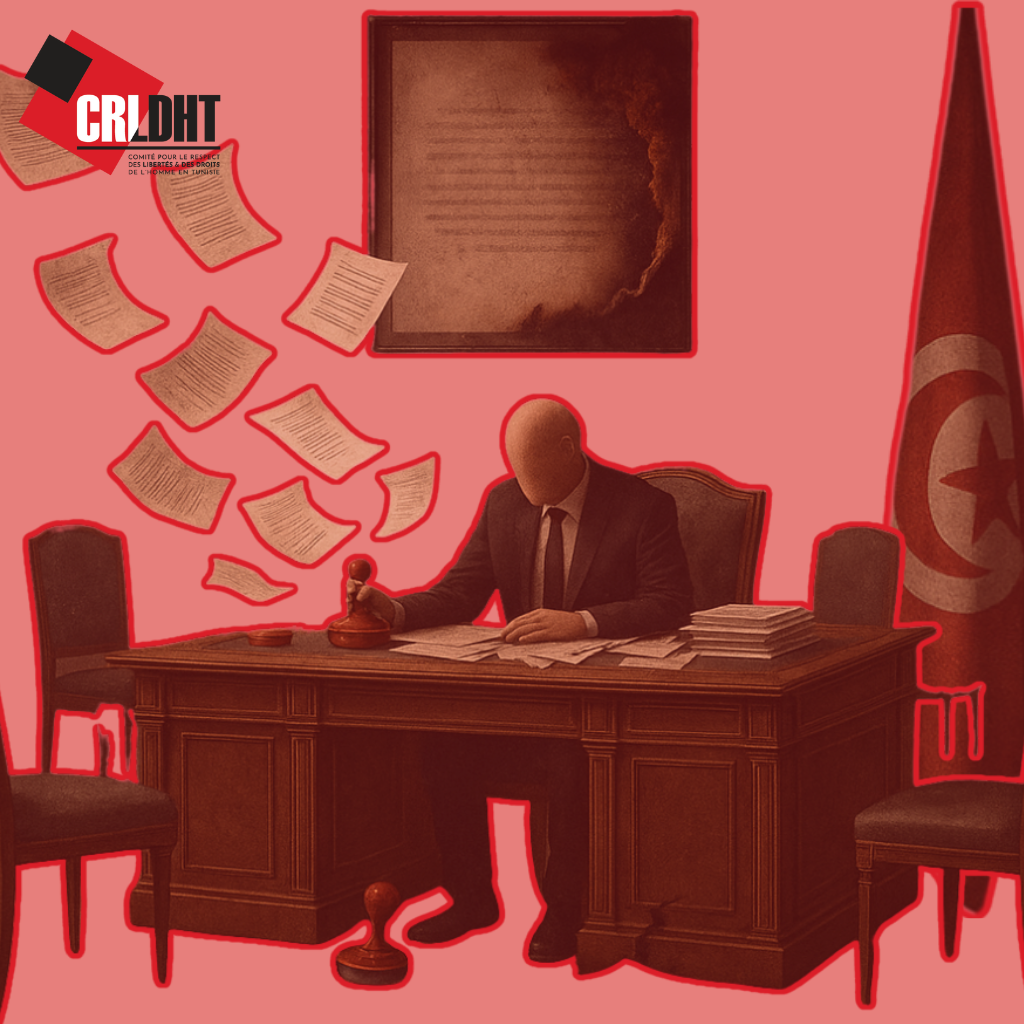
Reviewing or approving a presidential decree-law in a Parliament where competition is fierce to praise, incense and even venerate President Kaïs Saïed, would be tantamount to blasphemy.
This attitude speaks volumes about Saïed's conception of the parliamentary role, reduced to a mere recording chamber, incapable even of preserving its vile status as an office of order.
II- Amendments to the decree-law on community companies
A number of changes have been made to a text that is nevertheless recent:
- The qualification criterion for local community companies (SOCOL) and regional community companies (SOCOR) is no longer geographical (based on activity), but personal (based on participants' place of residence).
- The minimum number of participants is lowered: from 50 to 10 for SOCOL, and from 50 to 15 for SOCOR.
- Share capital is reduced: from 10,000 to 5,000 dinars for SOCOL, and from 20,000 to 10,000 dinars for SOCOR.
- The creation of an electronic platform for the incorporation, registration and updating of SOCOs, via a National Register of Community Companies (RNSC).
- The number of board members is reduced from 6-12 to 3-5 for SOCOL, and 5-10 for SOCOR, with the possibility of renewing the three-year term twice.
- Elimination of the possibility of issuing optional interest-bearing shares.
- The minister in charge of SOCOs becomes the new supervisory authority: governors are no longer competent to assist or control SOCOs, which must now report administratively to this minister. The Minister can intervene within a given timeframe, and SOCOs must comply with his suggestions - perhaps in response to complaints to the Presidency about the actions of certain governors or delegates towards SOCOs, widely relayed on social networks.
- The privileges granted to SOCOs are spectacular: exemption from taxes and duties for the first ten years, suspension of VAT, preferential rates for bank financing, priority in private leases on state-owned land (agricultural and non-agricultural), as well as on private municipal land and forests. These leases are for 25 years, extendable to 40 years, and include rent-free periods for the first five years. In the event of multiple applications, lots will be drawn.
For SOCOs operating in the transport sector, specific privileges will be defined by regulatory texts.
III- not a viable development model
As soon as they were introduced in 2022, all the experts agreed that this project was stillborn, since it could neither be viable nor provide economic or social solutions capable of transforming modes of production, operation or services, at both macro and micro levels.
This populist, do-it-yourself recipe does not even serve the presidential propaganda, which presents it as a "revolution" likely to provide answers to human challenges on a planetary scale - as Kaïs Saïed has stated, without laughter, on several occasions. The meagre and derisory results of these companies have cruelly betrayed the president's expectations.
But this brutal landing in reality has not discouraged the president, who is stubbornly determined to maintain his pious hope.
By recalling the theory of the dead horse, Kaïs Saïed implicitly admits in this new text that his idea as conceived in 2022 was neither realistic nor feasible. Today, he is spoiling the SOCOs with privileges of imperial largesse, at a time when the country is experiencing a vertiginous imbalance in its public finances.
Despite all these facilities, these companies remain a failure, because they defy economic and social logic.
Why, then, is President Saïed so keen to promote them?
He is ready to intervene at any time to promote them; in fact, a specific budget line has been allocated to them in the Finance Bill.
Kaïs Saïed, although he has always shown a moody and impavid character, has a definite sense of tactics - which is not obvious when it comes to community companies.
If we don't confine ourselves to conceiving of these companies as an economic model, we can discern elements of a political response to the President's stubbornness. Indeed, Kaïs Saïed confirms the suspicions of political clientelism: these companies will play the role of intermediary bodies - a role he denies to civil society and political parties. In reality, they will be a sort of soviets or kibbutzim à la tunisienne, breeding grounds for "honest and patriotic people" according to Saïed's definition, i.e. loyal to the Massimo leader, in exchange for privileges.
A new, crude version of popular rent-seeking this time.
Pending the unlikely approval of parliamentarians, it is certain that new decree-laws will patch up this institution dreamt up by the president - and a nightmare for the country's economy and the principles of the rule of law - according to the clientelist needs of the supreme commander and the loyalties of his subjects.