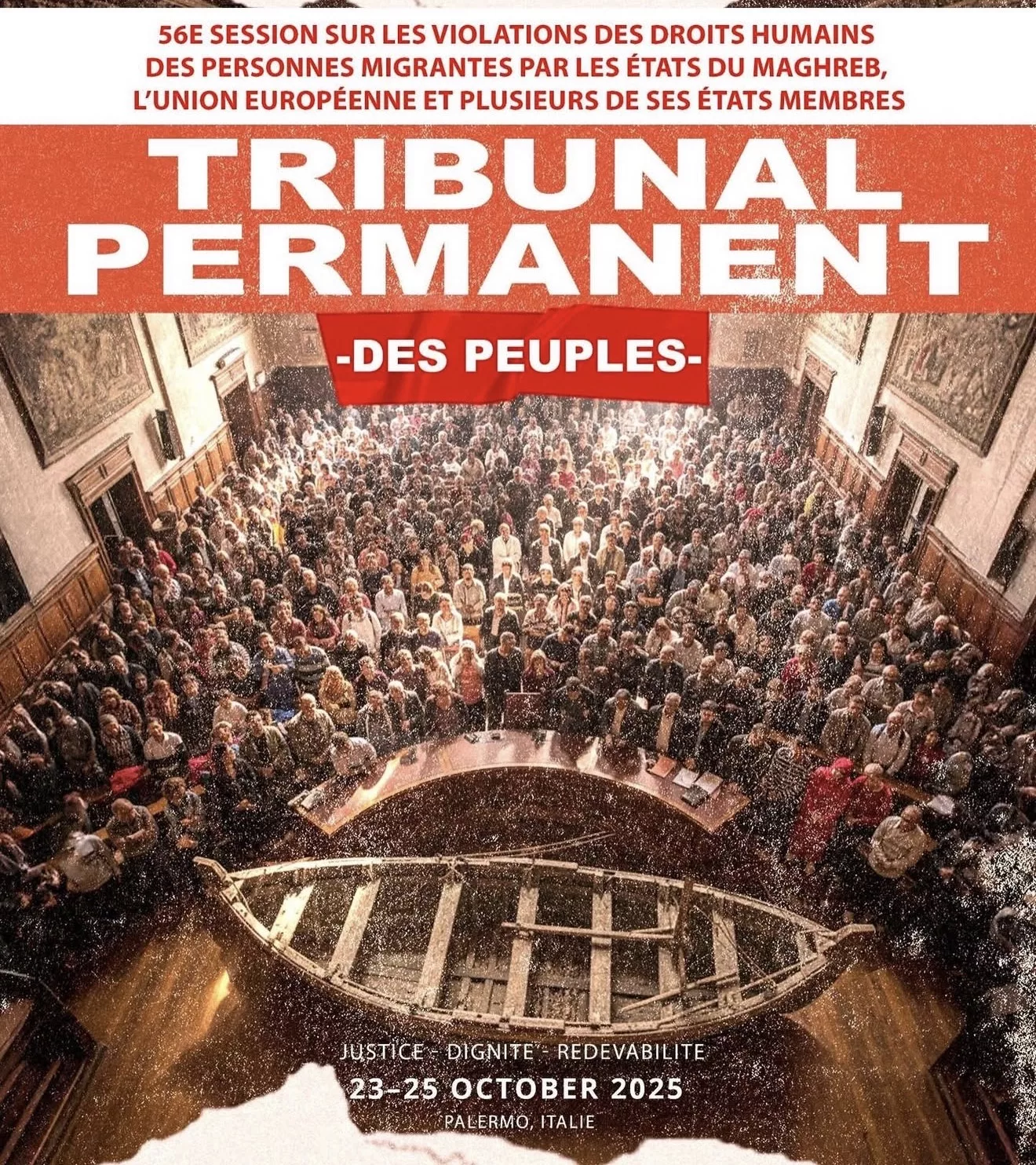
The Permanent Peoples' Tribunal (PPT) held its fifty-sixth session in Palermo, Sicily, from October 22 to 25, 2025. The TPP is a symbolic court that simulates trials of cases brought before it by civil society around the world. Equipped with a permanent registry and ad hoc juries, the Tribunal issues convictions and recommendations following adversarial, but always accusatory, proceedings.
Jury composition
The jury was composed of :
- Sophie Bessis, eminent historian, elected president by the members of the jury,
- Ms Chadia Arab, historian,
- Mr Moro Braulo, journalist,
- Mr. Amzat Yabara, historian,
- Mr. Wahid Ferchichi, Dean of the Faculty of Law.
Parties to the trial
The applicants in the case dealt with at this session are 54 human rights associations active on both shores of the Mediterranean, as well as in Mauritania, Belgium and the Netherlands, working on violations linked to so-called irregular migration.
The Comité pour le Respect des Libertés et des Droits de l'Homme en Tunisie (CRLDHT) was one of these associations.
The applicants were represented by three lawyers: Anna Brambilla, Zakaria Belahrech and Brahim Belghith.
In the dock were :
- Maghreb countries: Algeria, Libya, Morocco, Mauritania and Tunisia;
- European countries: Italy, Spain, France, Greece, Germany, Malta ;
- the European Union;
- International Organization for Migration (IOM);
- European Border and Coast Guard Agency (Frontex);
- as well as private bodies and organizations acting as implementing partners in projects financed by the EU and its member states.
Although the defendants were served with the indictment and the documents in the case file, they all chose not to appear, or even to mandate representatives: there was therefore no defense team at the trial.
Subject of the session and indictment
The associations' application concerned violations of the human rights of migrants, a theme already examined at previous sessions of the Tribunal, but this is the first time that the countries of the southern Mediterranean have been implicated. A number of events that occurred after the last session, in 2020, were brought before the Tribunal.
The indictment, which runs to more than a hundred pages, was presented at the first hearing.
With regard to the facts imputed to the defendant States, it lists the violations divided into six chapters according to their nature:
- Migrant refoulements ;
- Non-assistance and shipwrecks ;
- Arbitrary detention, torture and inhuman treatment;
- Discrimination and the racist criminalization of migration ;
- The criminalization of solidarity with migrants;
- The outsourcing of borders and the illegal delegation of sovereign functions.
On the legal front, the act lists the international conventions, treaties and instruments for the protection of human rights which have been the subject of serious violations by the defendants, before asking the Tribunal to condemn them for these breaches and complicity, and to make specific recommendations, notably to the Maghreb countries, to remedy the systematic violations of migrants' rights.
The applicants also asked the Tribunal to reiterate the recommendations it had made to European countries and entities at previous sessions, calling on them to revise any agreements, arrangements or texts adopted since 2020 that are contrary to the standards set out in the act.
The hearing process
After the presentation of the indictment on the first day, a succession of experts appeared before the Tribunal to explain the national and international contexts, and to present their analyses, research and field findings.
The plaintiffs' lawyers invited the Tribunal to view a number of documents and video-recorded testimonies, and to listen to the poignant accounts of the victims who had come to give their testimonies, moments of intense emotion.
Each theme was the subject of a specific pleading for two days, before the three lawyers presented their final pleadings on the third day, setting out the material and moral elements of the violations, the types of responsibility and the claims made.
The hearing was then adjourned for deliberation. The full judgment will be handed down in two months' time.
Verdict
The Permanent Peoples' Tribunal (TPP), born out of the Universal Declaration of Peoples' Rights (Algiers, 1976), will meet in Palermo from October 23 to 25, 2025, to continue its mission of universal awareness,
Having received and examined the indictment presented by 54 organizations represented by the Forum Social Maghreb, the Forum Tunisien des Droits Economiques et Sociaux (FTDES) and the Forum des Alternatives Maroc (FMAS), concerning violations of the human rights of migrants by the Maghreb states, the European Union, several of its member states and international organizations ;
After hearing from numerous witnesses, lawyers and experts who have suffered, documented or observed these violations ;
And after deliberation, declares as follows:
Legal foundations
The Tribunal relies on :
- the Slavery Convention (1926);
- the Universal Declaration of Human Rights (1948);
- the Geneva Convention relating to the Status of Refugees (1951) and its 1967 Protocol;
- the Convention for the Suppression of the Traffic in Persons and of the Exploitation of the Prostitution of Others (1951);
- the International Covenant on Civil and Political Rights (1966);
- the International Covenant on Economic, Social and Cultural Rights (1966);
- the Convention on the Elimination of All Forms of Discrimination against Women (1979);
- the United Nations Convention on the Law of the Sea (1982);
- the Convention against Torture and Other Cruel, Inhuman or Degrading Treatment or Punishment (1984);
- the Convention on the Rights of the Child (1989);
- the International Convention on the Protection of the Rights of All Migrant Workers and Members of Their Families (1990);
- the Statute of the International Criminal Court (1998);
- the International Convention for the Protection of All Persons from Enforced Disappearance (2010);
- the European Convention on Human Rights (1950);
- the OAU Refugee Convention (1969);
- the African Charter on Human and Peoples' Rights (1981);
- the Charter of Fundamental Rights of the European Union (2000).
Findings and convictions
Convinced of the seriousness of the facts recounted in the indictment and confirmed by the testimonies, the Tribunal condemns the violations of the human rights of migrants, in particular :
- serious violations of the right to life, liberty, security and non-discrimination (articles 6, 7, 9 and 26 of the International Covenant on Civil and Political Rights);
- violation of the absolute prohibition of torture (article 3 of the Convention against Torture);
- the practice of trafficking in persons, in violation of the 1951 Convention for the Suppression of the Traffic in Persons and of the Exploitation of the Prostitution of Others;
- the violation of the principle of non-refoulement (article 33 of the Geneva Convention);
- the violation of the provisions of the United Nations Convention on the Law of the Sea (1982), in particular the obligation to rescue;
- sexual abuse;
- the increasing militarization of borders and the systematic use of force;
- the proliferation of transit and detention centers, often outside the legal framework, transformed into places of torture, murder, rape and disappearance;
- the criminalization of migrants, prosecuted for so-called irregular entry or residence and deprived of procedural guarantees;
- the violation of the Convention on Enforced Disappearances;
- the criminalization of solidarity through prosecution or pressure on associations, NGOs, lawyers, journalists or citizens providing assistance to migrants;
- the widespread dissemination of racist and xenophobic discourse, including by certain institutions or official figures;
- the outsourcing of the European Union's borders to third countries.
Also convinced that some of these violations can be considered crimes against humanity,
the Tribunal notes:
- the deliberate and systematic nature of these violations, which are part of structured policies with foreseeable effects: deaths and disappearances at sea or in the desert, detention and inhumane treatment, violence, extortion, institutionalized racism;
- the importance of the legacy of slavery and racism in the Maghreb countries, where this historical legacy still legitimizes violations of the rights of black migrants.
The Tribunal holds all the Maghreb states (Mauritania, Morocco, Algeria, Tunisia and Libya), the European Union and some of its member states responsible for these violations:
.
While recognizing the existence of individual responsibilities, the Tribunal indicated that it was unable to establish them, and therefore retained the responsibility of States and organizations, common but differentiated.
It notes that the five Maghreb states are guilty of systematic practices of arbitrary arrest, collective expulsion, forced displacement and deportation to desert areas or militarized borders, deliberately exposing thousands of people to trafficking, hunger, thirst, torture, death or disappearance.
They have maintained or tolerated the existence of illegal, unhealthy and inhumane detention centers, where ill-treatment, sexual violence, deprivation of liberty without legal basis and the absence of any judicial control prevail.
The Tribunal draws attention to the particular situation of Libya, marked since 2011 by political and security instability, as well as by the proliferation of armed groups and militias that have turned the trafficking and exploitation of migrants into a source of income.
The Court also found that the European Union, some of its Member States, its agencies - in particular Frontex - and its service providers were responsible. It notes the worsening of violations despite previous recommendations, notably due to the implementation of border outsourcing policies and security and financial agreements.
Recommendations and conclusions
Faced with this serious situation, which sacrifices the lives and dignity of thousands of people every year, particularly black people from sub-Saharan Africa, the Tribunal:
- calls on the organizations concerned to continue documenting migratory routes, to identify missing persons and to clarify the repressive mechanisms implemented within the framework of Maghreb-Europe cooperation;
- invites to make violations visible and to go beyond their simple statistical dimension;
- recognizes the direct or indirect responsibility of the states and organizations concerned in the violations, including those that may be qualified as crimes against humanity;
- encourages the parties to take legal and political action to put an end to illegal and inhumane practices, obtain recognition, full reparation and prosecute those responsible.
Finally, the Tribunal expresses its gratitude to the witnesses and salutes their courage in making visible a reality too often hidden behind legal formulas and figures.