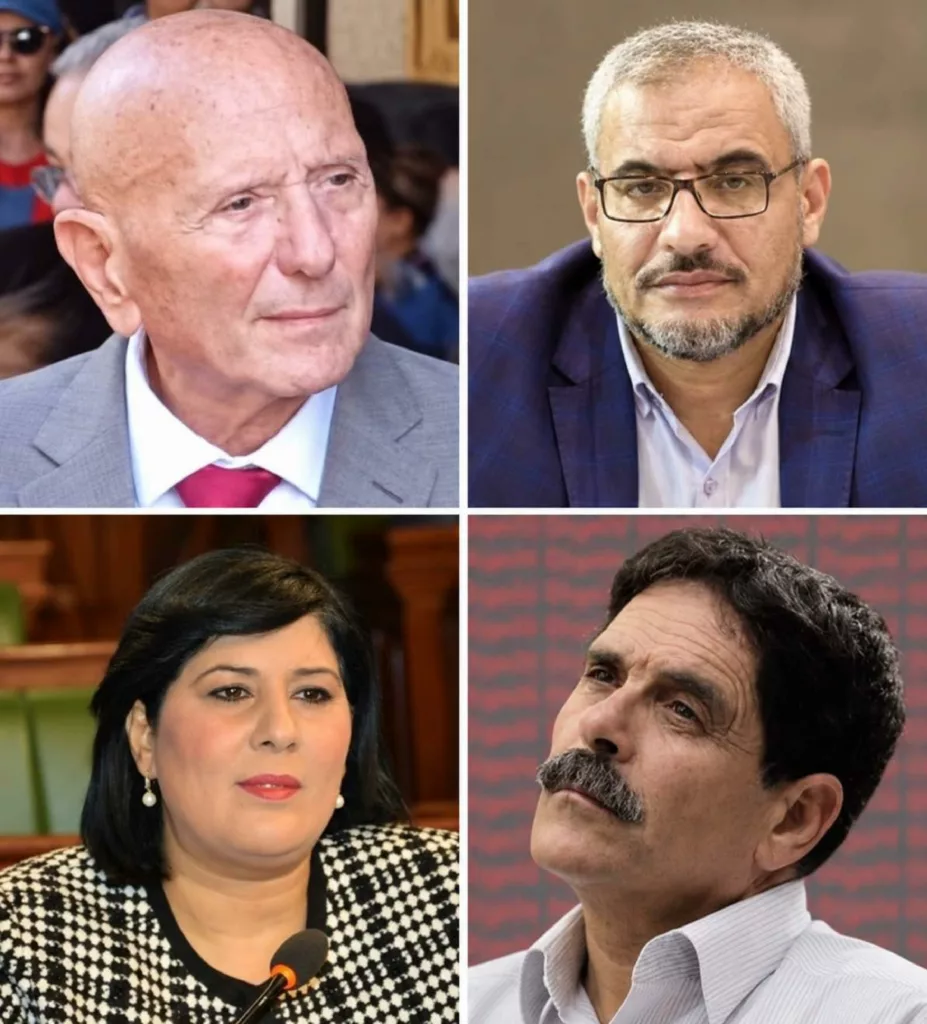
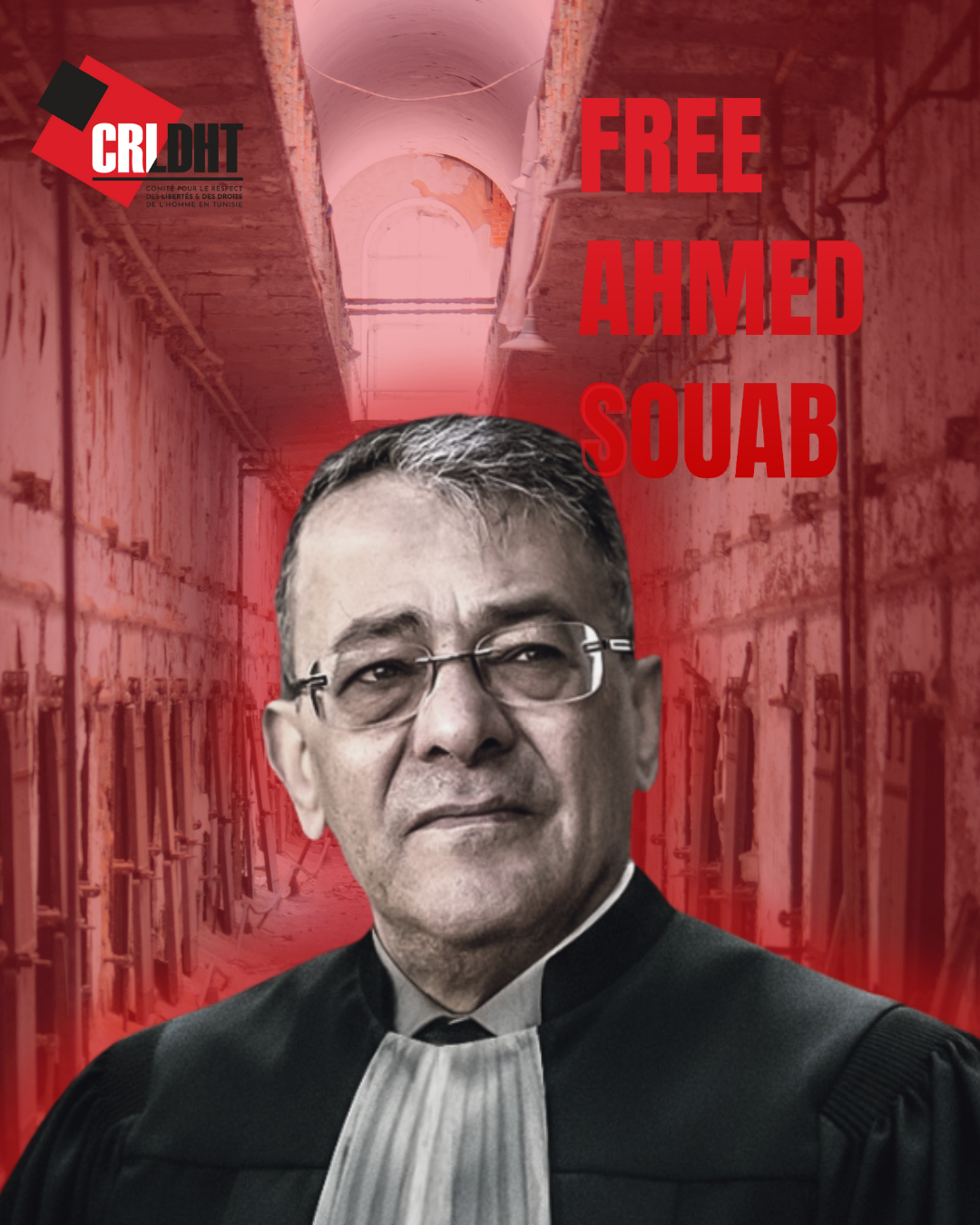
The first hearing in the trial of Me Ahmed Souab, former administrative judge and defense lawyer in the case known as the plot against State security, will be held before the 5ᵉ criminal chamber of the anti-terrorism division of the Tunis court of first instance on October 31, 2025.
A reminder of the facts
At the end of the April 18, 2025 hearing in the case of the plot against State security, Me Ahmed Souab, still dressed in his gown, spoke to the press to denounce the excesses of a trial that had become the symbol of breaches of justice under Kaïs Saïed's regime.
Following a Hollywood-style raid and search of his home, Me Souab was arrested and subsequently detained under a committal order issued by the examining magistrate of the anti-terrorist section of the Tunis court of first instance.
What is Me Souab accused of?
According to the Indictment Division's ruling, Me Souab is being prosecuted for his public statements made that day in front of the Maison du Barreau in Bab Bnet (Tunis), in a video widely circulated on social networks.
During the investigation, questioning focused on the passage in which he stated:
"Today is a scandal and a disgrace for the judiciary and magistrates. I'll say it again: the state of the judiciary is one of mass destruction, just like what's happening in Gaza. This is my personal opinion. It seems to me that the knives are not only on the prisoners, but also on the president of the chamber who is going to judge... a lot of cases", while accompanying his words with a hand gesture mimicking a slit in the throat.
What's he accused of?
The order closing the investigation, confirmed by the Indictment Division and the Court of Cassation, considers that the file contains sufficient evidence to accuse the lawyer of the following facts:
- Dissemination and publication of information for the benefit of a terrorist cartel or persons linked to terrorist crimes, with the aim of assisting in their commission, concealing them, profiting from them or ensuring the impunity of their perpetrators, with a view to compelling a natural or legal person to act or refrain from acting.
- Endangering protected persons by deliberately revealing data that could identify them.
- Damage to others via public telecommunication networks, in particular through the production, dissemination or publication of false news, data, rumours or falsified documents, with the aim of harming the rights of others, public safety, national defence or spreading terror.
- Use of information systems to publish defamatory or hateful material, particularly against public officials.
- Criminal threats linked to terrorist crimes.
The absurdity of the chase
Needless to say, Me Souab's comments were allegorical, the metaphor of "knives on throats" expressing the pressure weighing on the judiciary and in particular on the president of the 5ᵉ chambre criminelle - a magistrate already cited in several cases, including that of the yacht stolen by Ben Ali's son-in-law, dealt with by the anti-corruption commission chaired at the time by Professor Abdelfattah Amor.
However, the facts support Mr Souab's assertion:
- The president of the chamber in question was illegally appointed by a simple memo from the Minister of Justice, a few weeks before the trial of the plot against state security, in clear violation of the principle of independence of the judiciary.
- The trial in question involved serious breaches of the Code of Criminal Procedure: the detainees were prevented from appearing before the chamber seized of the case, following an illegal decision by the president of the court and the public prosecutor, who was nevertheless a party to the trial.
- There were no hearings of experts, witnesses or defendants, and no pleadings, even though appeals in cassation and a request for recusal were pending.
- In the end, the Minister of Justice herself implicitly confirmed the accuracy of Me Souab's comments by transferring Chamber President Lassad Chamakhi to a new post in the wake of the case.
Despite this, examining magistrate Bassma Arouri and the indictment division brought charges of terrorist threat and one-person terrorist conspiracy against Me Souab (!).
According to them, the finger-on-the-throat gesture was not a metaphor, but an order to unknown terrorists to slit the throat of the president of the criminal division.
The Court of Cassation, in validating these procedural and substantive violations, has sealed one of the most surreal episodes in current judicial repression.
What can we expect on October 31, 2025?
The modus operandi of the criminal division of the anti-terrorist unit in this type of case is now well known: no one is under any illusions.
Me Souab will probably receive neither a fair trial, nor respect for the rights guaranteed by the Constitution, international conventions and Tunisian law.
It is possible that he will not be taken to the hearing, which could take place remotely from prison. It is just as likely that he will not be heard, since it is precisely his words, his lucidity and his eloquence that have shaken the regime to the point of bringing judicial vengeance against him.
The defense is well aware that it is not just a question of defending a man, but of defending a symbol:
that of a struggle against arbitrariness, tyranny and the violation of human rights.
For as long as Kaïs Saïed confiscates the Republic, no dismissal or provisional liberty is conceivable for Me Ahmed Souab.
His trial embodies the resistance of a people deprived of their dreams of a democratic, just and social Republic, founded on freedoms and rights.
The CRLDHT
- Reiterates its full support and solidarity with Me Ahmed Souab and his family, and through them with all prisoners of conscience and political prisoners and their families.
- Calls for the mobilization of as many Tunisian and foreign lawyers, media, journalists and civil society activists as possible to attend this hearing and transform this trial into a high point in the struggle for human rights and the rule of law in Tunisia.
- Urges the Tunisian people, especially their youth, to safeguard their rights and their Republic, in order to halt the destructive hemorrhage of this populist regime and peacefully and civically reclaim their homeland.