Since February 2023, the repressive apparatus of Kaïs Saïed's regime has been in full swing. The more the Tunisian president loses legitimacy and popularity, the more repression intensifies: arbitrary arrests, unfair trials and the instrumentalization of justice are becoming the tools of a power obsessed with control and fear of dissent. The guarantees of a fair trial have become, in today's Tunisia, a fiction used to punish dissidents and ensure the impunity of the authoritarian machine.
Among the many victims of this drift, Moncef Houaidi embodies the figure of a local resistance fighter and an activist for economic, social and environmental rights. A native of Houaidia, in the Jendouba governorate, he has been involved for several years in defending the right to a healthy environment, drinking water and dignity for the inhabitants of marginalized rural areas in the north-west.
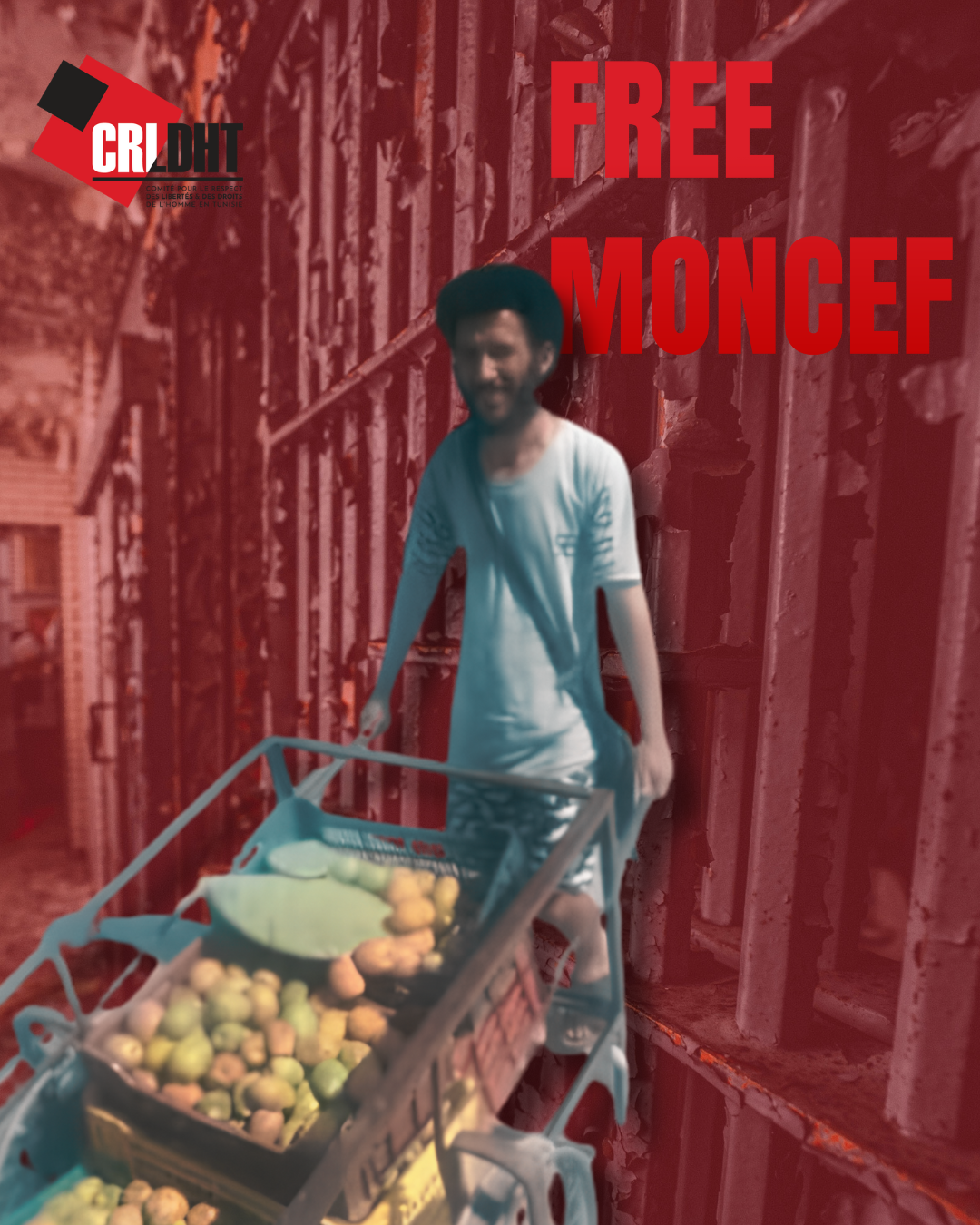
Moncef Houaidi first came to prominence in 2018, when an incident while selling prickly pears thrust him into the public eye. After refusing to hand over his fruit free of charge to a policeman, he was violently arrested and sprayed with tear gas. His arrest sparked a wave of indignation on social networks. He was given a three-month suspended prison sentence by the Tabarka cantonal court - an episode that reveals the authorities' contempt for modest citizens who refuse arbitrary treatment.
Since then, Moncef Houaidi has become an emblematic figure in the region's ecological and social struggles. In Aïn Dhokar, on the outskirts of Houaidia, Moncef Houaidi and his fellow villagers fought a long battle against a stone quarry that was being exploited with no regard for the environmental consequences: destruction of ecosystems, pollution of springs, damage to flora and fauna, and degradation of farmland. The inhabitants organized several sit-ins and peaceful mobilizations, demanding the closure of the site and the protection of their environment.
These acts of resistance earned him repeated prosecutions. Condemned in absentia in December 2024, Moncef Houaidi was subsequently charged on new counts, without benefiting from a real right to defense or a fair trial. Detained on several occasions, he has gone on hunger strike at least twice to denounce the judicial harassment of which he is a victim, the infringements of his fundamental rights and the deplorable prison conditions which have seriously affected his health.
The Tunisian League for Human Rights (LTDH) has given him its support, recalling the arbitrary and political nature of his detention.
More recently, Moncef Houaidi was brought before an examining magistrate for :
- offence against the Head of State (article 67 of the Penal Code),
- dissemination of false news (article 24 of Decree-Law 54 of 2022 on cybercrime).
On October 7, 2025, the criminal division of the Jendouba court of first instance sentenced him to two years' imprisonment and a fine of 1,000 dinars - a heavy, unjustified and politically-motivated sentence.
Moncef Houaidi is no criminal: he is the voice of an abandoned population, the inhabitants of Houaidia, Nadhour, Tabarka and other rural areas where poverty, marginalization and pollution undermine daily life. He has also initiated, with other young people and residents, a "cultural farm" project combining agriculture, library and creative space - a civic and ecological project stifled by a lack of public support.
His struggle illustrates the increasing criminalization of environmental and human rights defenders in Tunisia, in a context of authoritarian drift where any free voice is suspect.
The CRLDHT :
- expresses its total solidarity with Moncef Houaidi and demands his immediate release, as well as full respect for his rights to a fair trial and to free expression;
- supports the legitimate demands for a healthy environment and fair access to water put forward by Moncef Houaidi, the residents of Houaidia and, through them, all Tunisian citizens;
- denounces the systematic violations perpetrated by the police and judiciary under the orders of a power that seeks to mask its political, economic and social failure through terror and intimidation, targeting peasants, trade unionists and activists.