The Committee for the Respect of Freedoms and Human Rights in Tunisia (CRLDHT) expresses its deepest outrage at the wave of arrests that took place during the night of Sunday, September 20, to Monday, September 21, 2026, a large number of participants in the peaceful march organized on Saturday, September 19, in Tunis in support of the four detainees from the Sumud Flotilla—Wael Naouar, Ghassen El Henchiri, Ghassen El Boughdiri, and Nabil Chennoufi—who have been detained since March 6, 2026, and have been on a hunger strike for nearly two weeks, with Wael Naouar having begun his own hunger strike more than a month ago. These arrests come just a few days after the court ruling extending their detention by another four months, even as concerns about their health continue to grow.
An operation carried out outside any legal framework
Accounts gathered from families and the Commission for the Defense of Detainees describe nighttime arrests—both at home and on the street—carried out with a disproportionate use of force. Several of those arrested were deprived, for many hours, of any contact with their loved ones or their attorneys, as the attorneys themselves were prevented from visiting them or being informed of their fate—a situation that, by its nature, is comparable to short-term enforced disappearances. Minors and, in at least one case, an entire family were reportedly affected by these raids.
The CRLDHT would like to commend and highlight the swift and united mobilization of human rights organizations, whose statements all point to the same conclusion.
In an unprecedented joint statement, the Tunisian General Labor Union (UGTT), the National Bar Association of Tunisia, and the Tunisian Human Rights League (LTDH) reiterated that the right to freedom of expression, assembly, and peaceful protest is a fundamental right, the exercise of which cannot, in and of itself, justify an arrest or prosecution. The three organizations warn of the risk that the security and judicial handling of peaceful protests could replace political and social dialogue, and of the erosion of confidence in the independence of the judiciary caused by the expansion of prosecutions to include mere participants in gatherings, without distinguishing between the exercise of a right and any potential criminal acts.
For their part, several civil society organizations denounced in a joint statement a crackdown unprecedented in its scale, describing the nighttime arrests as a veritable intimidation campaign aimed at tightening the noose on civil society and silencing any voice of solidarity with the Palestinian cause. These organizations view this as yet another political trial, following in the footsteps of proceedings already initiated against other civil and political movements, and link this repression to a regional context marked by pressure to normalize relations.
The National Union of Tunisian Journalists (SNJT) also expressed concern following the detention, under troubling circumstances, of journalists from the investigative news site Nawaat, who were arrested and then released—an incident that adds to a series of attacks targeting the independent press.
Finally, the Union of Unemployed Graduates (UDC) has condemned the arrest, on Saturday, September 19, of one of its long-standing leaders, activist Karim Teraa, without any clear reason having been given to date, viewing this as yet another instance of Decree-Law No. 54 being used to restrict freedom of expression and target social protests.
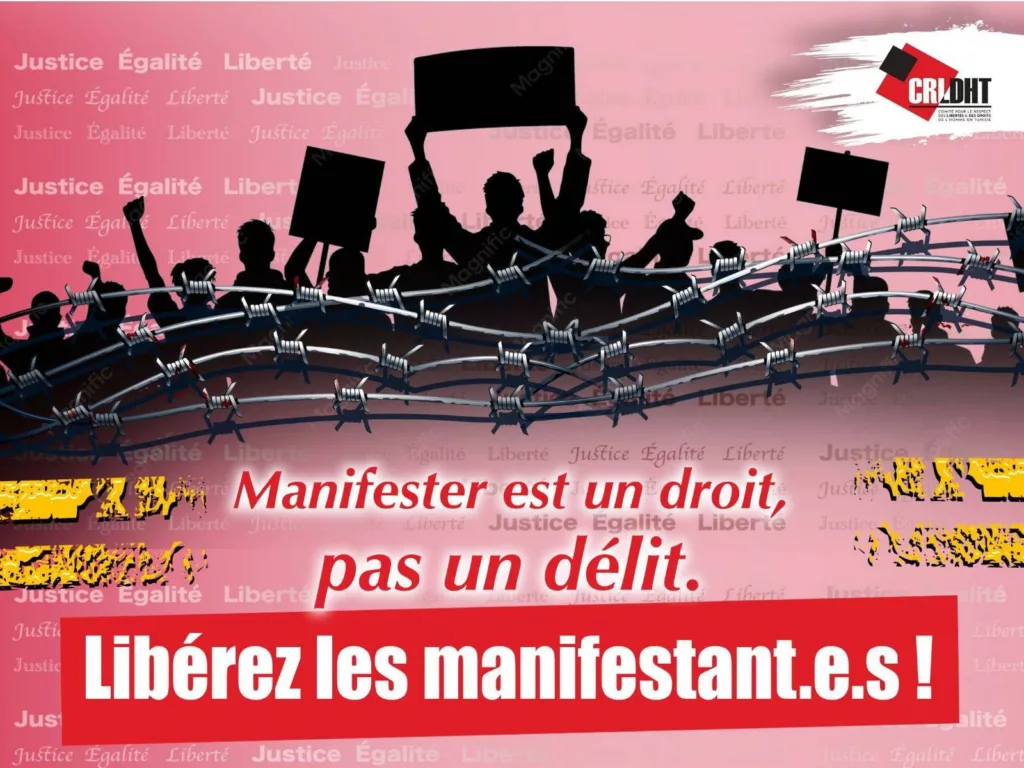
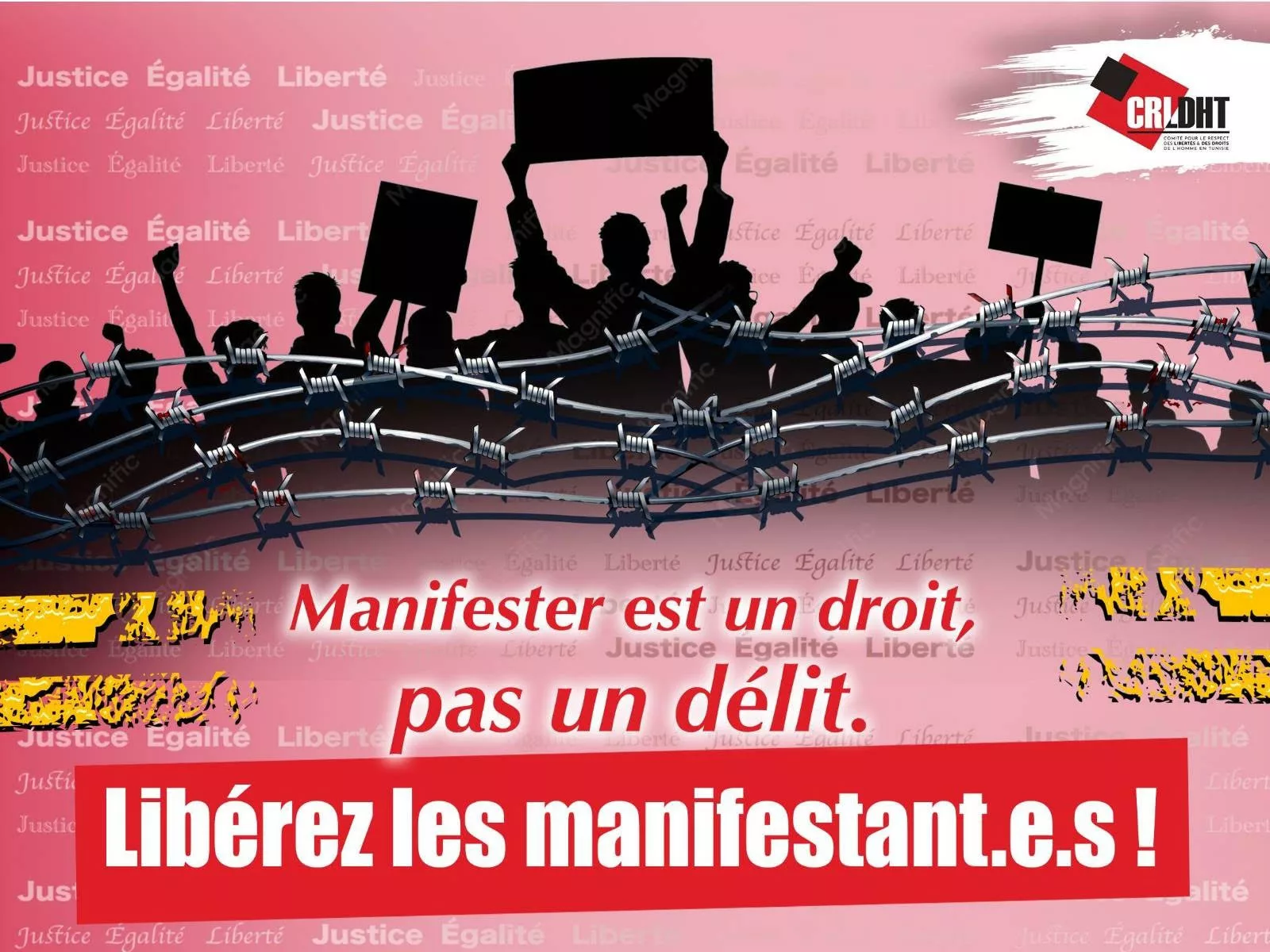
The CRLDHT notes that the government, after successively restricting freedom of the press, freedom of expression and opinion, freedom of creativity, and freedom of association, is now directly attacking the freedom to demonstrate peacefully—the last remaining space for collective expression. The CRLDHT reiterates that peaceful protest is a right, not a crime, and that repression must not become a means of governance.
The CRLDHT demands:
- the immediate and unconditional release of all arrested protesters, as well as the dismissal of the charges against them;
- the immediate release of Karim Teraa and an end to the use of Decree-Law No. 54 to criminalize labor and social activism;
- ensuring the physical and mental well-being of all detainees, particularly those on hunger strike, and providing medical care in accordance with legal and humanitarian standards;
- the immediate cessation of all restrictions on the right to demonstrate and assemble peacefully;
- full and complete respect for the presumption of innocence and the rights of the defense for any person facing prosecution.
In the face of this drift toward authoritarianism and the increasing number of violations of fundamental freedoms, the CRLDHT calls on all labor unions, professional organizations, civic groups, political parties, and citizens’ organizations to set aside their differences and build a united front in defense of freedoms. At stake is the preservation of the gains won through hard struggle by the Tunisian people—at the cost of the blood of their martyrs—up until the Revolution. The CRLDHT calls for the broadest, most peaceful, and most determined mobilization to put an end to this spiral of repression and ensure that Tunisia returns to effectively respecting the rights and freedoms of all.
Silence is not an option. Solidarity is not a crime.