Day by day, Tunisia is sinking into an unprecedented authoritarian spiral. Under the guise of restoring the State and fighting corruption, the authorities are now orchestrating a veritable hunt against independent civil society, in a climate of accelerated regression of rights, political lock-in and institutional disintegration.
The administration, justice and security services are being mobilized as instruments of political coercion.
What is unfolding before our eyes is no longer just a crisis of power, but a regime shift, where the law becomes a sham, justice a weapon and civil society an enemy to be slaughtered.
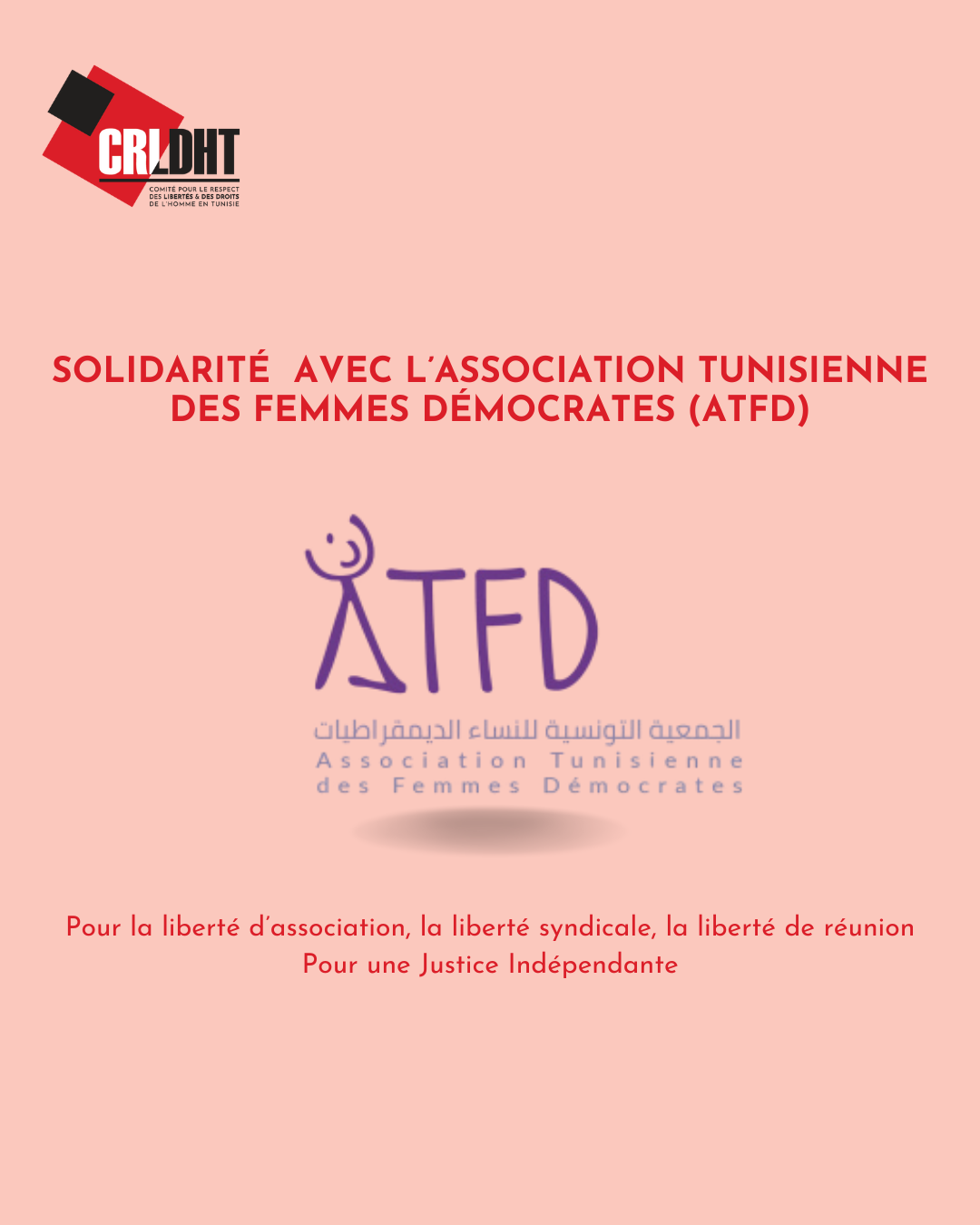
ATFD suspended: symbol of an authoritarian drift and a moral shipwreck
On October 24, 2025, the Tunisian authorities ordered the suspension for one month of the Association Tunisienne des Femmes Démocrates (ATFD), one of the oldest and most emblematic feminist organizations in the Arab world.
Under the guise of "administrative irregularities", this decision is part of a coordinated offensive targeting several independent associations active in the fields of human rights, the environment and freedom of expression.
These suspensions and freezes on activities reflect a deliberate desire to muzzle any autonomous space, particularly those denouncing corruption, repression or ecological disasters.
But to strike at ATFD is to strike at a founding symbol of the Tunisian democratic movement. Since 1989, it has embodied freedom, equality and dignity, training generations of activists and carrying the voice of women in all struggles for justice and rights.
Jurist Sana Ben Achour summed it up: "The law is no longer conceived as a limit to the hegemony of power, but as a cleaver in its hands. "
Decree-Law 2011-88, which guarantees freedom of association and expressly authorizes foreign funding within a transparent and legal framework, is now being misused to criminalize international cooperation and justify repression.
To equate this legal support with national treason is to step outside the law into the realm of the arbitrary, by inventing an imaginary crime.
A campaign of defamation and fear
Under the pretext of combating foreign interference, the authorities have launched a smear campaign targeting dozens of organizations: feminist, environmental, legal, media, migrant and minority organizations.
Official discourse and subservient media relay the same propaganda: independent associations are said to be "manipulated from outside", financed by "Soros" or "foreign powers", with the aim of destabilizing the state.
These grotesque accusations are reminiscent of the methods used by authoritarian regimes in the region: fabricating an enemy within to mask the failure of governance and legitimize repression.
Behind this paranoid rhetoric lies one constant: the elimination of all checks and balances.
After political parties, trade unions, the media and independent bodies, civil society is now the priority target.
Justice under orders, power in decomposition
The instrumentalization of justice reaches a new peak with the hastily scheduled appeal hearing in the case of the "plot against state security", scheduled for October 27, 2025 - remotely, without the presence of the detainees or prior information of their lawyers.
This parody of justice is just one episode in a long series: rigged proceedings, arbitrary detentions, expedited hearings, judicial harassment, while real emergencies - such as the ecological disaster in Gabès - remain ignored. A power that fears the truth no longer governs: it represses.
Faced with this global offensive against civil society and the collapse of the guarantees of the rule of law,
Comité pour le Respect des Libertés et des Droits de l'Homme en Tunisie (CRLDHT)
observes that the pseudo-judicial maneuvers undertaken by the authorities constitute not only a strategy of repression, but also a calculated diversion designed to divert the attention of public opinion.
They are preparing and blurring the judicial ground ahead of the forthcoming hearings, in particular the appeal case of "conspiracy against state security", set under opaque and arbitrary conditions - with a Jarnac twist.
The CRLDHT points out that this is a case of multi-speed justice: expeditious and politicized procedures when it comes to cases against opponents, and inexcusable slowness when it comes to urgent decisions such as the suspension of disastrously polluting activity in Gabès.
In this context, the CRLDHT :
- Reaffirms its total solidarity with the associations, collectives and civil movements unjustly targeted for their commitment to defending fundamental rights and public freedoms, in particular ATFD, a symbol of courage and democratic continuity.
- Strongly denounces the selective and perverse use of Decree-Law 2011-88, transformed from a democratic achievement into an instrument of repression. The CRLDHT recalls that foreign funding is legal, recognized by Tunisian law and international standards, and constitutes a legitimate source of cooperation between civil societies in the North and South. Criminalizing this practice amounts to criminalizing international solidarity and cutting Tunisia off from its own democratic alliances.
- Condemns the manipulation of the judicial system for political ends, the systematic use of the law as a weapon of persecution, and the submission of control institutions to the executive.
- Calls on Tunisian civil society to go beyond a simple defensive reaction and develop a collective resistance strategy based on coordination, pooling of expertise, legal documentation of violations and networking of regional and international solidarity.
- Invites international human rights protection mechanisms - UN special rapporteurs, the African Commission on Human and Peoples' Rights, European institutions and partner donors - to intervene without delay to demand :
- the immediate lifting of arbitrary suspensions,
- an end to prosecutions of human rights defenders,
- and the effective restoration of guarantees of judicial and associative independence.
- Alerts Tunisia's partners to the major risk that this drift represents for the stability of the region and for Tunisia's international commitments,
Suspending the ATFD, criminalizing foreign funding, manipulating the justice system and repressing free voices: all of this does not reflect the strength of a state, but its fear, vacuity and failure.
The regime has chosen fear as its ultimate policy. But Tunisian civil society, strengthened by its history and solidarity, will not abdicate.
The authorities may suspend associations, but they will never suspend conscience, memory or freedom.
It is in this loyalty to the Tunisia of December 17, 2010-January 14, 2011, to the dignity of struggles and the universality of rights, that the CRLDHT inscribes its position: resist, connect, rebuild.