Without warning and almost out of the blue, Kais Saied announced on the presidency’s Facebook page on September 29, 2026, that he had reviewed a number of draft decree-laws during a Cabinet meeting. The following day, four decree-laws (Nos. 1 through 4 of 2026) were published in the Official Gazette.
Before examining the content of these texts, it would be wise to first consider their form.
Decree-laws as a form
Kais Saied’s ukases have, once again, taken the form of decree-laws. Theoretically, he is acting on the basis of Article 73 of the Constitution, even though he does not mention this in the preamble to these decree-laws, which refer only to the deliberations of the Council of Ministers and the notification provided to the Legislative Committee of the Assembly of the Representatives of the People (the Assembly).
Article 73 authorizes the president to issue decree-laws, subject to certain preconditions—namely, the approval of the Council of Ministers and notification to the relevant standing committee of the Assembly—as well as a subsequent condition requiring that these texts be submitted to the Assembly for approval during the regular session following the recess.
While it may not seem excessive to suggest a repeat of past actions, it is important to recall that Kais Saied’s decree-laws were his weapon of choice to dismantle the gains of the democratic transition, without any legal basis or respect for the 2014 Constitution, in particular without regard to Article 80, or even the general principles of the rule of law or those of positive law, since he reversed the hierarchy of legal norms, elevating his decrees and decree-laws to a supra-constitutional status.
Another aspect of the illegality of these decree-laws is that they were not submitted to the Assembly for approval during its first regular session in 2023, as required by Article 70 of the 2014 Constitution in the event of the Assembly’s dissolution, or by Article 73 of the 2022 Constitution.
Even more serious is the fact that the Assembly, as a legislative body—assuming it is one—has effectively endorsed the unconstitutionality of these decrees by refraining from approving them. Of course, the reason is that it does not dare to have the final say on texts promulgated by the highest authority of the State. Nor is this a matter of omission, since the Assembly amended one of these decree-laws without approval, as if it were not invalid for lack of such approval.
The Texts and the Context
While, on the face of it, Kaies Saied has the authority to enact these laws—pending the Assembly’s response and whether or not Article 73 of the 2022 Constitution is applied—the context in which this action is taking place raises questions. First, one must question the timing, and then the regime’s state of dependence, which means that certain laws can be interpreted politically as a step backward.
Questionable timing
With just a few days to go before the start of the parliamentary session, Kais Saied is pushing through his decree-laws, even though there appears to be no explanation for the urgency that might account for this decision to bypass the legislative branch—to use the terminology of the 2022 Constitution.
In this regard, we must not forget the chaotic end to the Assembly’s last session, when some rumors even suggested the Assembly might be dissolved due to criticism that was growing increasingly scathing and embarrassing for the government. To a lesser extent—and in an unprecedented move, at that—a member of the Assembly was convicted and imprisoned before a presidential pardon shortened his sentence.
That said, this unlikely rebellion should be viewed with some caution, since the lawmakers remain disciplined and vote in favor of bills—particularly those related to appropriations submitted by the government—even as they appear to criticize its policies.
Foreign pressure
While, by their very nature, these pressures cannot be proven with concrete evidence, common sense suggests that they are the factor explaining the urgency of the maneuver.
Kais Saied’s isolation on the international stage is well established, as is the regime’s dependence on foreign powers. Although, on the whole, the United States and the European Union tolerate and ultimately condone Kais Saied’s drift toward autocracy for various reasons, the fact remains that they continue to urge him to ease up, particularly on human rights issues, and openly criticize these policies and practices—without, however, severing ties with him—due to interests that are primarily military and security-related for the Americans and immigration-related for the Europeans.
The Algerian regime, too—even though it is hostile to the idea of resuming the democratic transition, which might give its oppressed population ideas—seems to fear that the pressure cooker will explode and is urging its protégé, Kais Saied, to loosen the grip of his oppression before it is too late.
The vulnerability of the current regime—due to economic and social failure, financial imbalances, and an inability to revive the economy—means that Kais Saied is eager to prove himself so that various external donors will continue to back him, even if there is no better alternative.
These amendments to the decree-laws appear to respond—at least formally and partially—to the fairly frequent calls from the European Union and UN bodies. But the fact that they come just a few days after a meeting between a U.S. delegation led by the ambassador and the Minister of Justice, and one day before the announcement of the delivery of security equipment funded by the U.S. government, worth one million dollars as part of the fight against terrorism, suggests that this backtracking—though formal and insignificant—by Kais Saied should be interpreted as a move aimed at improving his international standing.
The infamous Decree-Law 54/2022
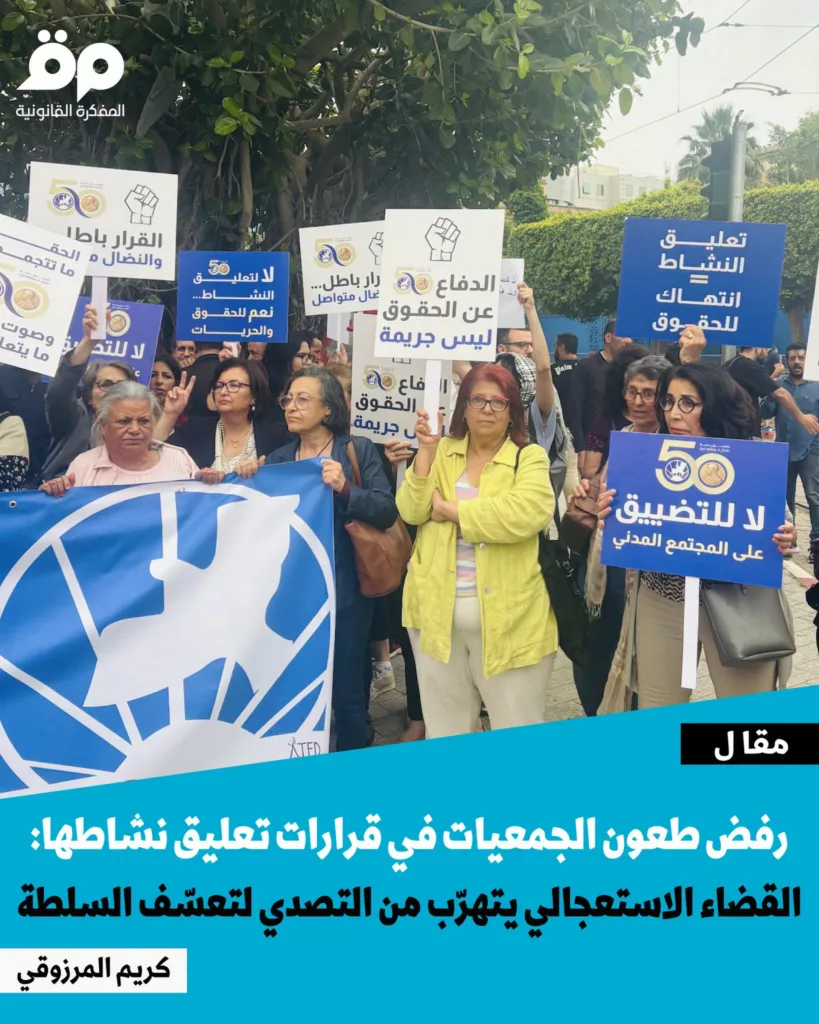
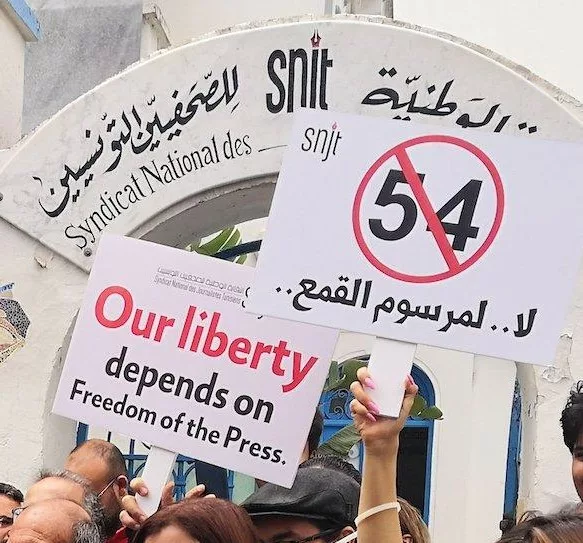
This decree-law was once the preferred tool of repression used by the regime’s prosecutors, and despite the abusive misinterpretation of the text—particularly Article 24— the courts have condoned its violations of freedom of speech and expression, resulting in hundreds, if not thousands, of victims being imprisoned for a statement made to the media, a published article, or even a Facebook post or comment. NGOs, independent UN experts, and the High Commissioner for Human Rights have repeatedly condemned the text and its illegal application. The European Union has also explicitly condemned the freedom-suppressing application of the decree-law, which is the subject of several cases before the African Court on Human and Peoples’ Rights, the most recent of which was initiated by the Tunisian League for Human Rights and the Pan-African Lawyers Union, registered under No. 006/2026.
Tunisia’s accession to the Budapest Convention on Cybercrime should have led to a radical overhaul of Decree-Law 54/2022 to bring it into compliance with the Convention, but nothing has been done.
It should also be noted that a bill to amend Decree-Law 54/2022 was introduced by a number of members of Congress in February 2024 and remains stalled in committee.
Decree-Law No. 1/2026 of September 30, 2026, amends Decree-Law 54/2022. There are three changes:
- The penalty is reduced from five years in prison to a fine of 10,000 to 20,000 dinars for first-time offenders.
- In the event of a repeat offense, the penalty is reduced to six months in prison and a fine of fifty thousand dinars.
- The prohibition on applying Article 53 of the Penal Code in favor of a repeat offender, that is, taking mitigating circumstances into account and suspending the execution of the sentence.
These changes are limited, discriminatory, and do not guarantee an end to repressive practices.
They are limited to the severity of the sentence imposed: the structure of the article remains intact, including the definition of the offense and the elements of the crimes. This in no way foreshadows the hoped-for change in practice or in the way this text is used; this amendment only serves to confirm all the human rights violations it contains.
The sentence imposed is blatantly discriminatory, since the amount of the fine is beyond the reach of the overwhelming majority of those likely to be convicted, who are unable to pay it. This fine may be converted into imprisonment for nonpayment pursuant to Article 343 of the Code of Criminal Procedure. Article 344 of the same Code specifies that this imprisonment for non-payment is enforced at the rate of one day of imprisonment for every three dinars or fraction thereof, provided that the duration does not exceed two years.
So, of course, you have to be well-off to be able to speak up even once.
Finally, it is worth noting that this amendment does not alter the situation with regard to human rights and due process. No new provisions appear to aim at ensuring that abuses committed under this law will not be repeated. It should be noted that this law is no longer the most commonly used tool for suppressing freedom of expression, since the regime now relies on other provisions of the Telecommunications Code or the Penal Code instead of the amended law—as it has no shortage of repressive measures at its disposal.
This amendment to Article 24 of Decree-Law 54/2022 therefore serves only to reduce the sentences of those who will be brought before the courts in the future, as well as those who have already been convicted but not yet by a final judgment, and who benefit from the “more favorable provision” exception. Once again, the timing is striking, since this new amendment was enacted nearly one day after the Court of Cassation upheld Abir Moussi’s conviction based on the very article whose penalty is now being modified.
Kais Saied's "Sisyphus's Rock": Decree-Law 13/2022
For the umpteenth time, Kais Saied is stubbornly trying to patch up his stillborn criminal plea bargain proposal by amending the text yet again. Despite the harsh reality checks—even the outright failures—that this empirically flawed concept has faced, Kais Saied seems to be applying the “dead horse” theory to the letter in an attempt to revive his dream, or rather, his utopia.
This time, Kais Saied is making four changes:
- The establishment of a provisional settlement plan to pay half of the amounts owed within a timeframe proposed by the commission—not exceeding two years—based on reliable and verified data submitted by the petitioner.
- The authority of the Supreme National Security Council to allocate the funds raised from the transaction.
- The commission has the authority to propose, if appropriate, a lower rate if it deems it necessary based on the information in each case. This refers to the 10 percent rate due for each year since the offense occurred.
- The repeal of the established allocation for the distribution of proceeds from the transaction—specifically, 80 percent for beneficiary delegations, from the poorest to the least poor, and 20 percent for local governments, to be used as capital contributions to local and regional institutions.
There is no doubt that these latest changes will not turn this fiasco around, as the regime has lost all credibility with those affected, who continue to languish in prison for months, or even years, after agreeing to pay substantial sums. But it is clear that these changes facilitate corrupt practices by granting unchecked—or at least unregulated—discretionary power to the commission responsible for setting the amounts owed, and to the National Security Council for approving and allocating the funds collected.
The Presidential Election Authority: Decree-Law No. 3/2026
Once again, and without any excuse whatsoever, Kais Saied is showing blatant disregard for his own Constitution and the principle of the hierarchy of legal norms.
In fact, the area of elections is reserved for organic laws, as clearly and unambiguously provided for in Article 75 of the 2022 Constitution. In other words, the electoral law cannot take the form of a decree-law.
In addition to this clear unconstitutionality, the decree-law, being of lower legal standing, cannot amend an organic law, which is of higher legal standing. And yet, once again, we find ourselves with a presidential decree-law amending Organic Law No. 23/2012 establishing the Independent High Electoral Authority of December 20, 2012.
As for the content of the new presidential statement, it covers:
- Change the number of ISIE members from 7 to 9, which would put an end to the body’s unconstitutional composition—a fact it itself admitted before the Administrative Court during the litigation over the presidential election candidacies.
- Add the requirements regarding experience and seniority for the three candidates directly appointed by the President of the Republic.
- Add a statistical engineer, nominated by the National Institute of Statistics, to the membership from among three candidates.
- Add a retired member of the diplomatic corps, nominated by the Department of State, to the list of candidates, from among three nominees.
- Specify that the designation takes the form of a decree.
- Maintain the membership status of members in the public sector, notwithstanding any provisions to the contrary.
- Provide that the President of the Republic’s appointment of the ISIE chairperson is no longer limited to one of the three members of previous ISIE compositions.
- Extend the term of office for members to six years, with no possibility of reappointment.
- One-third of the members shall be replaced every two years, with a random selection for the first two replacements; however, the chair of the body shall be excluded from this random selection during those first two replacements.
- Provide that the Prime Minister no longer receive the special report for each election, the ISIE’s annual report, and the Court of Auditors’ special report on each election.
- Provide that, in the event the Legislative Assembly does not approve the ISIE’s financial report, the investigation shall no longer be conducted by a commission composed of certified public accountants, but rather by specialists in accounting or financial auditing appointed by the President of the Republic.
- Retain the current members of the ISIE until a new executive board is appointed in accordance with the new decree-law.
In conclusion, there is nothing substantial about the changes contained in this new decree-law, which can simply be described as a mere reorganization within a body that is no longer either superior or independent, but rather presidential.
Decree-Law No. 4/2026 on the City Council
The fourth decree-law was issued following the dissolution of the elected municipal councils, without any elections being held. Members of the ISIE have consistently stated that they were ready to organize municipal elections but were awaiting a legal framework—in accordance with the 2022 Constitution—governing local governments. However, once again in violation of Article 75 of the Constitution, the organization of local governments—a matter reserved for organic law—is being governed by a presidential decree-law.
This time, the decree-law goes so far as to nullify any provisions of the organic law that conflict with it, as provided for in Article 139, which repeals any conflicting provisions of Organic Law No. 29/2018 on the Local Government Code.
Of course, this article cannot fully capture the changes introduced by this legislation, which establishes new rules for municipal operations as conceived by the current administration. Of course, there is no question of municipal independence, nor of any conflict of jurisdiction or authority with regional or central government. Quite the contrary: the president of the municipal council operates under the supervision of the governor, who can even take the council president’s place—marking a return to a model that predates the 2011 revolution.
In this decree-law, Kais Saied is going on the offensive—admittedly belatedly and clumsily—but this foreshadows the holding of municipal elections, the stakes of which are not particularly appealing in a context as chaotic as that of Kais Saied’s Tunisia.