In just a few months, the Soumoud flotilla case has become much more than a judicial investigation. It pits Tunisia’s tradition of solidarity with Palestine and the health of prisoners on a hunger strike against a security and judicial apparatus that has now turned against those calling for their release. The incarceration of 17-year-old high school student Adam Mbarek has made him the most striking symbol of this situation.
From the flotilla to break the Gaza blockade to the court case
In September 2025, the Soumoud flotilla made Tunisia a visible hub of international solidarity with Gaza. Its name—meaning “resolve” and “perseverance”—reflected both the determination to break the siege imposed on Gaza and the conviction that the Palestinian cause was a collective responsibility.
But this initiative ran up against the brutality of the blockade. The participants in the flotilla were intercepted and abducted at sea by the Israeli navy, forcibly taken to Israel, arrested, and subjected to mistreatment before being deported. Their commitment to reaching Gaza and denouncing the siege thus led them from the sea to Israeli detention centers where thousands of Palestinians languish.
In early March 2026, the Tunisian government abruptly changed its stance. After being intercepted, detained, and mistreated by the Israeli navy for attempting to break the siege of Gaza, the leaders of Soumoud now face a policy of repression and obstruction in their own country.
The planned activities in Sidi Bou Saïd and Tunis have been banned. The use of Tunisian ports to prepare for a new departure of the flotilla has been blocked. In the name of so-called security concerns, the very possibility of a civilian initiative in solidarity with Gaza is being curtailed.
For the organizers, these are not isolated measures, but rather the beginning of a campaign aimed at stifling, criminalizing, and deterring the entire Tunisian movement in support of the Palestinian people.
Starting on Friday, March 6, 2026, a series of arrests took place. On Monday, March 16, 2026, seven executives from the fleet were remanded in custody as part of an investigation led by the Economic and Financial Crimes Unit. The alleged charges—forgery, use of forged documents, fraud, aggravated breach of trust, and money laundering—are very serious. At this stage, these remain charges under investigation: no convictions have been handed down.
Three people were subsequently released: Sana Messaoudi on April 17, 2026, Jawaher Channa on April 23, 2026, and Mohamed Amine Bennour on May 22, 2026. However, Wael Naouar, Ghassen Henchiri, Ghassen Boughdiri, and Nabil Chennoufi remain in custody at Mornaguia Prison.
On Friday, September 11, 2026, their pretrial detention was extended by four months. On Wednesday, September 23, 2026, the appeal filed by their attorneys was denied.
The hunger strike puts Soumoud back in the spotlight
On Sunday, August 16, 2026, Wael Naouar began a hunger strike. He demanded his release, the release of his fellow activists, and an end to the legal proceedings. On Thursday, September 10, 2026, Ghassen Henchiri, Ghassen Boughdiri, and Nabil Chennoufi joined him.
The warning signs are becoming unbearable: repeated episodes of fainting, hospitalizations, rapid weight loss, constant pain, difficulty walking, breathing, and sometimes even standing. Bodies are breaking down, but the confinement continues.
In Tunisian prisons, a hunger strike is never a matter of convenience or a theatrical gesture. It is the last cry of those who have been stripped of every other means of making themselves heard. When the justice system turns a deaf ear, when appeals fail, and when detention drags on with no end in sight, all that remains is one’s own body to denounce the injustice.
It is this situation that has sparked a broader mobilization. On Thursday, September 3, 2026, the Tunisian General Labor Union (UGTT) hosted the National Committee for the Defense of Soumoud Activists and Palestinian Rights. The next day, union leaders called for participation in the rallies, emphasizing the detainees’ ties to the student movement, social struggles, and the labor movement.
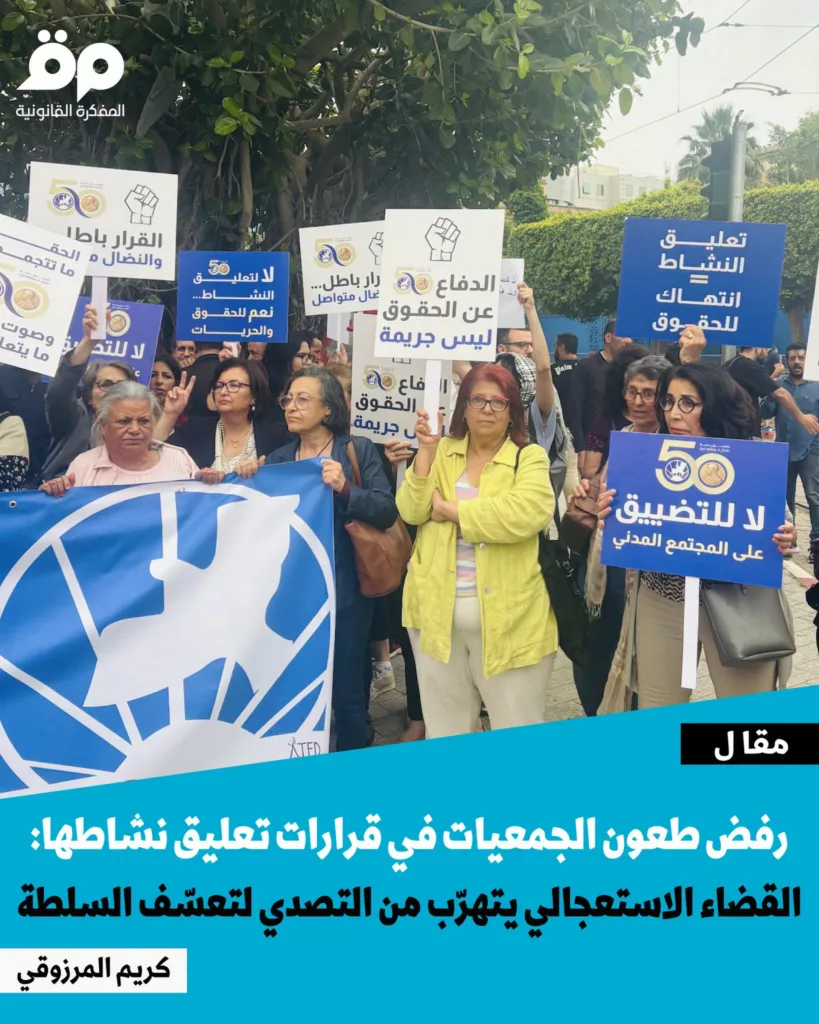
The National Bar Association of Tunisia (ONAT), the Tunisian League for the Defense of Human Rights (LTDH), the National Union of Tunisian Journalists (SNJT), the Tunisian Forum for Economic and Social Rights (FTDES), and the Tunisian Association of Democratic Women (ATFD) have joined this movement.
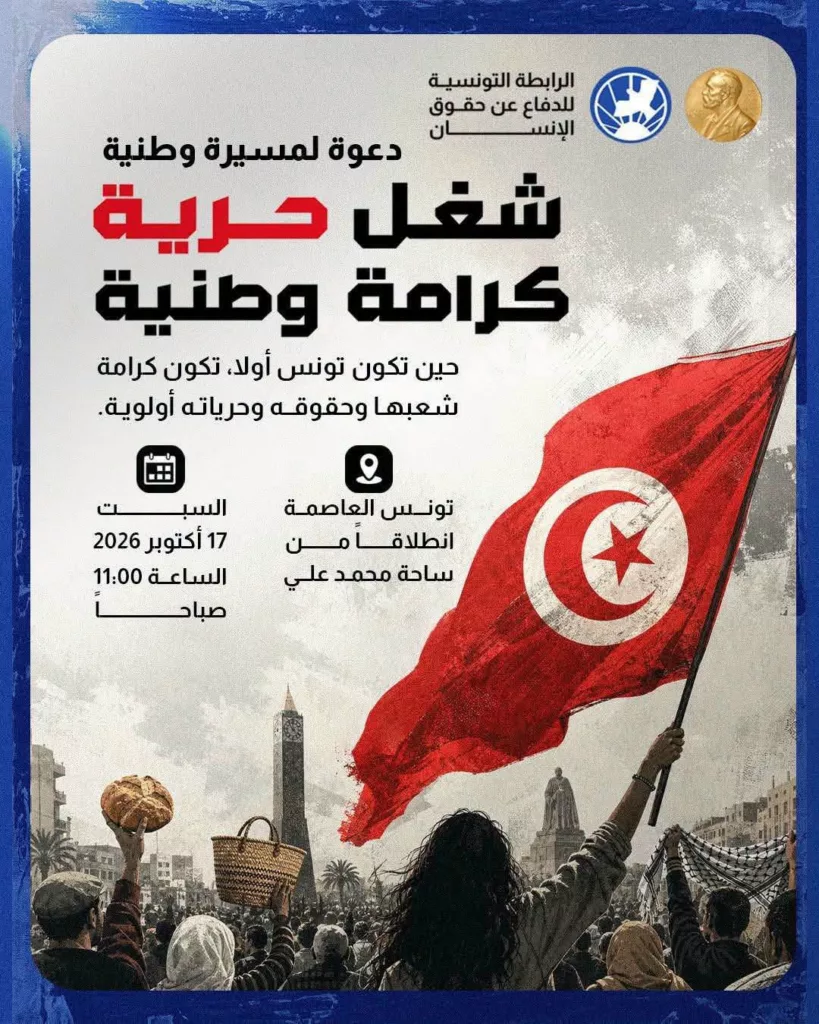
On Saturday, September 19, 2026, several hundred people marched in Tunis, starting from the headquarters of the National Union of Tunisian Journalists, to demand the release of prisoners and respect for the right to show solidarity with Palestine.
Wael Naouar ended his hunger strike on Wednesday, September 23, 2026, after thirty-eight days, due to health risks and appeals from his family, his lawyers, and national organizations. Ghassen Boughdiri did the same on Friday, October 2, 2026, after twenty-three days on hunger strike and a hospital admission on Wednesday, September 30, 2026.
After the march: the shift toward cracking down on solidarity
The march on September 19, 2026, was supposed to be a moment of unity. Instead, it became the starting point for a new wave of repression.
On the night of Sunday, September 20, through Monday, September 21, 2026, participants were arrested at home, on the street, or while out and about. An entire family was targeted; the two daughters were later released. The initial period was marked by uncertainty regarding the locations of detention, the specific reasons for the arrests, and whether lawyers would actually be granted access.
Those facing prosecution are charged with offenses related, in particular, to participating in a gathering, publicly chanting slogans and singing songs, making allegations against public officials or institutions, and defamation. Yet this is precisely the issue at hand: Can political slogans and the collective exercise of the right to protest serve as grounds for depriving someone of their liberty?
On Monday, September 21, 2026, the UGTT, ONAT, and LTDH issued a joint statement. They condemned arbitrary arrests, procedural violations, and a serious infringement on the freedoms of assembly and demonstration.
The protests are also spreading to the regions: rallies are taking place in Gafsa, Mahdia, Sousse, Béja, and the capital, among other places, while solidarity events are also being held in France.
AdEm Mbarek: A High School Student Caught Up in the Wave
Adem Mbarek’s arrest lends the case particular significance. Adem is seventeen years old. A ninth-grade student at Raoued High School, he is a member of the Mouvema collective, which grew out of a youth initiative in Ariana.
His friends and family describe him as a teenager actively involved in his neighborhood: cultural activities, photography, video editing, graffiti, raising awareness about addiction, cleanup efforts, and advocacy work related to the coastline and pollution. In particular, he helped organize the Touiza des Marges festival, which aims to provide a platform for young artists from working-class neighborhoods.
According to Mouvema and his attorneys, Adam was arrested at his home at dawn on Monday, September 21, 2026, after several police vehicles arrived. His father accompanied him to the Aouina police station. His family and his defense team allege that he was made to wait for a long time without food or water, that he was initially prevented from communicating freely with his loved ones and his lawyer, and that he was subjected to mistreatment and pressure during questioning. These allegations have been raised by the association and the defense team; no detailed official response has been made public regarding them.
On Friday, September 25, 2026, Adem was brought before the juvenile court judge and placed in custody. His case involves Articles 79, 128, 220 bis, 245, and 247 of the Tunisian Penal Code, which pertain in particular to public gatherings, public slogans, and accusations against public officials. His next hearing is scheduled for Monday, October 6, 2026. The juvenile court judge ordered his release.
The fact that a minor is being deprived of liberty following a march publicly organized by major national organizations is the real scandal. The juvenile justice system should treat detention as the exception and prioritize the protective and supportive measures provided for under Tunisian law.
From Arrests to Convictions
A wave of arrests targeted participants in this protest. Among them were Hadhami Hammami, Meriem Halfaoui, Marouen Bedhiafi, Mounir Ayadi, Kaïs Bouzouiza, Khalil Laabidi, Thouraya Chtiba, Rachid Othmani, Ghaith Hamrouni, Souhail Chebbi, Adel Ben Ghazi, and other activists. Adem Mbarek was released on October 6; Hadhami Hammami and Meriem Halfaoui were sentenced on October 8 to six months’ suspended prison terms, Marouen Bedhiafi to seven months’ suspended prison term, and Mounir Ayadi was also released. On October 12, Kaïs Bouzouiza, Khalil Laabidi, and Thouraya Chtiba were in turn released after receiving suspended sentences—one year, eight months, and eight months, respectively, according to information provided by the defense committee. Rachid Othmani, however, remained in custody as of the latest available information. These releases are a relief for the families, but they cannot obscure the fundamental issue: citizens were arrested, imprisoned, and sentenced for exercising their right to demonstrate peacefully and express their solidarity with prisoners and with Palestine. Regaining their freedom does not put an end to the injustice; on the contrary, it requires the dismissal of all charges and the release of all those still in detention.
What *Soumoud* Reveals About Tunisia Today
The Soumoud flotilla case is unfolding against a backdrop in which the Tunisian judiciary can no longer be considered independent. It has been gradually weakened and placed under pressure from the executive branch.
That is why the mere opening of a financial investigation cannot, on its own, dispel doubts. Any accusation must be based on serious, verifiable facts that are examined in a fair trial. The rights of the defense, the presumption of innocence, and the exceptional nature of pretrial detention must be fully respected.
There is also a legitimate concern: that this case will serve as a pretext to neutralize and discredit an activist movement that has succeeded in mobilizing Tunisian and international public opinion against the genocide in Gaza, and in concretely underscoring the need to break the siege imposed on the Palestinian people.
The government cannot invoke public order to silence any dissenting voice. It cannot use a peaceful march, slogans, solidarity with prisoners, or support for Palestine as grounds for arrest, prosecution, and imprisonment.
Making civic expression a crime instills fear in society and sends the same warning to everyone: keep quiet, or risk going to prison.
What is striking is the gradual broadening of the target: first, the leaders of the flotilla; then, the hunger strikers; after that, those who support them; and finally, a teenager actively involved in his neighborhood.
The question now faces all of Tunisian society: Is it still possible to defend Palestine, demand the release of prisoners, and demonstrate peacefully without risking arrest, imprisonment, and stigmatization?
The answer to this question concerns the right of every citizen—male or female—to participate in public life, to defend a just cause, and to refuse to allow solidarity to become a crime.
Freedom for the Soumoud flotilla activists!
Freedom for everyone arrested following the September 19 march!