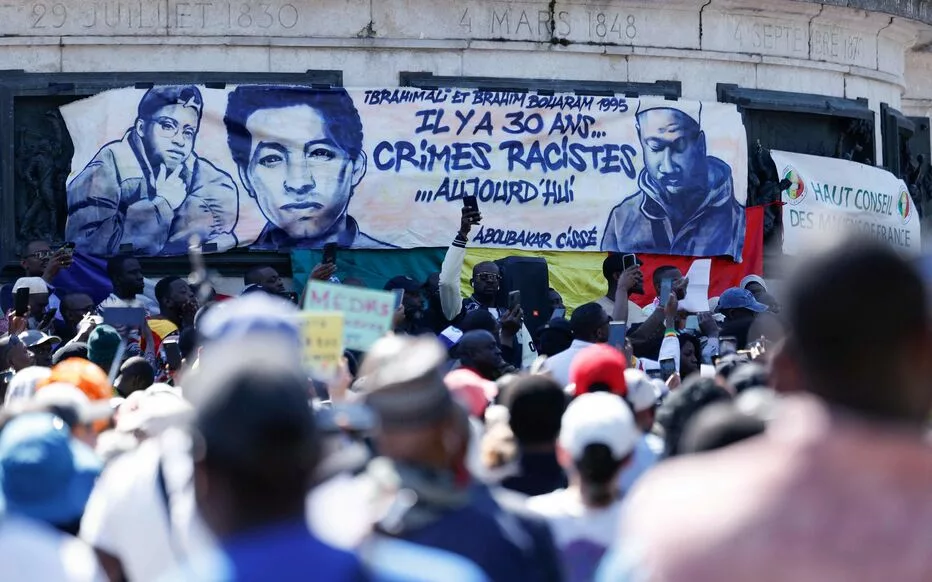
The murder of Aboubakar Cissé, a 22-year-old man stabbed to death while praying alone at a mosque in La Grand-Combe, Gard, was a turning point. It is not just the racist act of a deranged individual: it is the most brutal expression of a political and media climate in which Islamophobia, far from being marginal, is systemic, instrumentalized and legitimized at the very top of the State.
This is a scream. A cry from the belly. A cry stifled for too long.
The French authorities refused to qualify the act as terrorist. They dismissed the Islamophobic motive, preferring to insist on the killer's mental health. This recurring posture reflects the official denial of Islamophobia. At a time when attacks, insults and discrimination against Muslims are exploding, the authorities continue to deny its structural roots.
This denial is part of a colonial continuum. The Muslim is still seen as a body to be monitored, forcibly integrated or rejected. The law "against separatism", the arbitrary dissolution of associations such as the CCIF or Barakacity, the closure of mosques, the S files - all these are part of a neo-colonial logic in which populations of immigrant origin are treated as suspect subjects. In reality, what is described as "separatism" is nothing other than the political, spiritual or associative autonomy of Muslims.
This logic of exclusion is not new. As long ago as 2004, the law banning conspicuous religious symbols in public schools targeted the wearing of the headscarf. Behind its declared universalism, this law helped to exclude young Muslim girls from school in the name of a misguided secularism. Twenty years later, the circular against the abaya follows the same line: a sartorial obsession that poorly masks a policy of racializing Muslim bodies. These measures protect neither women nor secularism: they assign, stigmatize and exclude.
And now, a new bill, tabled in the Senate, would prohibit girls under 15 from wearing the veil. Under the guise of "child protection", the law would infantilize, disqualify and dictate to teenage girls what they should wear, think and believe. Their subjectivity is trampled underfoot in the name of a Republic that regards them first and foremost as dangers.
This text does not defend Islam. It defends true secularism. One that protects and guarantees the freedom to believe or not to believe. The kind that doesn't impose, stigmatize or legislate against clothing. It does not designate an enemy within.
It's a symbolic war. A war against Muslim bodies, identities and freedoms.
The proposed law on the "Muslim Brotherhood" is part of this dynamic: designate a vague and shifting internal enemy, foster fear, and reinforce the tools of control. This bill, like the anti-terrorism laws that preceded it, aims to criminalize Muslim commitments and solidarity with oppressed peoples, particularly Palestine.
This criminalization is not isolated: it goes hand in hand with an ideological alliance between the Western right and the Zionist project, against a backdrop of civilizational war. While anti-Zionism is equated with anti-Semitism, any criticism of Israeli policy is seen as a sign of radicalism. At the same time, Islamophobic violence in France is relativized, depoliticized and depersonalized.
It's not a drift. It's a system.
Human rights defenders must reject this trap. Fighting Islamophobia is not about supporting an ideology: it's about defending a fundamental principle of equality. It means naming violence. It means refusing to trivialize a murder like that of Aboubakar Cissé. It means refusing to let Muslims become the scapegoats of a Republic that has renounced universalism.
This text is a cry for Aboubakar. A cry for those who are humiliated, denuded and excluded. A cry for the families we criminalize, for the mosques we close, for the children we teach to hate in the schoolyard.
Fighting Islamophobia cannot and must not be done without a clear and unambiguous condemnation of anti-Semitism. But rejecting anti-Semitism cannot justify its political instrumentalization. It is no honor to the memory of the victims of the Shoah to falsely accuse anti-colonial activists or Muslims of anti-Semitism as soon as they denounce the crimes of the Israeli state. It weakens the fight against all forms of racism. It's divide and conquer.
It's time to take a decolonial look. Name Islamophobia as specific racism. Recognize its historical roots. Denounce political and media complicity. Defend freedom of conscience and organization. And honor the memory of Aboubakar Cissé not in silence, but in resistance.
As Louisa Yousfi writes, we must "remain barbarians". In other words, we must refuse to integrate into a narrative that denies us. To refuse the façade of civilization that excludes, oppresses and dehumanizes. To reclaim our struggles, our anger, our voices, our memories. Remaining barbaric means refusing to remain silent. It means responding with dignity.