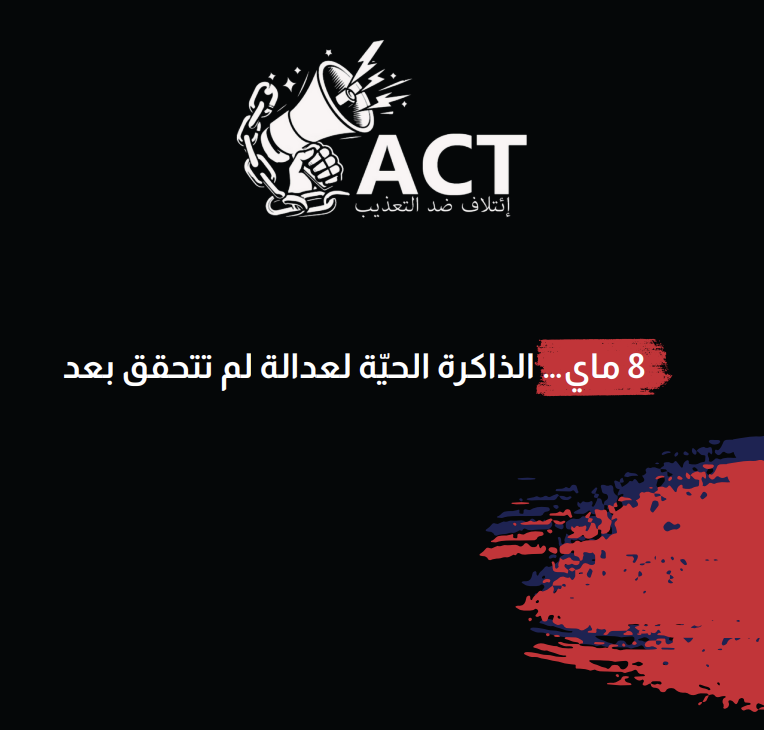
Report by the coalition against torture
In Tunisia, May 8 is no ordinary day. It commemorates the martyrdom of Nabil Barakati, an activist murdered under torture in Gaâfour in 1987. For several years, this date has become a symbolic milestone in the fight against torture, supported by civil society organizations and political players keen to pay tribute to the victims, but also to build a collective memory and a plea against impunity. The booklet published in May 2025 by a group of associations, entitled "May 8... the living memory of a justice that has not yet taken place", makes a damning assessment of the persistence of torture and ill-treatment in Tunisia.
Violence that goes beyond the revolution
Despite the hopes raised by the 2011 revolution, torture remains a daily reality, reinforced by a failing institutional system and a lack of political will. Since July 25, 2021, the date of President Kaïs Saïed's authoritarian shift, the country has seen an accelerated dismantling of checks and balances: concentration of executive power, marginalization of Parliament, and attacks on the independence of the judiciary. Decree-Law 54, in particular, has become a tool of repression against freedom of expression, journalists, human rights defenders and opponents.
From places of detention to public spaces: torture reinvents itself
The report explores the many faces of torture, whether in prisons, police stations, public spaces or in people's homes. Suspicious deaths in custody are multiplying, often filed "against X", without serious investigation. Detention conditions are described as inhuman: overcrowding, lack of medical care, systematic mistreatment, particularly of women.
Poignant testimonials describe how physical violence is accompanied by humiliation, deprivation and social stigmatization. The case of "Amel", a woman repeatedly harassed, arrested, beaten and humiliated since her teens, illustrates the psychological and generational cost of this state violence.
No one is immune: fans, minorities, ordinary citizens
One of the document's major contributions is to demystify the classic image of the "militant victim of torture". The repressive system now targets whole sections of the population:
- Soccer fans, especially ultras, are regularly arrested, assaulted or prosecuted for expressing their anger in stadiums.
- LGBTQI+ people, prosecuted under Article 230 of the Penal Code, humiliated, beaten and imprisoned for their sexual identity or orientation.
- Residents of working-class neighborhoods, often stigmatized as "criminals by default", prey to brutal and arbitrary police raids.
Institutionalized, normalized, unpunished violence
What the booklet highlights is the structural nature of torture in Tunisia: a system that is not content to use violence on an ad hoc basis, but produces and reproduces forms of domination, humiliation and erasure of the individual. Judicial procedures are often biased, victims deprived of effective recourse, lawyers prevented from exercising their role, judges sometimes complicit or powerless.
The stories we've collected show a justice system that's absent, a state apparatus that's hostile to its citizens, and a society where fear has become a way of governing.
A coalition against oblivion and impunity
Faced with this situation, a collective of organizations - including the Tunisian Human Rights League (LTDH), Damj, Oladna, Africa, Generation Against Marginalization and OMCT's SAND program - decided to act together. On May 8, 2024, they officially launched the "Coalition Against Torture", calling for a collective, feminist, intersectional strategy combining documentation, psychological support, strategic litigation and citizen mobilization.
A memory that calls for action
This booklet is not an administrative report. It is a cry, an archive of pain, a structured denunciation, but also a promise of struggle. It reminds us that as long as torture persists - whether in a cell, on a sidewalk, or through a decree - the revolution of 2011 remains incomplete.
May 8 is not just a day of commemoration. It is a duty of transmission, a call to break the silence, and to make the memory of victims the foundation of a fairer future.