In a particularly well-researched article published on June 29, 2026, under the title “Between Criminal Reconciliation and Exile Abroad… Where Have the Tunisian Businessmen Gone?”, https://tunisie-telegraph.com/news-tunisie-%d8%a3%d8%ae%d8%a8%d8%a7%d8%b1-%d8%aa%d9%88%d9%86%d8%b3/%d8%a8%d9%8a%d9%86-%d8%a7%d9%84%d8%b5%d9%84%d8%ad-%d8%a7%d9%84%d8%ac%d8%b2%d8%a7%d8%a6%d9%8a-%d9%88%d8%a7%d9%84%d9%87%d8%b1%d9%88%d8%a8-%d8%a7%d9%84%d8%ae%d8%a7%d8%b1%d8%ac/?fbclid=IwZnRzaASvRLBleHRuA2FlbQIxMQBzcnRjBmFwcF9pZAo2NjI4NTY4Mzc5AAEeQFHGrYUKrZhH6pvR6mwuhJLUA5X9jsMmsdz2hVgTebQvltt4cLtD0BSamrQ_aem_R_l_Q-RNFKmAHMxh6MQ2Sg
Tunisie Telegraph reports a troubling trend: as the government revives the criminal reconciliation process, the number of business leaders who have chosen to relocate outside Tunisia continues to rise. The investigation identifies numerous executives who have settled in the United Arab Emirates, France, Morocco, or other countries, while others are appearing in court, are in custody, or are attempting to negotiate a resolution to their legal status.
This investigation invites us to look beyond the mere succession of court cases and ask a more fundamental question: How did a country that, after the revolution, sought to stabilize its economy end up seeing some of its wealth creators leave?
This question relates directly to the report of the National Commission of Inquiry into Corruption and Embezzlement, chaired by Professor Abdelfattah Amor, which was submitted in November 2011. This seminal document of the transition took stock of the organized corruption system under the Ben Ali regime. It documented nearly 11,000 complaints, the review of more than 5,000 cases, and the referral of more than 400 cases to the courts. The report detailed the predatory mechanisms that allowed the presidential clan and a select circle of privileged businessmen to appropriate a significant portion of the national economy.
In fact, it was on the basis of this report that Kaïs Saïed developed his “criminal reconciliation” plan, asserting that 460 businesspeople owed the state nearly 13.5 billion dinars, which could be recovered to finance development projects in marginalized regions.
With this in mind, on March 12, 2024, members of the National Commission for Penal Reconciliation were sworn in before Kaies Saied, marking the official relaunch of this mechanism, which is presented as one of the main tools for recovering public funds. More than two years later, the head of state continues to assert that “the doors to reconciliation” remain open to those who wish to regularize their situation.
However, the reality we see today seems to be gradually drifting away from the original goal.
Prosecutions no longer target only the identified beneficiaries of the Ben Ali regime. They now involve business leaders from very different generations, sectors, and backgrounds, many of whom expanded their businesses after the revolution. By cross-referencing cases made public since 2021 , it is estimated that nearly 150 businesspeople—including executives of private conglomerates and company leaders— have been directly affected by arrests, pretrial detention, criminal prosecutions, travel bans, asset forfeitures, or forced departures abroad. This estimate does not claim to be exhaustive, but it illustrates the scale of a phenomenon that has become structural.
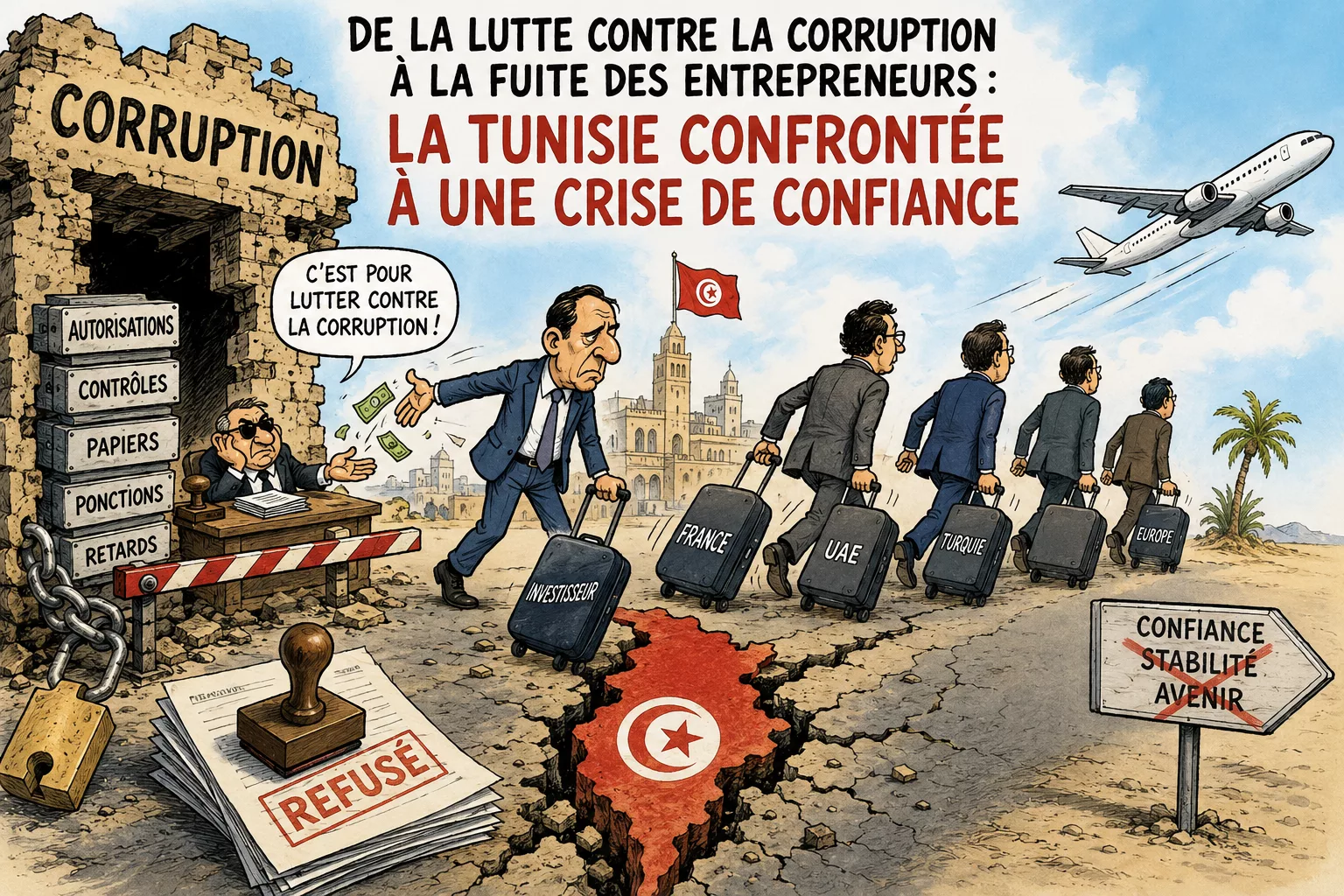
The paradox is now clear. While the government is urging businesspeople to return and reconcile with the state, a growing number of them are instead choosing to move their residences, investments, or businesses to Dubai, Paris, Casablanca, or other economic hubs considered safer.
A Silent Exodus
For several years now, Tunisia has been experiencing a phenomenon that has rarely been analyzed in its full scope: the gradual departure of some of its leading entrepreneurs.
The United Arab Emirates, France, Morocco, Kuwait, and other countries are now hosting several leading figures from the Tunisian business world.
The situations vary. Some are facing legal proceedings. Others were convicted at the trial court level but were acquitted on appeal. Still others have never received a final conviction but prefer to wait for the political situation to change before considering a return.
This movement does not merely reflect the desire of a few to evade justice. Above all, it reveals a profound crisis of confidence in the stability of the legal and economic framework.
When Uncertainty Becomes an Economic Risk
Criminal settlement was intended to resolve certain disputes while ensuring the repayment of sums owed to the government. However, the process has remained largely unfinished.
At the same time, legal proceedings against business leaders have increased, pretrial detentions have been extended, and financial penalties have in some cases reached unprecedented levels.
Under these circumstances, investors are no longer merely concerned about the amounts they might have to repay. They are concerned about the predictability of the rules, the independence of the courts, and the legal certainty of their investments.
For an economy, uncertainty is often more destructive than the penalty itself.
Prisons are filling up, investments are evaporating
At the same time, several prominent figures in the private sector are currently in custody or facing prosecution in cases involving financial corruption, money laundering, or public procurement.
Marouane Mabrouk, Ridha Charfeddine, Nejib Ben Ismaïl, Maher Chaâbane, and Habib Houas are among the cases that have received the most media attention.
Other businessmen were released on bail, with the amounts sometimes reaching tens of millions of dinars: Hatem Chaâbouni, Ahmed Abdelkefi, Abdelaziz Makhloufi, Abdelrahim Zouari, and Hussein Deglaoui.
These cases illustrate the scope of the legal proceedings brought against the Tunisian business community.
They also show that the line between criminal justice, financial regulation, and negotiations with the government can sometimes be difficult to discern.
An economy lacking confidence
The problem goes far beyond individual cases. For several years now, private investment has been stagnant. Foreign direct investment is declining. Young entrepreneurs are starting their companies outside Tunisia. Startups are establishing their headquarters abroad. Industrialists are hesitant to launch new projects.
The real issue, then, is not just about the businessmen who are being prosecuted. It is about trust. And trust rests on three essential elements:
- an independent and predictable justice system;
- a stable government;
- clear and sustainable economic rules.
When these three pillars weaken, capital naturally seeks out other opportunities.
Reconciliation cannot succeed without the rule of law
The reactivation of the criminal reconciliation commission may be seen as an attempt to revive a process that has so far remained unfinished. Its effectiveness, however, will depend on its ability to operate within a framework that respects judicial safeguards. More broadly, restoring investor confidence cannot rely on this mechanism alone.
Entrepreneurs are not merely seeking the opportunity to negotiate a financial settlement. Above all, they are seeking legal certainty.
They want to be assured that the rules will not change depending on political circumstances, that prosecutions will respect the guarantees of a fair trial, and that court decisions will be handed down by fully independent courts.
More than just an exodus of businesspeople—an exodus of trust
The departure of many entrepreneurs today is a symptom of a crisis that runs much deeper than the business world alone. It is part of a broader trend in which Tunisia is gradually losing some of its driving forces.
In addition to investors who choose to expand their businesses in Dubai, Paris, or Casablanca, there are doctors, researchers, engineers, academics, government officials, as well as thousands of recent graduates—and an increasing number of young people with few qualifications—who leave the country each year in search of opportunities they can no longer find at home.
This series of departures is no coincidence. It reflects a shared loss of confidence in the future, in institutions, and in the country’s ability to provide an environment where initiative, merit, and hard work are protected and rewarded.
The real challenge, therefore, is not simply to convince a few businesspeople to return. It is to rebuild a political, legal, economic, and social environment in which entrepreneurs, researchers, doctors, executives, students, and young workers can once again find reasons to believe in their country and build their future there.
Capital can return. Investment can be revived. Expatriate talent can sometimes be mobilized. But when trust erodes over the long term, it is the very contract between a country and its citizens that is undermined. And that trust is, without a doubt, the resource that takes the longest and is the most difficult to rebuild.