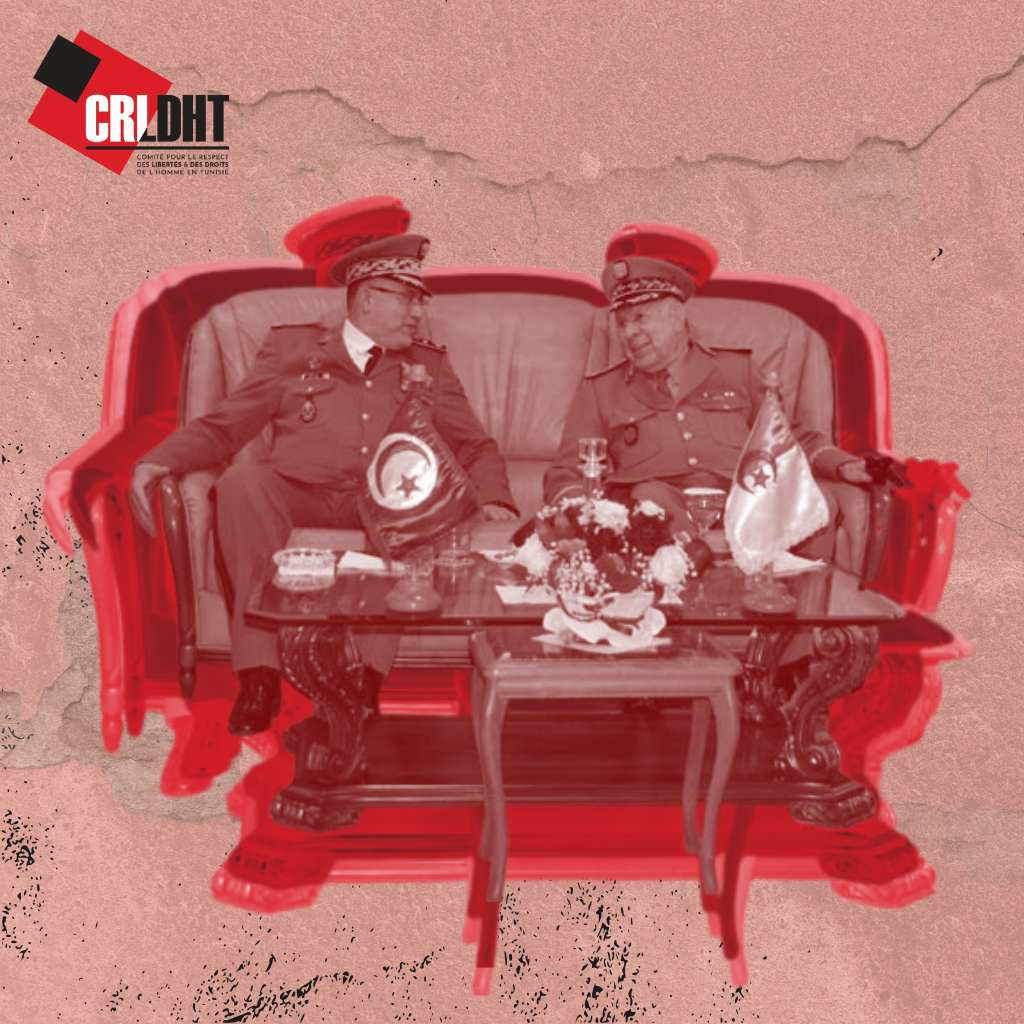
On October 7, 2025, in Algiers, General Saïd Chengriha, Chief of Staff of the Algerian Army, presided over the signing of a military and security cooperation agreement between Algeria and Tunisia. The Tunisian delegation, led by Defense Minister Khaled Shili, travelled to the Algerian capital in the greatest secrecy.
No official communication followed. It was the Algerian press that revealed the information, confirming what many observers sensed: a strategic turning point in relations between Algiers and Tunis.
A silent alliance
Neither Carthage nor the Tunisian Ministry of Defense commented on the signing. The text has not been published in the Official Journal, nor submitted to Parliament. This unusual silence contrasts with the breadth of the agreement's supposed content.
According to press reports, the plan includes the following:
- a permanent exchange of military and intelligence information;
- joint patrols and manoeuvres in border areas;
- integrated border control to combat smuggling and irregular migration;
- cross-training of officers from both armies;
- and above all, a limited right of pursuit, authorizing Algerian units to penetrate up to 50 kilometers inside Tunisian territory during joint operations against terrorist groups.
Even more disturbing: an exclusivity clause prohibits Tunisia from concluding security agreements with other partners without the prior agreement of Algiers.
If these provisions are correct, they mark an unprecedented break in the doctrine of Tunisian sovereignty.
An explosive context
This signing does not come in a vacuum. Since 2022, Tunis and Algiers have been forging closer ties, against a backdrop of regional instability and Tunisia's growing isolation.
At the time the agreement was signed, the region was rocked by drone attacks on the Soumoud flotilla in Sidi Bou Saïd, the genocidal war in Gaza and Israeli raids in Lebanon and Yemen.
Algerian President Abdelmadjid Tebboune, alarmed by what he describes as the "military targeting of Algeria", is multiplying his defensive alliances.
For his part, Kaïs Saïed, weakened by a dead-end economic crisis and deprived of solid external support following the halving of American aid, is looking for a regional partner capable of supporting him without political conditions.
Algeria thus appears as a last resort: a supplier of energy, cash and legitimacy. But this dependence comes at a price.
Behind the scenes of an unequal rapprochement
For Algiers, the interest is clear:
- consolidate a buffer zone on its eastern border,
- ensure an operational presence in southern Tunisia,
- and bypass European and American influence in the central Maghreb.
The agreement also gives it access to Tunisian infrastructure - southern ports, energy routes, surveillance networks - and strengthens its position as a regional guardian power, especially after the destabilization of the Sahel and the French withdrawal.
For Tunis, the logic is primarily defensive: to guarantee a security umbrella in the face of the fragility of its institutions and the risk of instability in border areas. But behind this search for protection lies a form of strategic vassalization.
Algeria sets the pace, defines the priorities and imposes the conditions. Tunisia becomes, de facto, an outpost of Algerian defense.
A worrying drift: security versus democracy
Beyond geopolitical calculations, this opaque cooperation raises major institutional and democratic questions.
The absence of any official publication, the refusal of any parliamentary debate and the silence of the presidency reflect a serious lack of legitimacy.
This type of agreement, which directly affects national sovereignty and security, cannot be decided in the secrecy of staff offices.
Recent history reminds us that the militarization of public affairs and the concentration of power in the hands of the executive further weaken a state already weakened by the economic crisis and citizen disaffection.
There is also the risk of authoritarian drift: transfer of information on activists, increased surveillance of NGOs, extension of the anti-terrorist field to social protest.
Tunisia in the Algerian camp?
This alliance also reflects a profound geopolitical repositioning.
Kaïs Saïed seems to have broken with Tunisia's traditional policy to refocus on a closed regional axis, dominated by Algiers and, in the background, a discreet rapprochement with Teheran.
The Maghreb is now divided:
- On the one hand, the Algiers-Tunis-Tehran axis, based on sovereignty and hostility to NATO;
- on the other, Rabat, Cairo and West Tripoli, all tied to the Western powers.
This polarization reinforces the isolation of Tunis, now perceived as aligned with the Algerian camp, and further weakens its relations with Europe, particularly Italy, whose migration agreements are likely to be called into question.
Sovereignty, security and rights: a fragile triangle
It would be illusory to deny the need for regional security cooperation. But such a partnership must be based on balance, transparency and reciprocity.
If it is confirmed that Tunisia has granted its neighbor a right of operational interference and exclusive defense rights, it is not only its military sovereignty that is at stake, but also the independence of its political destiny.
Security is not an argument for erasing democracy.
And sovereignty cannot be reduced to the survival of a weakened power: it belongs to an entire people, not to those who negotiate it in secret.
If it's classic cooperation, let's publish it.
If it's an exceptional commitment, let's discuss it.
Silence doesn't protect national security - it undermines public confidence.
In a region where the boundaries of legitimacy and sovereignty are becoming increasingly blurred by the day, Tunisia cannot afford to be a territory under tutelage.
Security is not built in the shadows: it is founded on trust, transparency and national dignity.