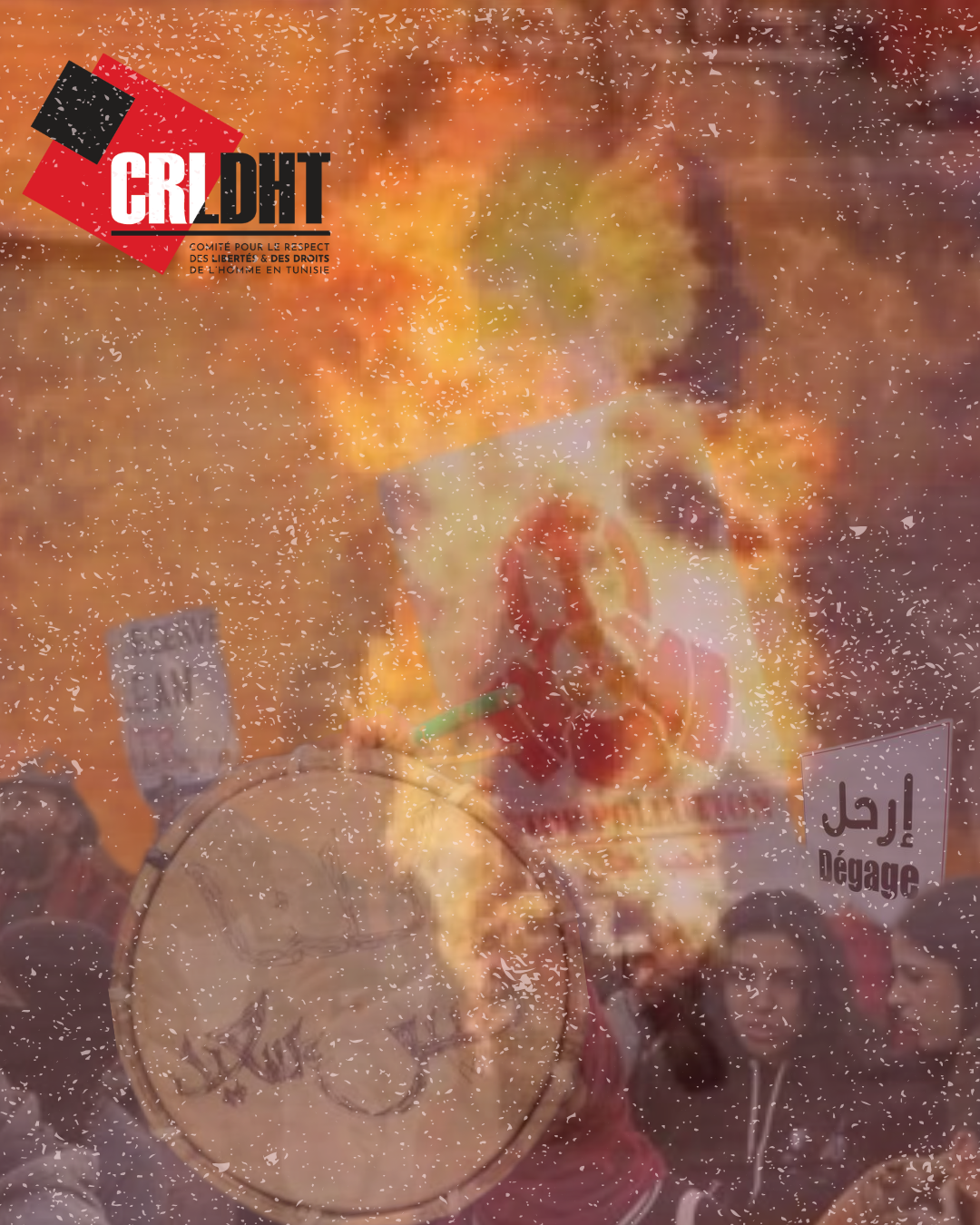
December 17, 2025 was not a unanimous commemoration. It was a day of divisions, revealing a Tunisia riven by anger, expectations, and conflicting uses of the streets. Above all, it was part of a specific political sequence: four consecutive Saturdays of successful demonstrations, particularly in Tunis, which brought freedoms, the independence of the judiciary, and an end to arbitrariness back to the center of public debate.
It is this dynamic that those in power have sought to curb, not through dialogue or political responses, but through the opposite approach: fabricating a show of support, then transforming it, through a semantic shift with far-reaching consequences, into a "popular mandate" supposedly authorizing a general acceleration of state action.
However, this shift poses a major political problem and, even more so, a fundamental legal problem.
Before December 17: four Saturdays that contradict the official narrative
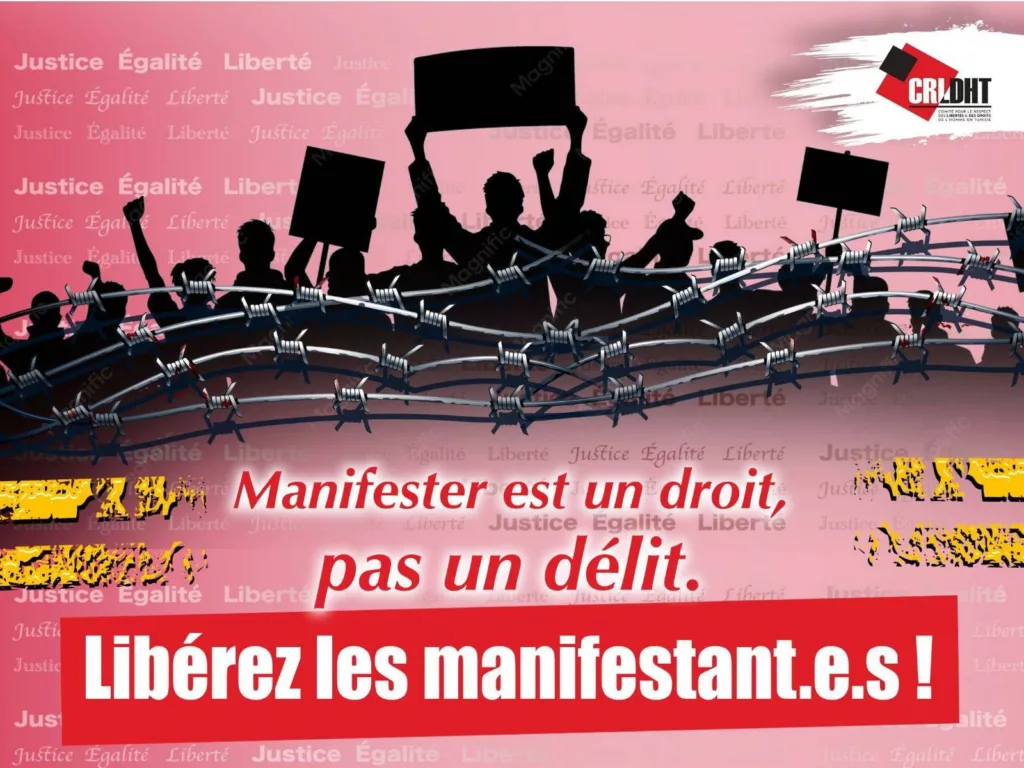
The rallies on December 17 did not arise in a political vacuum. They were preceded by four consecutive Saturdays of citizen mobilizations, organized despite a climate of fear, judicial intimidation, and repression.
These marches, far from being marginal, have shown:
- the reappearance of a pluralistic street, not controlled by the State;
- the centrality of clear demands: civil liberties, release of prisoners of conscience, independence of the judiciary;
- a continuity that contradicts the idea of a united or silent people.
From the perspective of constitutional and international law, these demonstrations are entirely consistent with the normal exercise of the right to peaceful assembly, which is guaranteed both by the 2022 Constitution and by the International Covenant on Civil and Political Rights, ratified by Tunisia. No authority can therefore legally disqualify them as "disorder," "treason," or "conspiracy" without violating its own normative commitments.
December 17 in Tunis: a demonstration turned into a "mandate"
The government has already made a symbolic decision: to designate December 17 as the "date of the revolution," instead of January 14. This is not a minor calendar detail: it is a rewriting of history. And December 17, 2025, becomes the perfect tool: to multiply images of "unity" and drown out the plurality of anger in a single narrative.
On December 17, in Tunis, a demonstration in support of Kaies Saied and the process resulting from the constitutional coup of July 25 was organized on Habib Bourguiba Avenue. The official support for this mobilization was acknowledged after the fact by the presidency, which successively described it as a "صفعة" (slap) and then a "صفعة تاريخية" (historic slap), before seeing it as the expression of a "popular mandate."
This is where the legal break occurs.
1. The "popular mandate" does not exist in Tunisian constitutional law.
Neither the 2014 Constitution (now repealed) nor the 2022 Constitution recognizes a legal category known as a "popular mandate" arising from a demonstration.
Under the Tunisian constitutional order, the sovereignty of the people is exercised exclusively through specific procedures: elections, referendums, and institutions provided for by the Constitution.
A demonstration—even a massive one—is not a mechanism for delegating power, let alone a general authorization to govern differently, more quickly, or outside the bounds of legal guarantees. To turn it into a "mandate" is to substitute political events for constitutional legality.
In other words: what the authorities present as a legal basis is merely an act of political communication, with no normative value.
2. Administrative neutrality: a violated principle
The controversy surrounding logistics (chartered buses, public or semi-public transportation, mobilization of local administrative networks) is not anecdotal. It touches on the constitutional principle of neutrality of the administration and public services.
According to the 2022 Constitution itself, the administration must serve the public interest in an equal and neutral manner. It cannot be mobilized for the benefit of one political camp, let alone to fabricate a demonstration of legitimacy.
If public resources—direct or indirect—have been used to facilitate a demonstration of support, while other mobilizations face obstruction, surveillance, or repression, then there is a breach of equality and a misuse of public power.
This issue also raises questions of criminal and financial liability, particularly with regard to the rules governing the use of public resources and public enterprises and the principle of non-partisan allocation of state resources.
On the same day, other streets, other legitimacies
Gabès: the street to live on
In Gabès, December 17 takes on a radically different meaning. Thousands of citizens march to demand an end to industrial pollution, the right to a healthy environment, and dignity.
Here, the street is not a backdrop for legitimizing power: it is a direct challenge to the state, based on recognized rights—the right to health, to life, to a healthy environment.
Legally, these demands fall within the positive obligations of the Tunisian state, derived from both the Constitution and ratified international conventions. Ignoring them, or relegating them behind abstract discourse on "سيادة" (sovereignty), constitutes a failure of the rule of law, not a neutral political choice.
Kairouan: anger over impunity
In Kairouan, the day is marked by anger over the death of Naïm Briki in circumstances involving police violence.
The ensuing protests and accompanying arrests raise a central question: that of the use of force, the responsibility of state agents, and impunity.
However, Tunisian law, like international law, requires:
- an effective, independent, and impartial investigation;
- proportionality in maintaining order;
- the protection of the right to protest, even in a tense environment.
Once again, talking about a "popular mandate" while families are demanding truth and justice reveals a stark disconnect between official rhetoric and legal reality.
Deleting the four Saturdays: a politically futile, legally unfounded attempt
By invoking a "popular mandate" stemming from December 17, the government is seeking to achieve a specific effect: to erase the previous sequence of events, delegitimize critical protests, and justify a phase of tougher measures—announced by the phrase "maximum speed."
But legally, this attempt fails on all counts:
- a demonstration does not create a mandate;
- "Speed" is not a constitutional regime.
- No mobilization, even on a massive scale, justifies the suspension of freedoms, the neutralization of justice, or the exploitation of the administration.
Even if the figures had been ten times higher, the reasoning would be the same: the rule of law does not function by acclamation.
December 17 reveals the true dividing line
December 17, 2025 did not prove the unity of the people. It revealed the depth of the divide:
- between a street staged to legitimize power,
- and streets demanding rights, justice, air, life.
In law as in politics, sovereignty is not proclaimed, it is exercised within specific frameworks, with clear limits.
Transforming a supervised demonstration into a "popular mandate" is crossing a dangerous line: the line where rhetoric claims to replace the Constitution.
Yet Tunisian history is clear on one point: every time those in power have confused the streets with a blank check, they have paved the way not for stability, but for the next crisis.