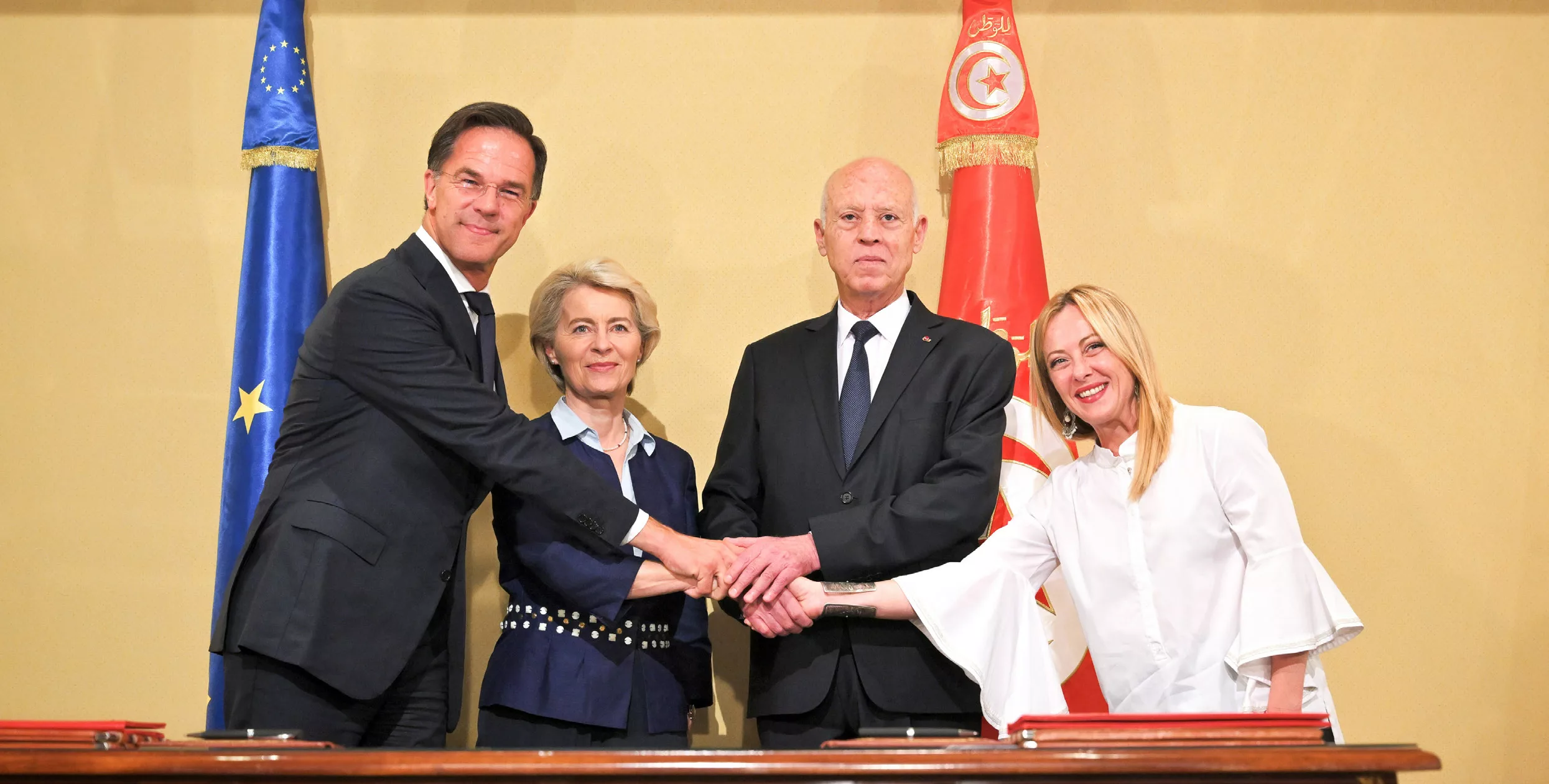
Three years after the signing, on July 16, 2023, of the memorandum of understanding between Tunisia and the European Union, the result is a policy that has turned the migration issue into a tool of repression, both in Tunisia and at Europe’s borders.
Presented as a strategic partnership based on cooperation, mutual respect, and Tunisian sovereignty, this memorandum has turned out to be, above all, an agreement to outsource European migration control. In exchange for political, financial, material, and technical support, the Tunisian authorities were encouraged to act as border guards for the European Union, in disregard of the fundamental rights of migrants, international refugee law, and civil liberties in Tunisia.
This memorandum is not merely a migration agreement. It has become a tool for political legitimization and the consolidation of authoritarian rule. By making the reduction of departures to Europe the top priority of their cooperation, European institutions have sidelined the very principles they claim to uphold: human rights, civil liberties, the independence of the judiciary, and freedom of association.
The past three years thus show that migration control has not simply been entrusted to a third country. It has been integrated into a broader system that combines border security, institutional racism, the repression of civil society, the criminalization of humanitarian action, and the weakening of democratic oversight mechanisms.
The presidential statement of February 21, 2023: a turning point
The signing of the memorandum did not take place in a political vacuum. It was preceded by the presidential statement of February 21, 2023, in which migrants from sub-Saharan Africa were portrayed as a threat to Tunisia’s demographics, security, and national identity.
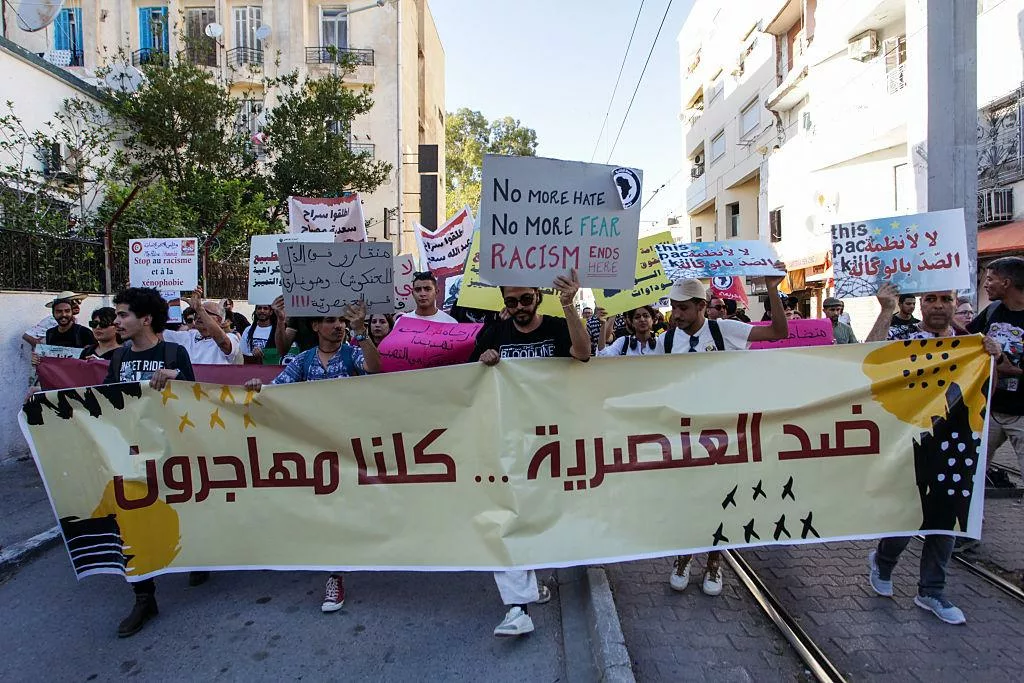
This speech, which echoed the conspiracy theories surrounding the “Great Replacement,” marked a major turning point. It provided political legitimacy for hate speech, discrimination, and racist violence. It helped turn women, men, and children into scapegoats for the country’s economic and social crises.
Coming from the highest levels of government, these words gave free rein to and normalized racism that was already present in society. Black people were assaulted, evicted from their homes, fired from their jobs, denied access to transportation, excluded from essential services, or forced into hiding. The lack of an effective response to this violence has further normalized it and allowed it to go unpunished.
Far from combating racist rhetoric, the government has enshrined it at the heart of its immigration policy. The rights-based approach has been replaced by a mindset of suspicion, surveillance, and repression. Migrants are no longer viewed as individuals with rights, but as a threat that must be kept at bay, detained, deported, or prevented from reaching Europe.
Raids, mass deportations, and abandonment in the desert
Since 2023, the situation for sub-Saharan migrants has continued to deteriorate. Raids, arbitrary arrests, forced displacement, confiscation of property, collective expulsions, and abandonment in border areas have become increasingly common.
Thousands of people have been forcibly displaced from Tunisian cities to the borders with Libya or Algeria, sometimes without water, food, medical care, or any means of recourse. Pregnant women, children, unaccompanied minors, sick people, and victims of human trafficking have been exposed to extreme heat, hunger, violence, and death.
In July 2026, independent United Nations experts reported on a possible organized system of arbitrary detention, collective expulsions, and human trafficking along the border between Tunisia and Libya. According to information brought to their attention, more than 7,400 people from sub-Saharan Africa have reportedly been victims of these practices since June 2023.
The testimonies collected describe beatings, mistreatment, the use of electric shocks, iron bars, and dogs, as well as threats with firearms. They also report humiliating searches, the confiscation of phones and identification documents, deprivation of food, and insufficient access to medical care.
United Nations experts also expressed deep concern over reports of torture, cruel, inhuman, or degrading treatment, deaths in custody, and enforced disappearances. They called on Tunisia and Libya to conduct prompt, independent, and impartial investigations, identify those responsible, and ensure that victims have access to effective remedies.
The evidence gathered suggests that people deported from Tunisia were handed over or sold to Libyan groups and border guards in exchange for money, fuel, narcotics, or other forms of payment. Women and girls were reportedly subjected to sexual exploitation, while men were reportedly forced into forced labor.
This is therefore no longer just a matter of illegal deportations or people being abandoned in the desert. The alleged incidents may be part of a full-fledged cross-border system of exploitation, trafficking, and commodification of human beings.
Four cases before the African Court
For the first time, Tunisia is being called upon to answer before an international court for systematic violations committed against migrants on its territory.
Four petitions have been filed with the African Court on Human and Peoples’ Rights by attorneys from the Associazione Studi Giuridici sull’Immigrazione (ASGI) and by Tunisian attorney Brahim Belguith. The alleged violations include arbitrary detentions, torture, collective deportations, abandonment in the desert, the sale of people to Libyan groups, and acts of violence committed during interceptions at sea.
The four documented pathways all follow the same mechanism.
A Cameroonian national, who had already been trafficked during her journey, claims to have been intercepted at sea by the Tunisian National Guard in 2024 and then detained for more than twenty days in a military camp located in the desert. She was reportedly locked in a cage set up beneath a power pole, deprived of sufficient food and water, before being handed over to Libyan border guards and subjected to sexual violence.
An Ivorian national, who was attempting to enter Tunisia in August 2023 after fleeing the insecurity in Libya, reports that he was arrested, beaten with sticks, belts, and whips, and then abandoned in the desert along with several dozen other people. Two members of his group reportedly died of dehydration and heat exhaustion.
A Guinean national, who set out to sea with forty-six other people in July 2024, claims to have been beaten and robbed after disembarking in Sfax, and then forcibly taken to the desert. He says he witnessed the rape of detained women before being sold to Libyan traffickers, imprisoned, and tortured until his family paid a ransom.
A Sierra Leonean national, a survivor of a shipwreck that occurred on April 5, 2024, off the coast of Sfax, claims that the boat capsized after a dangerous maneuver by the Tunisian coast guard and the firing of tear gas. Several women and children reportedly drowned before his eyes. After being rescued, handcuffed, and beaten, he was allegedly abandoned in the desert before being captured and transferred to a Libyan detention center.
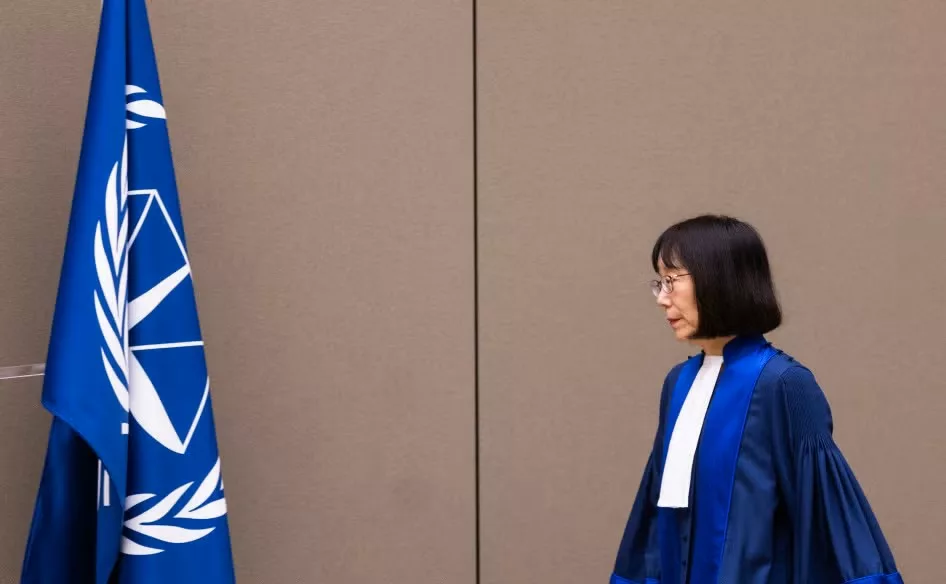
These petitions do not seek to directly establish the individual criminal liability of the perpetrators, as the African Court does not have that jurisdiction. They seek to establish the Tunisian State’s international responsibility for violations of the right to life, the prohibition against torture, the right to liberty and security, the principle of non-refoulement, and the prohibition against collective expulsions.
The lawyers are also calling for structural reforms: legislation consistent with the African Charter and international refugee law; independent mechanisms to monitor detention centers; measures to protect victims; accountability for the authorities involved; an official apology; and a mechanism to monitor the implementation of any ruling.
Appealing to the African Court appears to be a last resort for justice, as victims often lack documentation, financial resources, and any practical means of filing a complaint in Tunisia. The difficulty in accessing the national justice system illustrates the impunity with which these practices can take place.
This procedure is particularly important at a time when the Tunisian authorities have taken measures that make it more difficult for individuals and nongovernmental organizations to have direct access to the African Court. This setback further restricts the avenues of recourse available to victims and human rights defenders.
A subsequent referral to the International Criminal Court cannot be ruled out, but it would require documentation that meets particularly high evidentiary standards. Cases filed with the African Court may thus constitute the first step in a longer-term legal strategy, based on the rigorous gathering of evidence and cooperation between African and European networks.
Solidarity Turned into a Crime
Repressive policies have not only targeted migrants. They have also targeted all those who have chosen to provide them with assistance, shelter, care, legal protection, or solidarity.
Human solidarity has become a crime. Human rights defenders, nonprofit leaders, humanitarian workers, lawyers, and even local elected officials have been turned into suspects and targets of the authorities.
As a result, several members of Tunisian civil society have been prosecuted, imprisoned, or convicted for carrying out work related to humanitarian assistance and the defense of human dignity.
Chérifa Riahi, former director of the organization Tunisie Terre d’Asile, was prosecuted in connection with the organization’s activities in support of migrants and refugees.
Mustapha Jemmali and Abderrazek Krimi, leaders of the Tunisian Council for Refugees, have also been implicated in legal proceedings while providing assistance to refugees and vulnerable individuals.
The former mayor of Sousse, Mohamed Ikbal Khaled, and his deputy, Imen Ouardani, were sentenced to two years in prison after spending more than twenty months facing extremely serious legal charges. The charges against them were related to the shelter and assistance they provided to migrants in their municipality.
Saadia Mosbah, president of the M’nemty association and a leading figure in the fight against racism and the defense of migrants, was sentenced to eight years in prison, a sentence that was upheld on appeal. This conviction constitutes a serious attack on civic activism, the anti-racist movement, and the right to publicly defend the most vulnerable people.
Abdallah Saïd, who has been in custody since November 2024, was sentenced in the first instance to one year in prison. The prosecution’s appeal prolongs the proceedings and maintains constant legal pressure on an activist committed to defending human rights.
Through these cases, the message to civil society as a whole is unambiguous: documenting violations, sheltering a person in distress, providing humanitarian aid, defending a victim, or speaking out against a mass expulsion can now lead to arrest and prosecution.
The equipment, funding, and training provided in the name of “border management” have therefore not only increased migration control capabilities. They have also given authoritarian authorities additional means to monitor, prosecute, and intimidate migrants and those who assist them.
An attack on civil society as a whole
The crackdown on organizations working in the field of migration is part of a much broader offensive against independent civil society.
The report published in July 2026 by the Intersection association, which focuses on violations committed against associations between May 2024 and May 2026, documents 88 cases: 47 incidents targeting associations and organizations, and 41 legal proceedings against association leaders, members, or activists. Seven people had already been convicted in the first instance, while thirty-four others were still facing prosecution.
The report documents arrests, searches, raids on premises, suspensions of operations, freezing of bank accounts, prosecutions for money laundering, collusion, or financial offenses, as well as the prolonged use of pretrial detention.
These procedures are often based on official rhetoric that equates organizational independence, foreign funding, and international cooperation with treason or interference. They aim to paralyze organizations, wear down their leaders, disrupt the services provided to beneficiaries, and impose widespread self-censorship.
Organizations working on migration issues were among the first to be affected, but they are not the only ones. Feminist, anti-racist, electoral, social, economic, environmental, journalistic, and human rights organizations are also subject to various forms of intimidation and administrative or judicial oversight.
The treatment of migrant advocates thus serves as a testing ground for a broader policy of restricting civic space.
The European Union’s Political and Financial Responsibility
This crackdown would not have reached such a scale without the political, financial, material, and technical support provided by the European Union and some of its member states.
By prioritizing a reduction in the number of arrivals on European soil at the expense of respect for human rights, European institutions have helped reinforce a system in which migrants have become tools for political bargaining.
The petitions filed with the African Court emphasize that the alleged violations were made possible—or at the very least facilitated—by the material, technical, and financial support provided by the European Union to the Tunisian authorities. The arguments presented by the attorneys assert liability based both on the funding of border policy and on the European Union’s silence in the face of practices that are, in fact, widely documented.
The plaintiffs and their counsel are therefore calling on the European Union and its member states to cease all cooperation on migration matters that could contribute, directly or indirectly, to the commission of these violations. They maintain that Tunisia cannot be considered either a safe country for migrants or a safe place of disembarkation for people rescued at sea.
Italy has played a central role in this policy by strongly supporting security cooperation with the Tunisian authorities and by making the reduction of arrivals on its shores a priority objective in its relationship with Tunis.
Border control has thus taken precedence over the protection of people. The Mediterranean has been transformed into a zone of surveillance, interceptions, pushbacks, and death.
This partnership also cemented a deeply unequal relationship. Tunisia was transformed into a buffer zone tasked with holding back people whom Europe did not wish to accept, while the migration issue served as a means for the Tunisian government to secure resources, political recognition, and greater leniency in the face of its authoritarian excesses.
Forty-six organizations are calling for the suspension of migration cooperation
On July 16, 2026—the third anniversary of the memorandum—forty-six international human rights and humanitarian aid organizations, including Amnesty International, Human Rights Watch, SOS Méditerranée, and Sea-Watch, called on the European Union to immediately suspend its migration cooperation with Tunisia.
These organizations believe that the memorandum has “fueled and normalized” violations of migrants’ rights. They argue that EU-funded border control measures—including interceptions at sea—expose European institutions to the risk of complicity in serious violations of international refugee law.
In particular, they are calling for the suspension of support for Tunisian security forces involved in deportations, mistreatment, pushbacks, and maritime interceptions.
This call marks a significant shift. It is no longer limited to urging the European Union to better monitor its funding or to include human rights clauses. It directly challenges the legitimacy and continuation of migration cooperation within its current framework.
The Human Cost of Europe's So-Called "Success"
European officials regularly cite the decline in the number of arrivals on European shores as proof of the memorandum's success.
But such “success” cannot be assessed solely on the basis of arrival figures. It must be measured in terms of the people who have died at sea or in the desert, the women who have been victims of sexual violence, the children abandoned at the borders, the people detained and tortured, the lives shattered, and the advocates imprisoned for choosing solidarity.
Behind every statistical decline may lie a violent abduction, a forced return, an arbitrary detention, a disappearance, or a death that will never be recorded.
A decrease in the number of arrivals in Europe is not an indicator of protection. It may be the result of policies that make the routes more dangerous, drive people toward violence, and hide human rights violations from the eyes of the European public.
The memorandum has thus shifted the European border onto Tunisian territory, while shifting the violence and responsibility onto third-party authorities. Europe exercises remote control, funds the measures, and commends the results, while migrants and Tunisian civil society bear the human, political, and legal costs.
Solidarity is not a crime
Three years after the memorandum was signed, the CRLDHT reaffirms that solidarity is not a crime.
Helping a person in distress, providing them with water or shelter, ensuring their legal defense, documenting a violation, speaking out against a mass expulsion, or fighting racism does not constitute a threat to the state. These are human, civic, and legal obligations that must be protected.
The CRLDHT calls on :
- end the criminalization of advocates for the rights of migrants;
- Release Saadia Mosbah, Abdallah Saïd, and all those detained or convicted because of their humanitarian, civic, or anti-racist activism;
- drop the charges against association leaders, humanitarian workers, local elected officials, and human rights defenders;
- put an end to roundups, arbitrary detentions, violence, abandonment in the desert, and mass deportations targeting sub-Saharan migrants;
- launch independent investigations into allegations of torture, enforced disappearances, human trafficking, and the transfer of persons to Libya;
- ensure that victims have effective access to justice, redress, and protection;
- establish independent mechanisms to monitor detention facilities and border operations;
- strictly adhere to the principle of non-refoulement and the obligations arising from the African Charter on Human and Peoples’ Rights, as well as from the international conventions ratified by Tunisia;
- suspend European funding and cooperation that could contribute to human rights violations;
- require the European Union and its member states to make any cooperation with Tunisia contingent on effective, verifiable, and independent guarantees of respect for human rights;
- recognize that Tunisia cannot be considered a safe country or a safe port of disembarkation as long as these violations continue;
- advocate for a different immigration policy based on dignity, equality, justice, freedom of movement, and solidarity among peoples.
Three years after the memorandum was signed, the facts show that this is no longer merely a controversial immigration policy. It is a system that combines the externalization of Europe’s borders, institutional racism, violence against migrants, the suppression of civil society, and the consolidation of authoritarianism.
The Mediterranean cannot continue to be turned into a border marked by violence, exclusion, and death. It must once again become a space of free movement, solidarity, freedom, and respect for human rights.