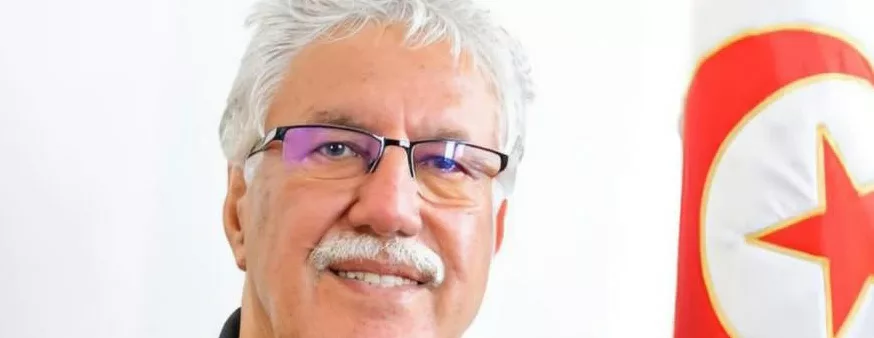
A video lasting a few minutes, which went viral on social media in mid-July 2026, marks a new low in the deterioration of Tunisia’s political climate. Its creator, described as a supporter of President Kaïs Saïed, does not merely insult opponents: he explicitly calls for their execution. Among those targeted is Hamma Hammami, secretary-general of the Workers’ Party.
These remarks are neither political polemics nor mere verbal excesses. They constitute public, explicit, and personally targeted death threats, made openly in front of tens of thousands of internet users.
But beyond their inherent gravity, these calls for murder are part of a broader context: the gradual emergence of a climate of political violence that accompanies the Tunisian regime’s drift toward authoritarianism.
Violence that doesn't come out of nowhere
Since July 25, 2021, the crackdown has gradually spread far beyond the courts and prisons.
Arbitrary arrests, political trials, and convictions of journalists, lawyers, judges, and opposition figures have become increasingly common. At the same time, official rhetoric has gradually portrayed political opponents as enemies of the nation. Opponents are regularly portrayed as “traitors,” “conspirators,” “mercenaries,” or “foreign agents.” This rhetoric does more than simply discredit critical voices; it labels them as enemies whom it would be legitimate to fight.
By systematically criminalizing all opposition, the government creates a climate in which some of its supporters feel they are on a mission to “defend” the president and the nation. The line between verbal violence and incitement to action then becomes increasingly blurred.
Precedents: Violence Fueled by Impunity
The threats against Hamma Hammami did not arise out of nowhere. They are the culmination of a process of normalizing political violence that has been underway for several years.
Since the coup d’état on July 25, 2021, calls for violence against opponents have multiplied without prompting any response from the authorities. Columnists and influencers close to the government have publicly called for opponents to be “beaten up,” arguing that physical violence is a legitimate response to the regime’s adversaries. On social media, hate campaigns have targeted politicians, lawyers, journalists, judges, and human rights defenders. Calls to “eliminate the traitors,” “hang the conspirators,” “clean up the country,” or “finish the job of July 25” have become commonplace.
Prominent figures such as Ahmed Nejib Chebbi, Jawhar Ben Mbarek, Issam Chebbi, Ghazi Chaouachi, Chaïma Issa, Ayachi Hammami, Samir Dilou, Ahmed Souab, Sonia Dahmani, Mohamed Boughalleb, Mourad Zeghidi, Haythem El Mekki, as well as numerous judges and human rights defenders, have been the targets of intimidation campaigns, threats, or calls for violence.
The vast majority of these incidents have gone unpunished. No meaningful legal action has been taken against those who incited violence, even as citizens are routinely prosecuted, arrested, and convicted simply for posting critical comments on Facebook or for the peaceful expression of political opinions. This disparity in treatment has gradually fostered the belief that inciting violence against opponents can be done without legal consequences. Yesterday’s impunity paved the way for today’s violence.
Hamma Hammami: Another Milestone Reached
The Hamma Hammami case, however, marks a particularly troubling turning point.
This is no longer just about calls to “punish” or “beat up” opponents. An individual is publicly calling, with his face uncovered, for the assassination of a specific political leader. He claims to be ready to carry out the act himself, declaring: “Let me kill him,” “I’ll kill that one.” He then extends his threats to other public figures, saying he wants to round them up, chain them together, and execute them.
The individuals in question are labeled “traitors,” “mercenaries,” and “dogs,” using almost the exact same language that has been employed for several years to describe opponents of the government.
This is no longer a political debate. It is an explicit incitement to murder.
A Disturbing Trend Toward Normalization
In light of the seriousness of these threats, Hamma Hammami decided to take legal action.
The Tunisian Human Rights League (LTDH) immediately condemned the release of this video and called on the public prosecutor’s office to launch an urgent, thorough, and independent criminal investigation, to prosecute those responsible for these threats, and to ensure the protection of the individuals targeted.
The Workers’ Party also condemned the fact that this video remains online, arguing that the authorities have taken no action to remove it or to prosecute its creator. The party views this case as part of a broader trend marked by a rise in hate speech and violence against opponents, journalists, civic activists, and union members.
To date, no official response has been made public.
Solidarity that transcends political affiliations
In the face of these threats, solidarity with Hamma Hammami is a matter of principle: no citizen, no political leader, no journalist, no lawyer, and no human rights defender should have to risk their life for exercising their freedom of expression or for their political activism.
The threats against Hamma Hammami affect all members of the opposition and, beyond that, everyone who refuses to let violence replace political debate. In the past, similar campaigns have targeted other opposition figures, journalists, judges, lawyers, and activists. Today, they take the form of public calls for assassination. Tomorrow, if nothing is done to stop them, they could turn into actual acts of violence.
We owe our full solidarity to Hamma Hammami, his family, and all those targeted by these criminal threats. Defending their safety is not about defending one political viewpoint against another; it is about defending the right of every Tunisian woman and man to live, express themselves, and act freely without fear of violence.
Reject the politics of fear
The death threats against Hamma Hammami go far beyond the case of a single political figure. They reveal a troubling trend in Tunisian public life, where the stigmatization of opponents, selective prosecutions, hate campaigns, and calls for violence reinforce one another.
The danger lies not only in the calls for murder themselves. It lies in their repetition, their trivialization, and above all in the impunity enjoyed by those who make them. By failing to punish past incidents, those in power allow a sense of implicit permission to take root. Yesterday’s impunity fuels today’s violence and paves the way for tomorrow’s.
A country descends into political violence when the state imprisons those who challenge the government while allowing those who call for their assassination to thrive with impunity. On that day, it is no longer just freedom that is in danger: it is the very lives of the opposition that are no longer protected.
It is now up to the Tunisian authorities to break this cycle by prosecuting the perpetrators of these criminal calls, ensuring the protection of all those under threat, and reaffirming that violence must never, under any circumstances, become a tool of political confrontation. For history teaches us a constant lesson: political assassinations rarely begin with weapons; they almost always begin with hate speech that no one puts a stop to.