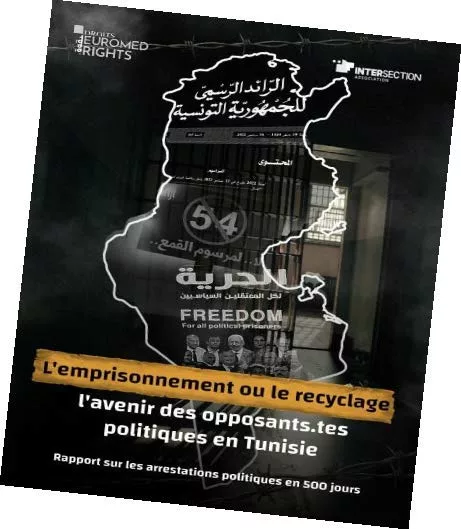
From May 2024 to May 2026, the crackdown on associations became state policy. This is the main conclusion of the report published in July 2026 by Intersection Association for Rights and Freedoms, titled “Civil Society in the Face of Repression: Report on Violations Committed Against Associations from May 2024 to the End of May 2026.” https://www.intersection.uno/
The result of two years of research, this report is one of the most comprehensive studies conducted to date on the gradual dismantling of civic space in Tunisia since power has been concentrated in the hands of President Kaïs Saïed.
A methodical crackdown on civil society
The report describes a profound shift in the policies of the Tunisian authorities. This is no longer merely a matter of isolated acts of harassment, but rather a comprehensive strategy aimed at neutralizing independent organizations through judicial, administrative, financial, and security measures.
According to the authors, the authorities now view many associations as suspicious actors, accused of serving foreign interests or participating in “plots” against the state. This official rhetoric has led to a surge in legal proceedings, smear campaigns, raids, suspensions of activities, and administrative restrictions.
88 documented cases of violations
The study documents 88 cases of violations between May 2024 and May 2026:
- 47 cases directly targeting associations and organizations;
- 41 legal proceedings against officials, employees, or nonprofit activists;
- 7 people have already been convicted in the first instance;
- Another 34 are facing charges in various legal proceedings.
The charges brought are often similar: money laundering, conspiracy, criminal association, financial offenses, or threats to national security. The report emphasizes that these criminal charges are part of an official narrative based on suspicion and the criminalization of associational activity.
A Multifaceted Crackdown
"Intersection" shows that the pressure being exerted on organizations goes far beyond the legal sphere.
Documented practices include:
- police raids and searches of nonprofit offices;
- repeated questioning of officials;
- extensions of police custody;
- administrative suspensions;
- banking and financial barriers;
- restrictions that prevent the normal conduct of business;
- smear campaigns in media outlets aligned with the government.
According to the report, the goal is as much to impose sanctions as it is to wear down the organizations and gradually reduce their capacity to act.
All sectors are now targeted
One of the main contributions of this study is to show that repression now affects virtually the entire civil society sector.
The report devotes specific chapters to organizations active in:
- advocacy for migrants and refugees;
- women's rights;
- the fight against discrimination;
- election monitoring;
- freedom of the press;
- economic and social rights;
- environmental protection;
- human rights in general.
Among the organizations mentioned are Mnemty, the Tunisian Council for Refugees, I Watch, Mourakiboun, LTDH, ATFD, OMCT, Lawyers Without Borders, Nawaat, Al Khatt, the FTDES, and several other national and regional organizations.
A break with the achievements of 2011
The report also reviews developments in Tunisia's legal framework.
After the revolution, Decree-Law No. 88 of 2011 paved the way for the emergence of a particularly dynamic civil society sector, recognized as one of the major achievements of the democratic transition.
This momentum is now being challenged. Since July 25, 2021, the government has been gradually seeking to bring civil society back under political control, breaking with the safeguards established after the revolution.
The Impact on the Population
The report highlights an often-overlooked aspect: the crackdown affects not only the organizations but also the thousands of people who benefit from their activities.
When organizations specializing in legal aid, migrants’ rights, protection of women who are victims of violence, election monitoring, or social services have their activities suspended or brought to a standstill, it is also the most vulnerable populations who lose essential support.
Recommendations to the Tunisian authorities and the international community
Intersection calls on the Tunisian authorities to:
- put an end to the prosecution of civil society actors;
- respect freedom of association;
- release individuals detained because of their involvement in civic organizations;
- stop using pretrial detention as a means of exerting pressure.
The organization also calls on the international community to strengthen its support for Tunisian civil society and to exert greater pressure to bring an end to the documented violations. Finally, it calls on Tunisian organizations to strengthen their coordination and solidarity mechanisms in the face of the attacks they are facing.
A reference document
A reference document
Beyond simply cataloging individual cases, this study provides a comprehensive analysis of the evolution of relations between the government and Tunisian civil society. It highlights the shift from an approach based on ad hoc control to a systematic policy of undermining autonomous spaces for citizen participation.
Given the scope of the data collected, the diversity of the organizations involved, and the thoroughness of the documentation, this report stands as an essential reference for understanding the evolution of Tunisia’s civic space since 2024 and the challenges currently faced by human rights defenders, associations, and all independent civil society actors.