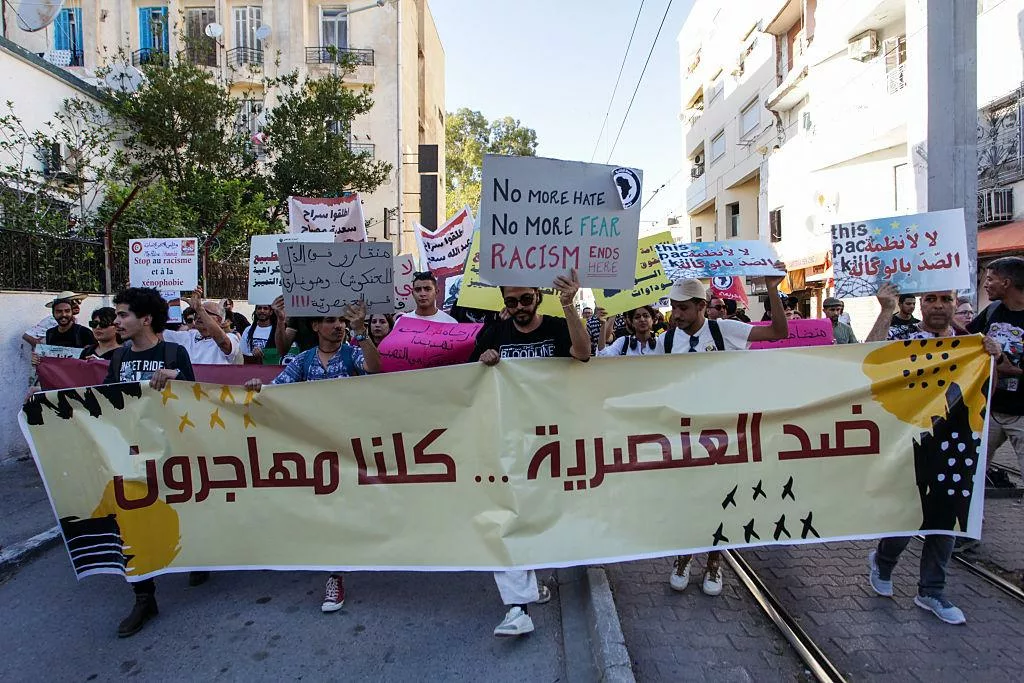
Just a few years ago, Tunisia could boast of being the first country in the Arab world to adopt a specific law against racial discrimination. The law of October 23, 2018, marked a significant step forward. It finally provided legal recognition of a reality that had long been denied: racism exists in Tunisia, it affects both Black Tunisians and foreigners, and it must be combated and punished.
Eight years later, the reality is a bitter one. Racism obviously did not begin with Kaïs Saïed. It existed in Tunisian society long before him. But something has changed since 2023: what was once a social prejudice that people might still have been ashamed to admit openly has found a political justification. Racism has begun to present itself under other names: defense of sovereignty, protection of Tunisian identity, the fight against illegal immigration, defense of the territory, and even patriotism. It is this shift that is troubling.
The Turning Point of February 21, 2023
February 21, 2023, will remain an important date in this regard. Speaking before the National Security Council, Kaïs Saïed referred to “hordes” of sub-Saharan migrants and an alleged “criminal plot” aimed at altering Tunisia’s demographic composition and its Arab and Muslim identity.
The message has been received.
In the days that followed, Black migrants were evicted from their homes, fired from their jobs, assaulted, or arrested. Landlords are now refusing to rent to them. Employers are firing them. Campaigns are circulating on social media. In some places, skin color has become almost synonymous with being an undocumented immigrant.
The president's speech did not invent racism. It helped give it a legitimacy it did not have before.
The mechanism is quite simple. It starts with no longer referring to migrants but instead to “illegal immigrants.” Then the illegal immigrant becomes a threat to security. Next, this threat takes on a demographic dimension: Sub-Saharan Africans are said to have come to settle permanently and transform the Tunisian population. Anyone who offers them assistance is then suspected of participating in this plan.
From that point on, everything can be turned on its head: those who drive out migrants believe they are defending their country, and those who defend migrants’ rights must explain why they are not betraying their country.
That's where the real danger begins.
The numbers paint a picture that is much less abstract
The work of the Tunisian Forum for Economic and Social Rights (FTDES) helps move beyond mere impressions and rhetoric.
A 2024 survey of 379 migrants in Tunis, Sfax, and Médenine shows that 77% of those surveyed had experienced at least one form of violence since their arrival in Tunisia. 67% had experienced verbal abuse, and 56.7% had experienced physical abuse.
Nearly 60% reported having fled certain areas because of violence perpetrated by groups of Tunisians. Only 5% of the victims had filed a complaint.
This last figure is perhaps one of the most alarming.
When a victim of an assault does not dare to go to the police because they fear being arrested themselves due to their immigration status, there is virtually no legal protection left. The assailant knows this, too. As a result, the assailant may come to believe that they enjoy a form of impunity.
Precarious living conditions are just as prevalent: 52% of those surveyed were unemployed, and many were living on the streets, in parks, in tents, or in extremely precarious housing. Three out of four people had had to change their place of residence several times.
And 53.8% said they personally knew someone who had died or gone missing at sea.
Behind the abstract term “migration,” there is a reality marked by fear, violence, displacement, deportations, poverty, and death.
An “invasion” that the numbers do not support
We also need to revisit this idea of a demographic invasion.
The FTDES notes that the latest benchmark survey by the National Institute of Statistics estimated the number of people from sub-Saharan Africa living in Tunisia—including students—at 21,466 in 2021.
This figure is outdated. Obviously, it does not tell us how many there are today. But it does at least allow us to gauge the gap between the data we had and the talk of an imminent shift in the country’s demographic composition.
The presence and transit of migrant populations in Tunisia, as in many countries, raise real issues regarding reception, protection, housing, the organization of public services, and border management. Some cities, notably Sfax, have experienced situations of high tension, exacerbated by the lack of appropriate and sustainable public responses. These difficulties must neither be ignored nor downplayed. Residents have a legitimate right to safety and peace of mind, just as migrants have a right to protection, dignity, and respect for their fundamental rights. The problem, therefore, is not the presence of migrants in and of itself, but the inability of public policies to manage this presence and address the challenges it may create without blaming any particular group.
But acknowledging these difficulties does not mean turning an entire population into an enemy. This, in fact, is the position advocated by the Tunisian League for the Defense of Human Rights (LTDH): to defend both the rights of residents and those of migrants, to condemn violence regardless of its origin, and above all to prevent the spread of racism, hatred, and what it has called “vigilante justice.”
Because when citizens begin to take it upon themselves to monitor, prosecute, or expel foreigners, we are no longer dealing merely with an immigration issue. We are facing a problem concerning the rule of law.
Tens of thousands of intercepts
In the meantime, Tunisian politics have become considerably more polarized.
Here is a much more concise version, retaining the key figures and the issue of opacity.
The FTDES estimates that approximately 60,000 people were intercepted at sea in 2023. In 2024, 32,644 had already been intercepted during the first six months, and the annual total is believed to have exceeded 80,000—for a total of more than 140,000 interceptions over two years. Since June 2024, however, the authorities have stopped publishing detailed data that would allow for reliable estimates for 2025 and 2026.
At the same time, land-based deportations continued. Amnesty International documented more than 11,500 people affected by at least 70 collective deportation operations between June 2023 and May 2025. According to humanitarian sources cited by Human Rights Watch, at least 12,000 migrants, refugees, and asylum seekers were reportedly deported to the Algerian and Libyan borders between January and April 2025 alone. These two figures, which were calculated using different methods, cannot be added together.
Some people have been abandoned in border areas, sometimes without sufficient resources. As of the summer of 2023, at least 28 deaths and 80 missing persons had been reported near the Tunisian-Libyan border. According to the FTDES, the gravity of these practices is now compounded by the increasing lack of transparency in the statistics, which makes it impossible to know precisely how many people have been intercepted, deported, died, or gone missing.
Applying for asylum is becoming nearly impossible
The situation for refugees is even more concerning.
Tunisia has signed the Geneva Convention on Refugees but has still not established a genuine national asylum system. For years, therefore, UNHCR has shouldered much of this responsibility.
In June 2024, the authorities asked it to suspend the registration of new asylum seekers and the determination of refugee status. The situation continues into 2026.
The number of people registered with the UNHCR thus fell from 18,362 in June 2024 to 7,515 in April 2026.
Some, however, come from Sudan, Syria, Somalia, or other countries where they may genuinely fear for their lives.
This leads to an absurd and dangerous situation: a person may no longer have normal access to a procedure that allows them to seek protection, and then be arrested because they do not have a residence permit.
In this way, we create some of the very irregularities that we then claim to be fighting against.
Those who help become suspects
Another milestone has been reached since 2024.
It is no longer just a matter of prosecuting or deporting migrants. The organizations and individuals who help them have also come under suspicion.
Leaders of civil society organizations have been arrested. Organizations that provided shelter, legal assistance, medical care, or protection to minors have been accused of facilitating the settlement of migrants in Tunisia.
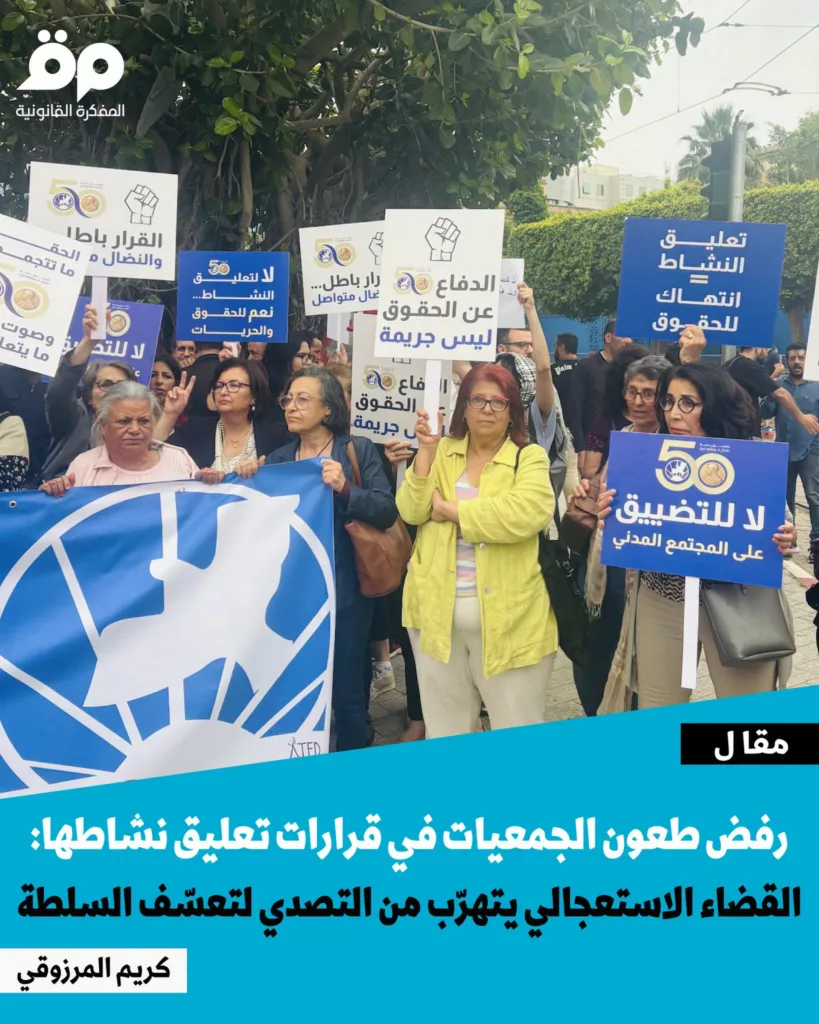
The case of Saadia Mosbah, president of Mnemty, is particularly symbolic. A Black Tunisian activist known for years for her fight against racism, she was arrested in May 2024. In March 2026, she was sentenced to eight years in prison, a sentence that was upheld on appeal in June.
We have reached a paradoxical situation: in the country that passed a landmark anti-racism law in 2018, one of the best-known figures in the fight against racism now finds himself in prison.
And she is not alone. Other officials and employees of organizations that work with migrants have been prosecuted.
The message sent to the nonprofit sector is clear: helping others can be expensive.
Fortunately, Tunisia is more than just that
It must be stated just as forcefully: this trend is not accepted by all of Tunisian society.
The FTDES, the LTDH, the Tunisian Association of Democratic Women, Mnemty, Terre d’Asile Tunisie, the Tunisian Association for the Defense of Individual Rights, Damj, the Tunisian Organization Against Torture, Al Bawsala, the FTCR, the CRLDHT, and numerous other organizations have condemned the violence, deportations, arbitrary arrests, and racist rhetoric.
The FTDES put it simply: “Racism is not a point of view.”
This is important because it serves as a reminder that rejecting racism is not a requirement imposed on Tunisia by Paris, Brussels, Geneva, or New York.
This struggle is, first and foremost, a Tunisian one. It is also based on a Tunisian law: Law No. 50 of 2018 against racial discrimination.
And what about Europe in all of this?
We cannot discuss this policy without discussing Europe.
A few months after Kaies Saied’s speech on February 21, 2023, the European Union signed a memorandum with Tunisia on July 16, 2023, providing, among other things, 105 million euros for migration management and border control.
The European goal is clear: to reduce the number of people leaving for Italy. And the figures show that controls have indeed been tightened.
But Europe cannot ask Tunisia to prevent migrants from crossing the Mediterranean and then turn a blind eye to the methods used.
It cannot champion human rights in Brussels while treating them as secondary in Sfax, Médenine, or along the Libyan and Algerian borders simply because boats are no longer arriving in Lampedusa.
Outsourcing a border does not mean outsourcing responsibility.
What's ultimately at stake
The problem goes far beyond sub-Saharan migrants.
Today, it’s a Black migrant who might be viewed as a suspect because of his appearance. Tomorrow, it could be a political opponent, a journalist, a union member, a community activist, or any citizen who has become a nuisance.
The pattern is always the same: a threat is identified, fear is stoked, security or sovereignty is invoked, and then it is explained that the usual rules can no longer fully apply.
That is why racism and authoritarianism always end up going hand in hand.
And that is why what is happening to migrants today concerns us all.
The real danger begins when a society no longer even considers racism to be something to be ashamed of. When driving out a foreigner can be portrayed as patriotism. When someone who comes to the aid of a persecuted person must explain that they are not a traitor. When solidarity becomes suspect while hatred becomes just one opinion among many . That is racism transformed into “national honor.”
Tunisia must, of course, control its borders and manage its immigration policy. No state can shirk this responsibility. But controlling a border does not give anyone the right to humiliate, beat, abandon someone in the desert, or treat a person as a threat simply because they are Black.
The answer already exists, for the most part, within our own legal system: effectively enforcing anti-racism laws, protecting victims, allowing refugees to seek asylum, punishing acts of violence, ensuring access to justice, and letting organizations do their work. Above all, we must return to a very simple idea.
A country’s honor is not measured by how it treats the most powerful. It is also measured by how it treats those who have nothing: no money, no power, no connections, and sometimes not even proper papers.
You don't defend Tunisia by humiliating an African just because he is Black.
You don't defend sovereignty by abandoning men, women, or children at a border.
And we certainly don't defend Tunisian identity by turning racism into a patriotic virtue.
Human dignity has no skin color, no passport, and no nationality. And the day we accept that it becomes negotiable for others is the day we begin to make it negotiable for ourselves.