In the wake of the tragedy on July 30, 2026, and the violence in late August, Ceuta once again highlights the dead ends of a migration policy based on closure, externalization, and fear.
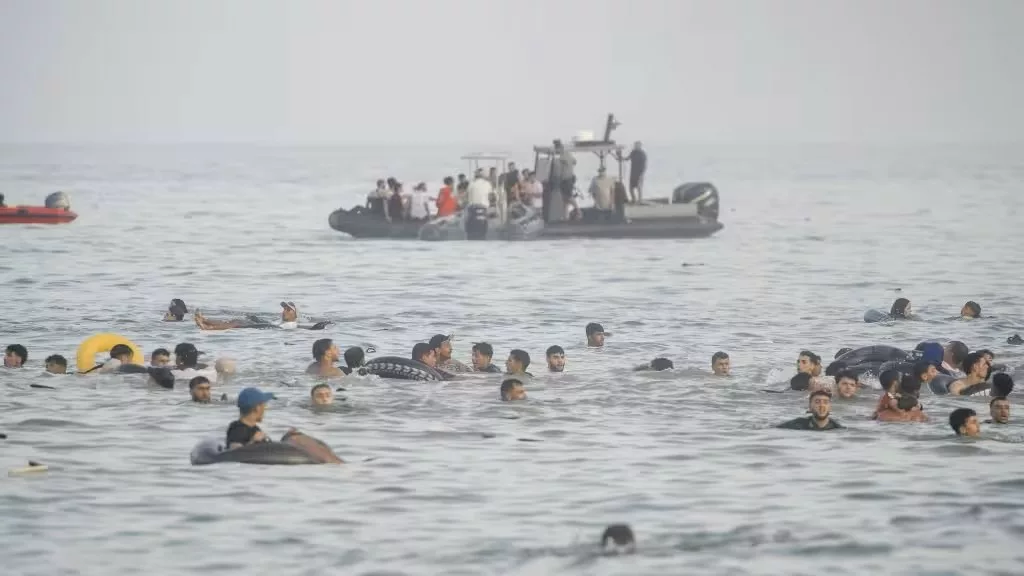
On July 30, 2026, within the space of a few hours, tens of thousands of people crossed the border separating Morocco from the Spanish enclave of Ceuta—by swimming, climbing over the seawalls, or taking advantage of a temporary breakdown in border security. The Spanish government now estimates that 72,000 people entered Ceuta on July 30 and 31.
The death toll itself remains uncertain. In early August, the government of the autonomous city of Ceuta reported that 88 bodies had been recovered near Tarajal, while the Spanish government delegation at the time put the death toll at 72. In addition to these victims, there is an as-yet-undetermined number of people missing. This uncertainty regarding the actual number of deaths speaks volumes about the fragility of migrants’ lives, which are sometimes erased even from the statistics.
A large majority of those who entered Ceuta left or were sent back to Morocco in the days that followed. However, one month later, the crisis had still not been resolved. On August 28, the Spanish Minister of the Interior estimated that there were still about 5,000 migrants in Ceuta, including nearly 1,500 minors. Many were living in precarious conditions, particularly in makeshift camps on the beaches.
This tragedy is not merely an accident. It reveals the consequences of a system that, for years, has been turning borders into militarized deterrents and delegating an increasing share of European migration control to countries in the Global South.
A border that has become a tool for exerting pressure
One key question remains unanswered: How were tens of thousands of people able to reach and cross, in just a few hours, a border that is usually subject to extremely tight police and military surveillance?
Social media, smugglers, rumors that the crossing had become possible, and the ripple effect of the first crossings likely explain part of the phenomenon. But they are not enough to account for the temporary collapse of such a tightly controlled border system.
Several observers have suggested that Morocco may have deliberately relaxed its controls, given that migration has long been a key issue in relations between Rabat, Madrid, and the European Union.
Beyond the case of Morocco, the problem is structural. The European Union has gradually developed a policyof externalizing its borders, which involves financing and equipping third countries to prevent departures and keep migrants out of European territory.
Tunisia provides a particularly telling example. On July 16, 2023, the European Union signed a memorandum with the regime of Kaïs Saïed that included, among other things, 105 million euros to strengthen migration controls, maritime surveillance, and returns. This agreement was concluded even as the Tunisian government was espousing openly racist rhetoric toward sub-Saharan migrants and stepping up its crackdown on civil society, journalists, and the opposition.
This model has since been replicated elsewhere, notably in Egypt. It is part of a broader European strategy: to prevent people from reaching the territory of the European Union, even if it means entrusting part of this mission to governments whose human rights records are regularly criticized.
From the Border Crisis to the Social Crisis
In Ceuta, the crisis of July 30 has gradually turned into a humanitarian, social, and security crisis.
In a very small area, the presence of several thousand people without adequate housing, overcrowding, precarious living conditions, a lack of prospects, and fear among part of the local population have created an explosive situation.
Serious acts have been committed by some migrants. Assaults, clashes, and various offenses have led to arrests. On the night of August 26–27, in Benzú, a group of several dozen people attacked a military vehicle, injuring several soldiers. These acts must be condemned, and their perpetrators must be prosecuted.
But one rule must remain absolute: criminal liability is individual. An offense committed by a few people cannot be attributed to several thousand others.
However, in the days that followed, the nature of the tension changed.
On August 27, several hundred people blocked access for more than two hours to a Red Cross vehicle that was supposed to distribute water and food to migrants gathered on Trampolín Beach.
Some protesters then made their way to the areas where the migrants were living. Makeshift shelters were destroyed or set on fire, forcing their occupants to flee while police intervened to prevent direct clashes.
The slogans heard during these protests are telling: “Invasores, expulsión” — “Invaders, expulsion” — or “Ceuta no se vende, Ceuta se defiende” — “Ceuta is not for sale, Ceuta will defend itself.”
We must be precise in how we describe things: when opposition to an immigration policy turns into attacks on residential areas, obstructs food aid, and collectively labels foreigners as “invaders,” we enter a cycle of xenophobic violence.
Of course, this does not mean that the entire population of Ceuta shares this attitude. On the contrary, many residents, volunteers, and organizations continue to offer their help. The residents of Ceuta, too, have a right to safety, effective public services, and political responses that are commensurate with the situation.
But their rights and those of migrants are not at odds with one another.
The Making of the Scapegoat
The danger lies precisely in the transformation of individual acts into collective guilt.
An actual assault takes place. A video circulates. A rumor spreads. Then, little by little, the perpetrator is lumped into a single category: “migrants.”
Social media, certain messaging groups, and political rhetoric amplify this confusion. Different facts are pieced together to construct an overall portrayal of migrants as a threat.
This is how a migration crisis becomes a crisis of coexistence.
And that is how migrants cease to be viewed as individuals with rights and instead become the scapegoats for all kinds of frustrations: insecurity, unemployment, precarious living conditions, the decline of public services, and distrust of the authorities.
It is precisely the government’s responsibility to prevent this cycle from taking hold: to prosecute all crimes, regardless of the perpetrator’s nationality; to ensure the safety of the local population; and to protect migrants from attacks and collective reprisals.
What We Are Asking For
In light of this situation, the CRLDHT calls for:
- the launch of an independent and transparent investigation into the circumstances surrounding the events of July 30 and 31, the exact number of victims, and the potential responsibilities of the authorities on both sides of the border;
- the identification of the deceased and the search for missing persons;
- effective respect for the right to asylum, the principle of non-refoulement, and the individual review of each case;
- protecting migrants in Ceuta and ensuring their access to water, food, medical care, shelter, and humanitarian assistance;
- the launch of investigations into acts of violence committed against migrants and into any attempt to hinder the work of humanitarian organizations;
- the prosecution of any offense committed by migrants, without ever equating individual responsibility with collective guilt;
- a reevaluation of outsourcing policies that delegate control of European borders to third countries without sufficient human rights safeguards;
- Finally, the establishment of safe and legal migration routes, as well as economic and social policies capable of offering real prospects to the youth of the Maghreb.
Ceuta is not an isolated incident.
It shows how the closure of borders leads to increasingly dangerous routes; how outsourcing turns migrants into bargaining chips; how a lack of preparation for their arrival creates precariousness and tensions; and how the actions of a few can be blamed on everyone, to the point of turning fear into hatred.
On July 30, women, men, and children died while trying to reach Ceuta.
A month later, some survivors were still sleeping on the beaches, while the aid intended for them had to be distributed under guard and protesters were calling them “invaders.”
Between these two images lies the complete failure of an immigration policy that claims to protect borders but no longer knows how to protect human beings.
No border, no reason of state, no diplomatic strategy, and no collective anger can justify human lives being used as a bargaining chip in power struggles.