The first hearing in the trial of several opposition figures, civil society personalities and former high-ranking government officials, accused of "plotting against state security", took place on March 4, 2025 under palpable tension.
From the outset, this affair has been the focus of criticism, raising suspicions that the justice system is being used to settle political scores. The publication ban imposed by the judicial authorities has only heightened suspicions of a desire to muzzle information and control the official narrative. With the opening of the trial to the public, the veneer of opacity is beginning to crack, revealing a judicial management that resembles a skilfully orchestrated production.
Strategic postponement and silencing of prisoners' voices
The court chose to play for time by postponing the hearing until April 11, 2025, while rejecting the defendants' requests for release. This categorical refusal confirms the hard line adopted by the authorities and fuels the hypothesis that the trial was designed as a show of force, with the verdict already written, rather than as an impartial exercise of justice.
Mobilization outside the courthouse
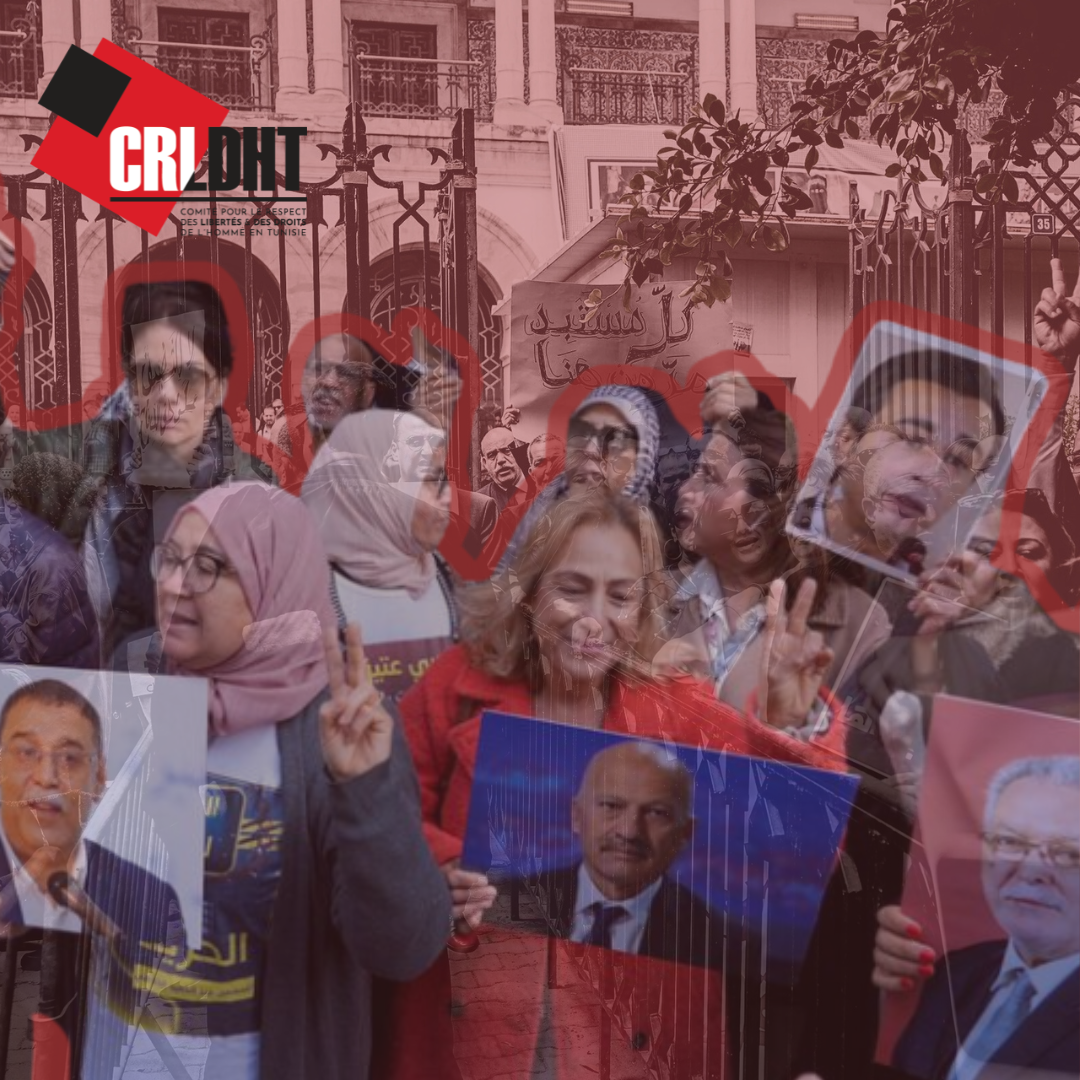
Far from resigning themselves to the situation, the families of the detainees, activists and political figures took to the streets of the courthouse to denounce what they saw as a parody of justice. At the heart of their indignation: the Ministry of Justice's decision to impose a remote appearance, perceived as a maneuver aimed at neutralizing the accused and sabotaging their defense. Demonstrators chanted their rejection of remote-controlled justice and demanded the release of political prisoners, denouncing a tailor-made trial designed to eradicate the opposition.
A hearing under high tension
The atmosphere in Room 6 of the Tunis Court of First Instance was electric. Journalists, diplomats, activists and over 100 lawyers were present, including the former President of the Paris Bar.
From the outset, the detainees' relatives exploded in anger at the absence of the defendants, whose physical presence was essential to the regularity of the trial. The unrest forced the judge to suspend the session briefly, a sign of the explosive climate.
At the resumption, Me Laroussi, President of the Tunis Bar Association, denounced the remote trial, calling it a crude subterfuge designed to deprive the defendants of a fundamental right to direct confrontation with their judges and accusers.
The protest did not stop there. Chaïma Issa, a defendant in the case, denounced the dematerialized justice system, while Jawhar Ben Mubarak, detained in Mornaguia prison, refused to appear remotely. The defense immediately denounced the absence of any official proof of this refusal, questioning whether it was a deliberate attempt to cut the defendants out of the trial.
Other voices were raised: Ayachi Hammami denounced a travesty of justice, while Riadh Chaïbi expressed his determination to be judged under dignified conditions, and not through a prison screen.
The matter took a more worrying turn with the case of Sahbi Atik, who was given a refusal to attend that he would never have signed. To compensate for the lack of evidence, the authorities resorted to the testimony of common law prisoners who were supposed to attest to his refusal - a bewildering and legally questionable practice.
In a statement, Sayed Ferjani, speaking from his cell, said that the trial was a farce, denouncing an indictment riddled with inconsistencies and manipulations.
As for Kamel Letaïef, his lawyer Amin Mahfoudh revealed that he had not even been informed of the remote trial, which constitutes a flagrant violation of the rights of the defense.
A court under orders, a botched procedure
- A travesty of an appearance: holding the trial remotely is seen as a crude maneuver designed to deprive the defendants of a voice and neutralize the impact of their defense in the court of public opinion.
- Manifest violation of the presumption of innocence: the biased media coverage of the case helped to demonize the accused, destroying any claim to impartial justice.
- Magistrates with dubious skills: lawyer Amin Boukar revealed that the deputy chief judge has no expertise in terrorism, raising doubts about the very legitimacy of the court.
- Justice under tutelage: lawyer Samir Dilou denounced a disturbing fact: the order to hold the trial at a distance came not from the judge, but from the court administration, a scandalous interference which betrays the stranglehold of the executive power on justice.
Will the truth finally come out?
After months of obscurantism, the publication ban on the conspiracy affair has finally been lifted. It's now up to the independent press - in a very bad way - to expose the darker side of this affair, far from the docile editorialists and opinion-makers taking orders.
What's next? The stakes for the next hearing
- The battle for the defendants' physical presence promises to further polarize the proceedings.
- Intensifying national and international pressure could force the authorities to loosen their grip on the detainees.
- The media's openness to coverage of the case could reveal new judicial manipulation maneuvers.
- The hearing on April 11, 2025 will be a real test of how far the authorities are prepared to go to keep this trial locked up.
A trial that goes far beyond mere legal issues
The "conspiracy against State security" affair no longer has much to do with justice: it has become a marker of Tunisia's general state of degradation. Every judicial decision, every procedural maneuver, every media stunt outlines the contours of a country where the law is perverted under the blows of authoritarian authority. The future of the trial will not only determine the fate of the defendants, but also that of Tunisian justice as a whole, and of Tunisia as a state and an independent country.
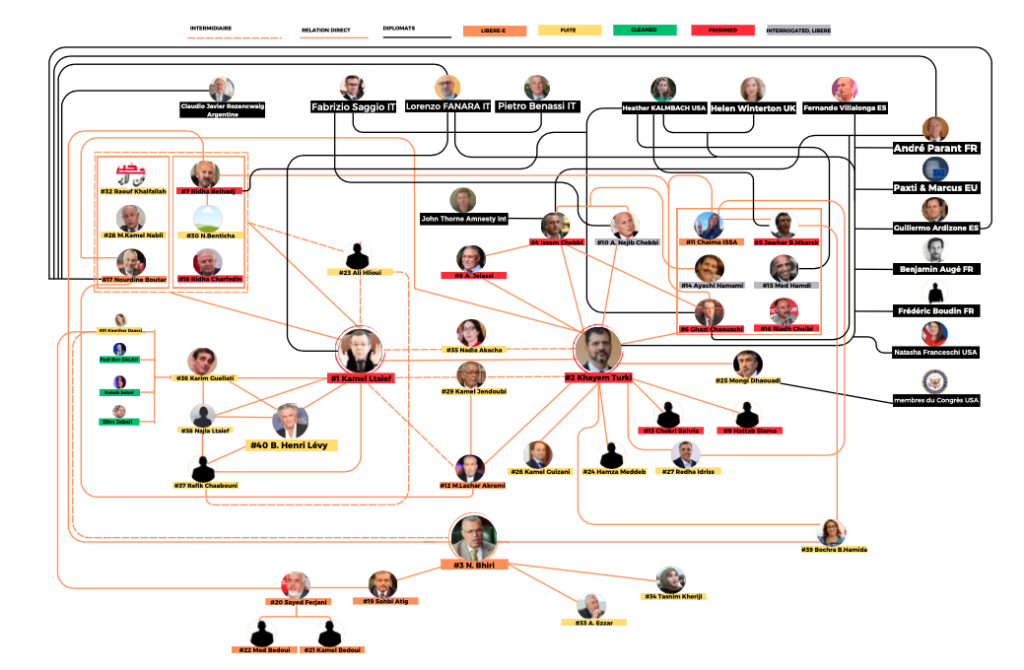
Diagram prepared by Zyna mejri