
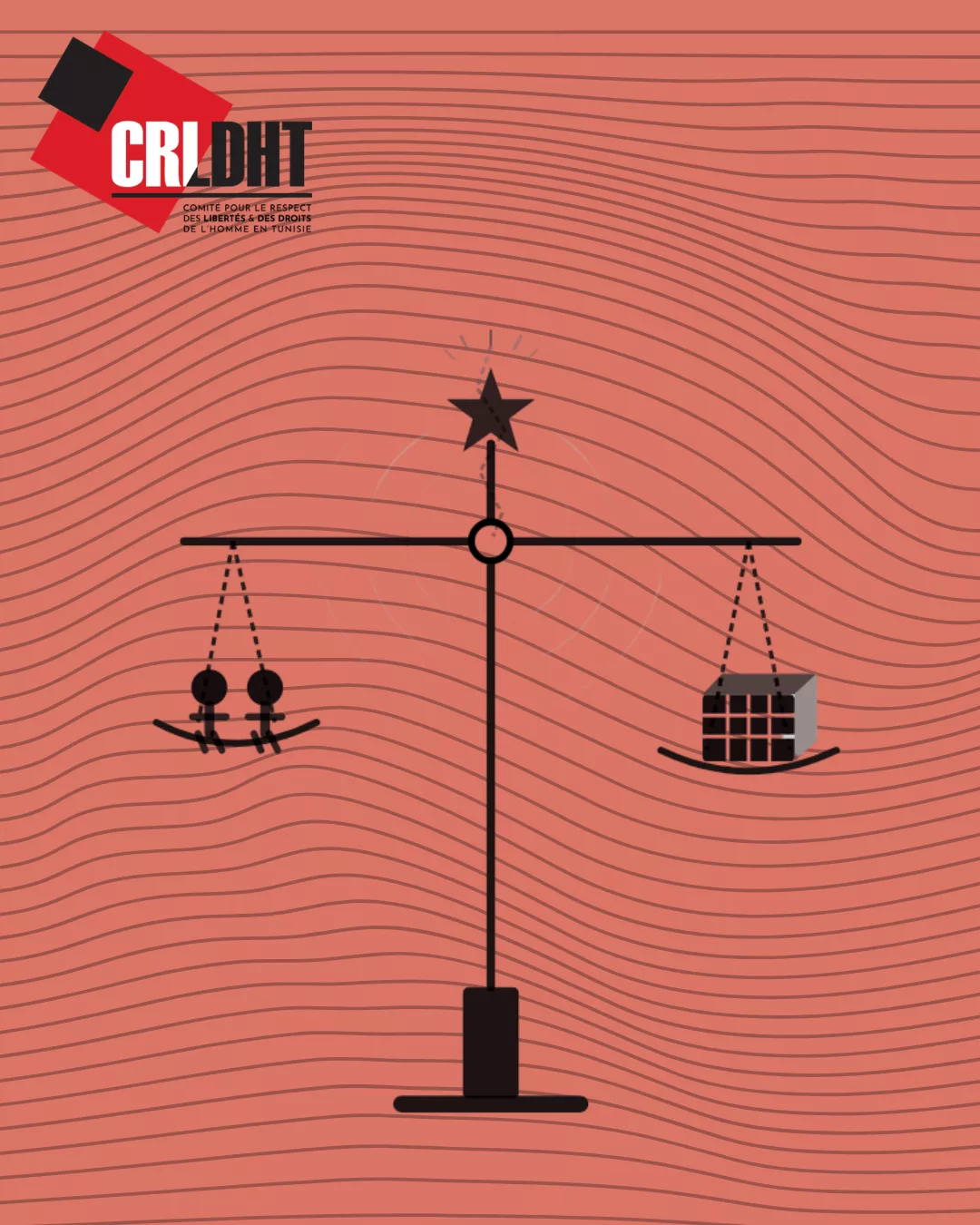
Against flexible approaches
The defense of rights and freedoms does not take place in a neutral space. It occurs within contexts shaped by power dynamics, institutional frameworks, and political practices that can, in certain situations, facilitate the systematic violation of these rights. In such contexts, simply asserting their universality is not enough: we must also analyze the concrete conditions under which they are exercised and the structural barriers that hinder them.
1- No favoritism, no glorification, no demonization
Feminism is not limited to joining an organization or participating in activities that advocate for women. Similarly, the defense of human rights is not limited to belonging to a human rights organization, just as union activism is not limited to joining or getting involved in a student or labor organization. Nor is political action limited to joining a party or coordinating with political forces.
None of this amounts to ready-made identities, but rather daily practices and ongoing challenges. For we are not “rights advocates,” “feminists,” or “political activists” in some finished, definitive sense. We strive to become them throughout our lives. These values are not slogans: they are a daily test of ourselves before we even face others.
As the late Adel Haj Salem once said: “I wasn’t born a democrat, but I’ve been trying to become one for forty years.”
2- PNo selectivity in the defense of individuals
Rights and freedoms are indivisible. They cannot be ranked or distributed based on agreement or disagreement. They are unique, equal, and cannot be selectively chosen. Therefore, the defense of rights cannot be selective, limited to those who resemble us, whom we associate with, whom we love, or with whom we agree, nor can it be subject to our personal relationships, our subjective views, or our disagreements.
When it comes to defending a right, calculations fall by the wayside, disagreements fall by the wayside, relationships fall by the wayside: all that remains is the principle.
This is where the maxim attributed to Ali ibn Abi Talib resonates deeply: “Men are known by the truth; the truth is not known by men.”
We must not, therefore, subject justice to our relationships, nor redefine it according to our affinities or affiliations.
This requirement of indivisibility does not mean that responsibilities are eliminated. Not all violations of rights are on the same level. When a state mobilizes its security, judicial, or administrative apparatus to restrict freedoms, it assumes a specific responsibility linked to the monopoly on force (so-called legitimate coercion) at its disposal. Defending rights in a non-selective manner therefore does not amount to neutralizing power relations, but rather to shedding light on them.
3- NNeither absolute innocence nor eternal damnation
Defending someone in a particular case does not mean giving them carte blanche in all other cases, nor does it turn them into a saint or a hero. We are speaking out against a specific injustice of which they are a victim at a given moment.
There is no contradiction in condemning someone in one case and then supporting them in another where they are being treated unfairly.
Our positions must be based on issues, not on individuals.
However, distinguishing between different situations does not mean setting aside the analysis of responsibility. Certain paths taken or positions adopted may have contributed to legitimizing or reinforcing authoritarian measures. Recalling them is a matter of political truth. Defending someone against a present injustice does not imply forgetting or erasing past responsibilities.
4- Authoritarian authoritarian is not trustworthy: the illusion of the “cold fire”
Authoritarian power cannot be trusted. It does not even protect those who come into contact with it or serve it.
Even though some people helped legitimize this power before becoming its victims, this comes as no surprise.
We defend them not because they were right, but because the principle demands it.
Authoritarian regimes do not rely solely on repression to maintain their hold on power; they also rely on mechanisms of co-optation, selective integration, and the fragmentation of actors. They create gray areas where the lines between opposition, accommodation, and participation become blurred. Understanding these mechanisms is essential for analyzing the conditions under which power is reproduced.
5-Women's Bodies, racism and segregation are linered lines redlines
At the heart of these conflicts, issues related to women’s bodies keep resurfacing. This is nothing new. But they represent a red line that cannot be downplayed or compromised.
It is essential to remember that championing a just cause, or finding oneself in a situation of oppression, does not confer any moral immunity. Under no circumstances can this justify resorting to practices that violate fundamental principles. Oppression, however real it may be, does not give anyone the right to infringe upon the rights of others, nor, in particular, to violate the physical integrity of women.
Women’s bodies must not be used as weapons, instruments of exploitation, or tools for exerting pressure or discrediting others. They cannot be invoked to justify, downplay, or divert attention from acts of abuse. Neither closeness, nor intent, nor any relationship can serve as a justification for undermining respect for them.
The growing number of people speaking out and reporting incidents does not reflect a so-called “exaggeration” or heightened sensitivity among women. Above all, it reflects a breaking of the silence and a greater ability to name acts of violence that have long been kept quiet or trivialized.
To cast doubt on these statements by dismissing them as exaggerated, self-serving, or malicious amounts to further harm. This prolongs the trauma suffered by undermining the credibility of the speaker and reinforcing mechanisms of dismissal.
Recognizing this statement requires that it be received with seriousness, respect, and vigilance, within a framework that protects both individuals and the principles of justice.
Finally, this requirement does not apply solely to women. It is part of a broader framework: that of respect for all rights and freedoms, particularly those of minorities, as enshrined in the universal principles of human rights. These rights cannot be fragmented, ranked, or subordinated to political or circumstantial considerations.
6- The courage to take a stand is the litmus test
These principles are not measured by words, but by the stands we take—at the very moment when doing what is right comes at a cost.
Courage means maintaining the same high standards of principle, whether toward loved ones or adversaries: condemning the positions of loved ones when they are questionable, and defending the rights of adversaries when they face injustice.
Courage also means refusing to remain silent. Because silence is not neutral: it amounts to complicity, it weakens victims, and it casts doubt on their words.
Our voice cannot be selective—loud when it suits us, silent when it’s inconvenient.
The real test begins when values come into conflict with relationships:
condemning the views of a loved one, defending an opponent, refusing to either deify or demonize, and sticking to principles when they must be upheld.
7- These rights violations are not of the same nature
Not all violations of rights are the same. Some are individual and isolated. Others are structural, organized, and perpetuated by institutions.
In authoritarian regimes, the violation of rights becomes a mode of governance: the manipulation of the justice system, the restriction of freedoms, the criminalization of the opposition, and pressure on the media and civil society.
In such situations, the defense of rights must be part of a comprehensive analysis of the policies implemented and the rationale behind them.
Individual consistency is necessary, but it is not enough. The defense of rights is also a collective endeavor, which requires organization, strategy, and the ability to build power dynamics.
It is not just a matter of saying the right thing, but of creating the conditions for it to be effective.
It is in this interplay between ethical standards and collective commitment that the possibility of defending rights and freedoms lies.