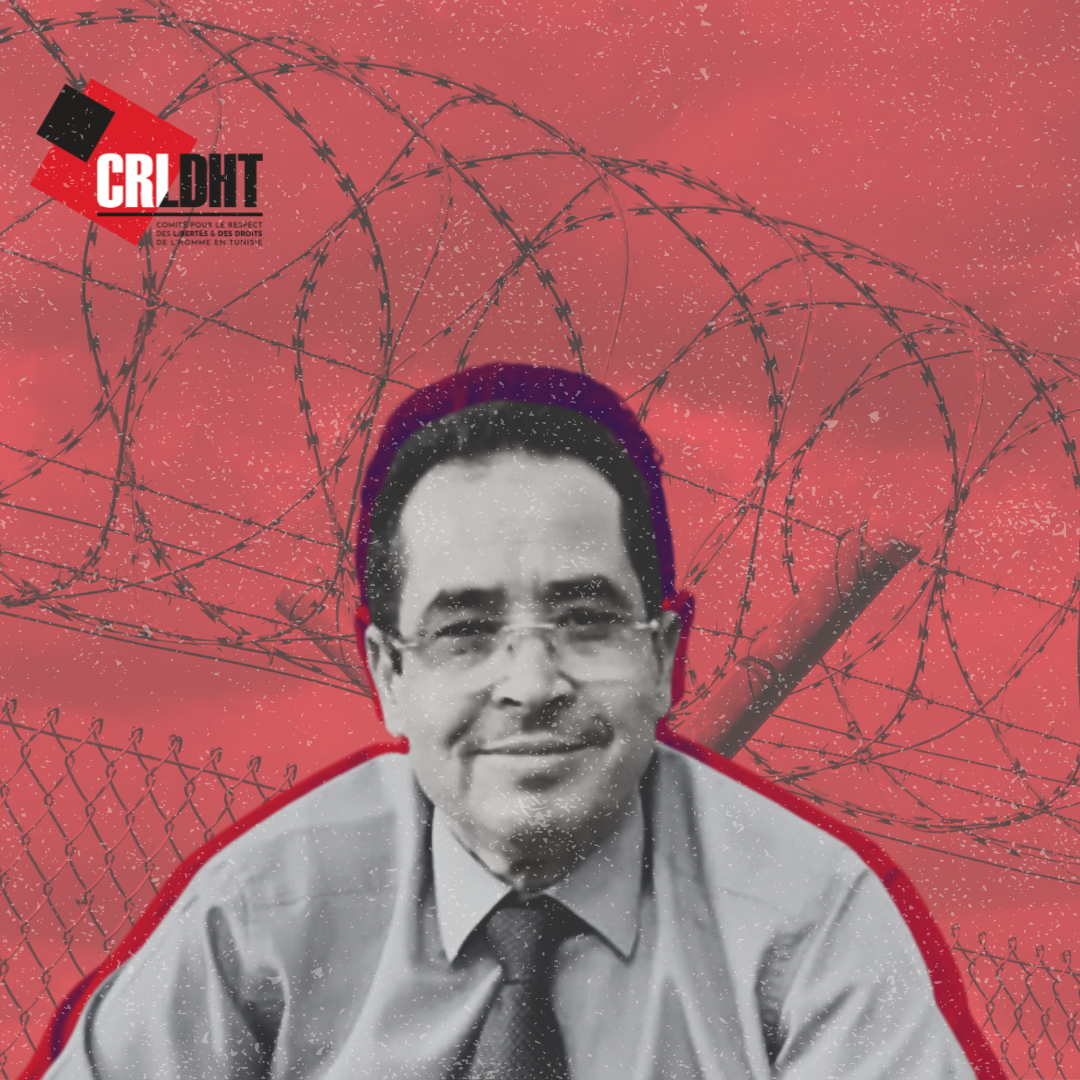
On Tuesday February 18, 2025, the Criminal Division of the Court of Cassation issued a decision formally accepting the appeal lodged by Bachir Akremi and Habib Ellouz, leader of the Ennahdha movement, while rejecting it on the merits. In so doing, it upheld the decision of the Indictment Division of the Tunis Court of Appeal, which had ordered their referral to the criminal division of the Tunis Court of First Instance specializing in terrorism cases.
The case of Judge Béchir Akremi cannot be understood without analyzing the context of manipulation and disinformation surrounding it. His arrest on February 12, 2023, on charges of financial corruption, concealment of evidence and obstruction of justice, is far from being a simple judicial case. It reveals an explosive mix of political manipulation, disinformation and violations of judicial independence. It illustrates a strategy aimed at destroying its image and discouraging any challenge to the authoritarian drift underway in Tunisia. It is part of a process of systematically dismantling judicial independence and a desire to rewrite Tunisia's recent history.
A magistrate targeted for political manipulation
As Public Prosecutor at the Tunis Court of First Instance, Béchir Akremi was one of the key players in the investigation of political assassinations and terrorist crimes. His commitment to the fight against terrorism has put him in direct opposition to several political and security lobbies. As early as 2013, his role in the investigations into the assassinations of Chokri Belaïd and Mohamed Brahmi was deliberately attacked.
For several years, Tunisia's democratic transition has been the subject of an information war, fueled by internal and external actors who believe that Tunisia's nascent democracy has benefited Islamists and must be eradicated under the guise of the fight against extremism. In this context, political forces and foreign states hostile to the idea of a democratic Tunisia where Islamist currents have a place on the political scene have exploited and amplified unfounded accusations to justify a return to a repressive regime.
The media campaign against Akremi is in line with this logic: he was presented as an accomplice of terrorism, even though his investigations were validated by the highest Tunisian and international judicial authorities.
Two fronts were formed against him:
- Political currents seeking to exploit these assassinations to eliminate their opponents.
- Security and judicial networks that refuse to question their role in the management of terrorism.
Disinformation and manipulation as political weapons
Tunisian public opinion was bludgeoned by an orchestrated media campaign in which Akremi was presented as a magistrate in the service of terrorists. This fabricated narrative served a precise purpose: to discredit not only the man himself, but also the entire post-2011 democratic transition, by delegitimizing it on the pretext that it had favored Islamism.
Several actors played a central role in this manipulation:
- Local and international media, aligned with geopolitical agendas, aim to undermine Tunisia's democratic experiment.
- Foreign states with an interest in presenting the Tunisian revolution as a failure, in order to justify their own authoritarian policies and interventions in the region.
- Part of the security and judicial apparatus, in collusion with these interests, to prevent any fundamental reform of the Deep State.
This intense media offensive has drawn in its wake actors who normally defend freedoms and the rule of law, demonstrating how fear and misinformation can pervert democratic struggles.
Selective justice and repression under equal cover
All judicial and administrative investigations against Akremi have failed to reveal any serious professional misconduct. Yet he was dismissed by a disciplinary procedure tainted by irregularities, before being illegally deprived of his functions and arrested.
The procedure followed a pattern typical of political purges:
- Arbitrary suspension by the Conseil de la magistrature in July 2021.
- This suspension was overturned by the administrative courts, which recognized a violation of fundamental rights.
- Direct intervention by the executive to dismiss it definitively in June 2022, outside any legal framework.
Psychiatric internment: a method of political persecution
The most shocking element of this affair remains his forced placement in the Manouba psychiatric hospital. This decision, taken outside any clear legal framework, has the obvious aim of degrading his psychological state and discrediting him publicly.
The authorities' refusal to allow his lawyers to visit him only reinforces the idea that this is an act of reprisal orchestrated to break the individual morally and psychologically. He has gone on hunger strike, denouncing the inhuman conditions of his detention and the political harassment to which he is subjected.
An authoritarian drift and a message for all magistrates
The Akremi affair is symptomatic of an authoritarian drift. It sends a strong signal to other magistrates: any attempt to guarantee independent justice will be severely repressed.
This is part of a general context of :
- Purge of the judiciary to put it at the service of the regime.
- Criminalization of opponents, under the pretext of fighting corruption or terrorism.
- Repression of democratic freedoms, in the name of stability.
A case emblematic of an authoritarian restoration project
The arrest of Béchir Akremi is not an isolated case, but a milestone in a broader strategy to bury the legacy of the Tunisian revolution. It illustrates how the fight against Islamism is used as a pretext to gag all opposition and rewrite the history of the democratic transition.
This affair highlights a clear desire to return to a justice system subservient to executive power, by rehabilitating the old methods of political and judicial persecution. The independence of the judiciary, already severely tested, is now in jeopardy.
The CRLDHT calls on
- The cancellation of irregular judicial and disciplinary proceedings and the immediate rehabilitation of Béchir Akremi.
- To guarantee an impartial investigation into the conditions of his detention and the misuse of psychiatric internment as an instrument of political persecution.
- Put an end to political pressure on magistrates and re-establish a truly independent Conseil Supérieur de la Magistrature.
- To set up a protection mechanism for independent judges so that they are no longer victims of political reprisals.