On February 6 and 7, 2026, the National Congress of Social Movements, organized by the Tunisian Forum for Economic and Social Rights (FTDES), was held at the headquarters of the Tunisian General Labor Union (UGTT) in Tunis.
In a country where public space is shrinking and civil action is increasingly subject to legal proceedings, this annual gathering was anything but a simple militant ritual. It has established itself as a pivotal moment: an attempt to structure a fragmented and dispersed social resistance.
A convention in a climate of political closure
The conference was held in a context marked by:
- the restriction of civil liberties,
- the persecution of activists and opponents,
- the weakening of institutional mediation,
- the lack of tangible economic prospects.
Since July 25, 2021, when President Kaïs Saïed initiated his power grab, the centralization of power has gradually marginalized political parties and reduced the scope of action of the traditional political sphere.
In response to this, social movements have not disappeared. They have proliferated.
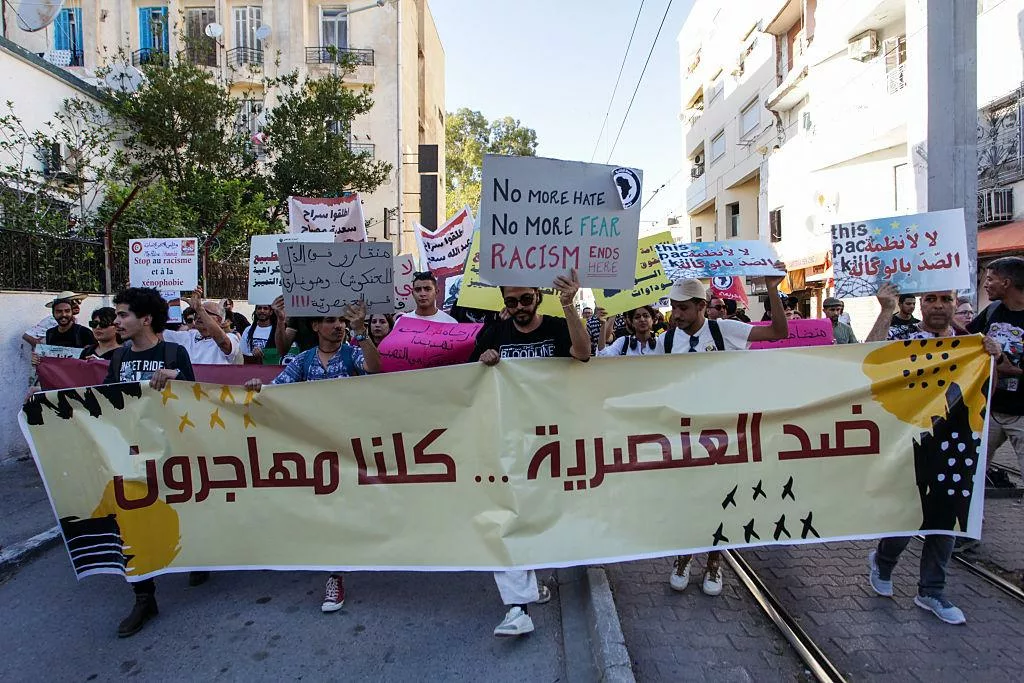
5,196 protests in 2025
According to the latest FTDES report, 5,196 protests were recorded in 2025, including 427 environmental protests.
These figures represent a dramatic increase compared to previous years.
The demands cover a wide spectrum:
- right to drinking water,
- employment and working conditions,
- health and social protection,
- environmental justice,
- defense of civil liberties.
Politics, driven out of institutions, has moved to the streets.
Gabès: the environment as a dividing line
In Gabès, protests against industrial pollution have become emblematic. For years, residents have been denouncing the effects of the chemical complex on health and the local economy. In 2025, the movement gained momentum and organizational capacity.
But the report highlights a paradox: despite the worsening environmental crises, these struggles often remain isolated, due to the lack of a unified discourse linking social justice and ecological justice.
Women at the heart of the protests
The last quarter of 2025 saw a 45% increase in protests, with a particularly strong female presence.
Agricultural workers, textile workers, unemployed graduates: women are no longer just participants, they are organizers and spokespersons.
The figures confirm the extent of inequality:
- 22% unemployment among women compared to 13.6% among men;
- 31.2% among female college graduates;
- only 25.3% have social security coverage
Structural insecurity fuels protest.
Generation Z: a new political grammar
On the streets, another phenomenon catches the eye: the emergence of a generation born with the Internet, well versed in visual and digital codes.
References to One Piece, hybrid slogans, smoke bombs, collective performances: protest becomes image, rhythm, virality.
This generation does not reject politics. It redefines its codes. It favors the cause over the apparatus, the symbol over the podium, the moment over the structure.
The Social Movements Congress did not ignore this transformation. It attempted to learn from it: how can this diffuse energy be channeled into sustainable strategies?
Blame the apparatus, without reforming the system
In managing social conflicts, the strategy of power, and especially that of Kaïs Saïed, is based on a recurring scenario: that of a president presented as outside the apparatus he leads, posing as a virtuous arbiter in the face of an administration accused of obstruction, corruption, or inertia.
With every crisis—shortages, local disasters, strikes, or social upheavals—the discourse points to "local officials," "lobbies," and "the deep state," as if the highest echelons of power were outside the chain of decision-making.
This rhetoric of internal opposition allows anger to be channeled toward middle management while preserving the image of a leader who is supposedly on the side of the people.
But beyond condemnation, the structural reforms announced—administrative overhaul, new control mechanisms, grassroots democracy projects—are struggling to translate into operational measures or concrete improvements.
A paradox emerges: a highly centralized power that, when faced with social conflicts, exonerates itself politically by designating the administration as the adversary, without the promises of transformation leading to tangible changes in everyday life.
Between fragmentation and attempts at unity
Three themes structured the conference discussions:
- Define legal and organizational tools to protect activists in a context of increasing criminalization.
- Strengthen the links between social and environmental struggles and the defense of freedoms.
- Examine new forms of mobilization promoted by younger generations.
The challenge is immense. Mobilizations are multiplying, but they often remain local, sporadic, and isolated.
Tunisia is experiencing a paradox: never have there been so many protests, but never has the institutional space been so narrow.
The street as the last mediator
Restricting political parties, marginalizing Parliament, weakening trade unions: these choices have not eliminated social conflict. They have merely displaced it.
When institutions cease to absorb tensions, the streets become the central arena for politics.
The Social Movements Congress in February 2026 did not just take stock of the situation. It asked a fundamental question: how can we transform this explosion of anger into a collective project capable of linking social justice, freedoms, and democracy?
Because when the street becomes the only space for political expression, it is not just a symptom. It is a warning sign.