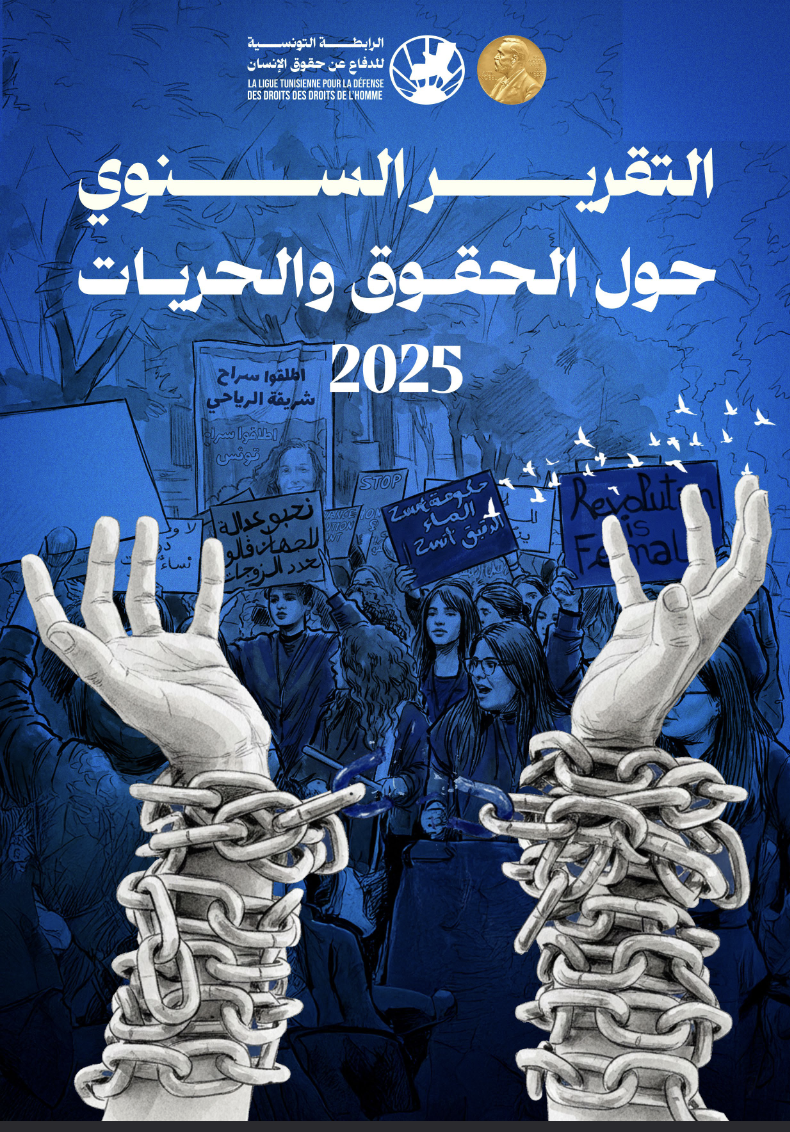
The 2025 annual report on rights and freedoms, published by the Tunisian Human Rights League (LTDH) in Arabic, التقرير السنوي حول الحقوق والحريات 2025 – LTDH, is not merely a status report. It is a major warning document that describes not just a temporary deterioration of freedoms, but the lasting establishment of a system of widespread restrictions on fundamental rights in Tunisia.
Fourteen years after the 2011 revolution, and more than four years after the authoritarian turn of July 25, 2021, the LTDH notes a gradual but systematic collapse of the rule of law, where the law ceases to be a guarantee and becomes an instrument of control.
Systemic repression
One of the report's key contributions is to show that human rights violations are no longer isolated incidents, but are now part of a systemic pattern. This pattern is based on the convergence of several factors: a repressive legal framework, a justice system under pressure, an omnipresent security apparatus, and official rhetoric that stigmatizes any form of dissent.
At the heart of this architecture is Decree-Law No. 54, officially presented as a tool to combat disinformation, but widely used in practice to criminalize digital expression, political criticism, and dissenting social discourse. The LTDH highlights the inherently problematic nature of this text, which is based on vague and expansive concepts that violate the fundamental principles of legality, necessity, and proportionality of penalties.
Alongside this text, old criminal provisions—such as "offense against the President" or "undermining the morale of institutions"—are being reactivated and combined with digital technologies, giving rise to a renewed form of thoughtcrime.
Justice: from countervailing power to transmission belt
The report provides a harsh but well-documented analysis of the role of the judiciary. The LTDH highlights a profound erosion of judicial independence, marked by increased dependence on the public prosecutor's office, hierarchical pressure, and the alignment of certain decisions with the security and political priorities of the executive branch.
Abusive pretrial detention, summary judgments, and the almost automatic recourse to imprisonment in cases involving freedom of expression illustrate a disturbing transformation: trials are becoming a disciplinary tool, intended to intimidate, exhaust, and deter any dissent.
In this context, punishment is not limited to the sentence handed down. It begins with arrest, continues with police custody, public stigmatization, social precariousness, and psychological pressure. The law is thus mobilized not to arbitrate, but to produce fear and resignation.
Socially and territorially targeted repression
The 2025 report emphasizes a key issue: social and regional inequality in the face of repression. Inland regions—Jendouba, Kasserine, Gafsa, Sidi Bouzid, Tataouine—appear to be particularly vulnerable areas where procedural safeguards are weaker and media coverage is less prominent.
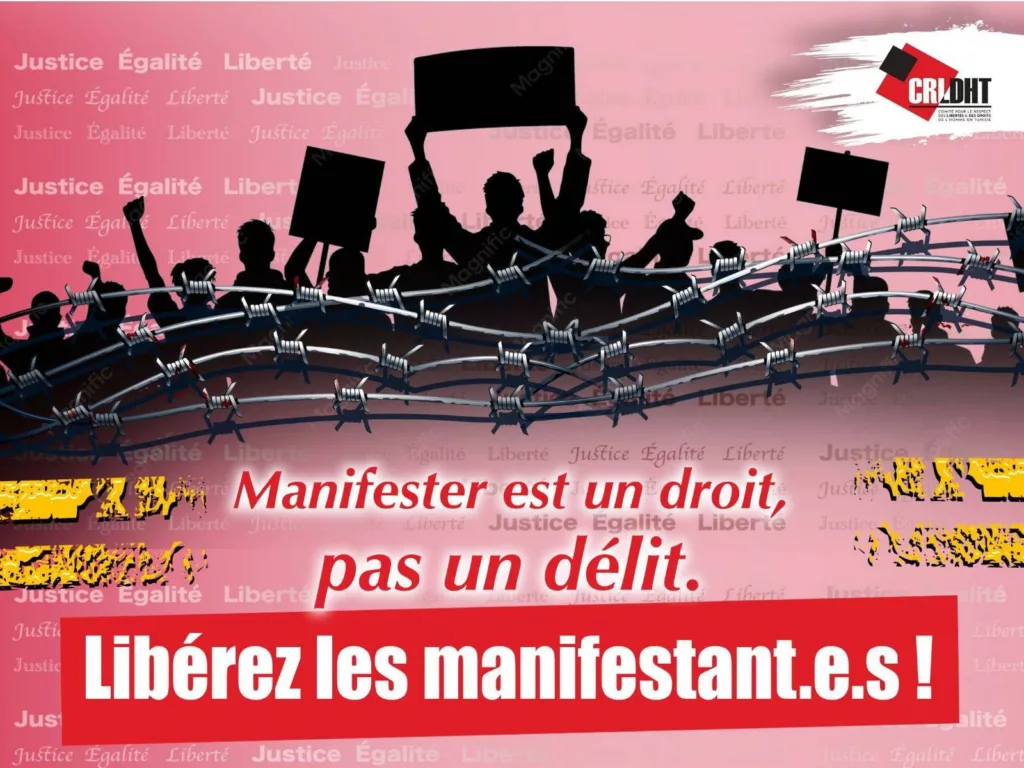
The criminalization of social struggles is particularly pronounced in this region. Demands related to the right to water, employment, the environment, or regional development are increasingly treated as threats to public order, rather than as the legitimate expression of violated economic and social rights.
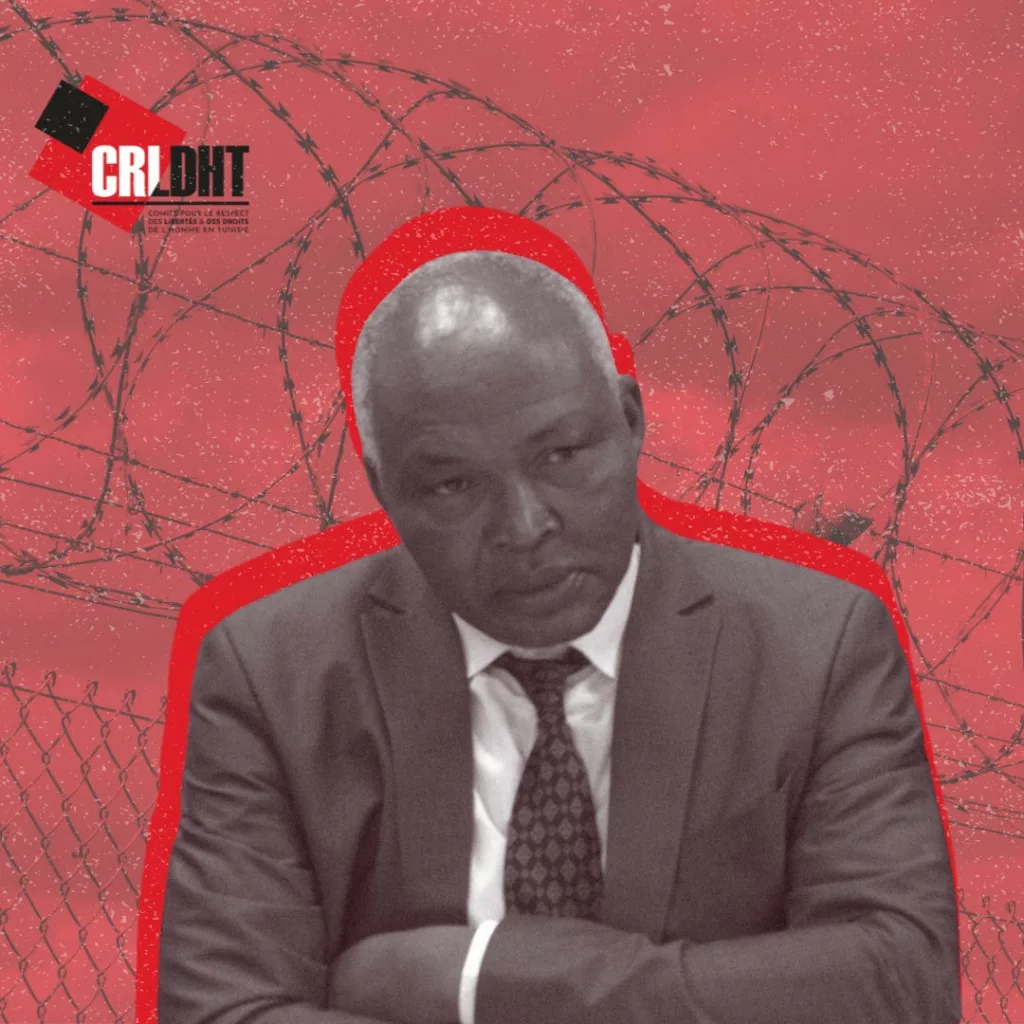
The case of Moncef Haouaidi, a prickly pear seller and social activist in Tabarka, illustrates this trend: prosecuted and imprisoned for a simple publication calling for the repeal of Decree-Law 54, before finally being cleared on appeal, he embodies the figure of the ordinary citizen punished for speaking out.
The suffocation of collective freedoms
The LTDH also devotes considerable attention to the state of collective freedoms. Associations face increasing administrative obstacles, stigmatization of their funding, and direct legal threats against their leaders. Civil society is gradually being redefined as a suspicious, even hostile, actor rather than a pillar of democratic debate.
Freedom of the press, meanwhile, is undermined by legal proceedings, the economic fragility of the media, and the rise of self-censorship. Formal pluralism remains, but real pluralism is eroding, replaced by a climate of widespread caution and enforced silence.
A structural crisis of the rule of law
The central message of the report is unambiguous: Tunisia is undergoing a structural crisis of the rule of law, characterized by the concentration of powers, the erosion of countervailing powers, and the normalization of exceptions. The most serious danger, according to the LTDH, lies in the trivialization of arbitrariness, which ends up being accepted as inevitable.
This report does not merely condemn. It is an act of remembrance, resistance, and advocacy, intended not only for the Tunisian authorities and international partners, but also for citizens themselves, to remind them that rights are never lost all at once, but through successive renunciations.
Conclusion: repair to rebuild
The LTDH's 2025 report should be read as a major wake-up call. It documents what is being lost, but also what will need to be rebuilt tomorrow: an independent judiciary, effective freedoms, and a state that is accountable to its citizens.
From this perspective, redressing individual injustices, such as those suffered by Moncef Haouaidi, is not a secondary issue. On the contrary, it is the primary condition for any future democratic renewal. Without truth, without redress, and without guarantees of non-repetition, no lasting transition will be possible.