Morocco, Algeria, Tunisia: three national trajectories, regional fragmentation
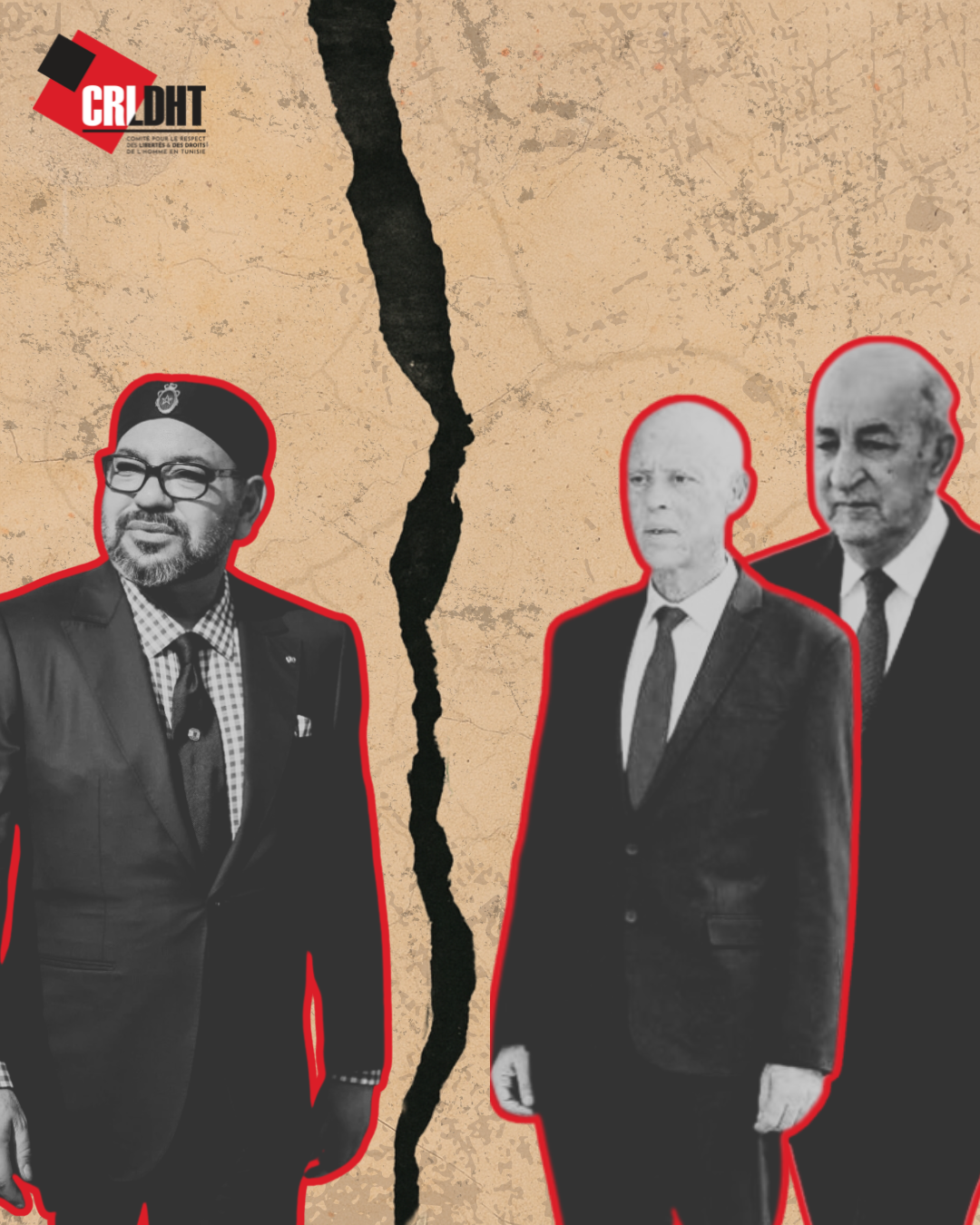
In a changing global context, where multilateral logics are being supplanted by raw power relations, the Maghreb presents itself as a region in turmoil. But what does this "turmoil" really mean? Is it a sign of generalized political instability, a shift in alliances, or a structural weakening of regional projects? Or is it a manifestation of a profound misalignment between state ambitions, social expectations and new geopolitical balances?
Foreign interference plays a structuring role in these dynamics. Whether Israeli, Emirati, French, American, Russian or Iranian, they help to complicate internal balances of power, exacerbate inter-state tensions and reinforce the fragmentation of the Maghreb. These external interventions, far from being homogeneous, reveal a fragmented geopolitics: security support for Morocco, energy support for Algeria, migratory instrumentalization in Tunisia.
At the same time, the historical alliances inherited from the Cold War are changing. Morocco has consolidated its traditional partnerships with the United States, the European Union, France, Saudi Arabia and the United Arab Emirates, while developing stronger ties with China and Russia. Algeria is attempting to open a strategic dialogue with the United States, despite a long-standing Russian bias. Tunisia, for its part, oscillates between occasional alignments, growing isolation and multiple dependencies, with no clear strategic vision.
- Morocco: between African ambitions, soft power and internal fractures
Morocco is actively seeking to establish itself as a regional power through a three-pronged strategy: international recognition of the "Moroccanness of Western Sahara", economic diplomacy focused on sub-Saharan Africa, and a soft-power religious policy promoting a "Middle Way Islam" in the face of Salafist currents financed by other Gulf powers.
This soft power is illustrated by the training of imams, the dissemination of moderate Islam, the financing of mosques, banking and commercial investments, and an offensive media strategy. It is accompanied by major infrastructure projects such as the Tangier Med port - fully operational for several years now - and the port of Dakhla, still at the project stage. The development of the automotive industry, technology partnerships and OCP's success in selling fertilizers in Africa and Asia complete this strategy.
However, this foreign policy, conceived as a showcase, does not mask the internal flaws: persistent poverty, blatant inequalities, degraded public services, massive rural exodus. The aftermath of the Atlas earthquake highlighted the limits of territorial and social redistribution. GDP per capita remains modest in relation to the ambitions expressed.
The question of the Western Sahara remains an obsession for the Moroccan state. While it continues to unite public opinion in a nationalist reflex, the barter made in 2020 (normalization with Israel in exchange for American recognition of the Sahara) has given rise to a moral rejection, notably because of popular attachment to the Palestinian cause and the King's spiritual role as Commander of the Faithful and Chairman of the Al-Quds Committee.
This strategy has nevertheless had diplomatic effects: Rabat has obtained the explicit support of several members of the Security Council (United States, Spain, France, United Kingdom) for its administration of the Saharan territory, despite international law and UN resolutions.
As the poet Abdellatif Laâbi so aptly put it, "Morocco is sick of its Sahara". This phrase aptly expresses the almost pathological centrality of this issue in the kingdom's foreign and domestic policy.
However, Morocco's rise to regional power is taking place against a backdrop of increasing repression, a clampdown on the press, and internal rivalries fanned by the King's weakening position. The expression "end of reign" here evokes less a political succession than a slowdown in decision-making and a latent war between influential advisors.
A fundamental question remains: is this African diplomacy, visible as it is, based on real influence or circumstantial activism? Morocco has distanced itself from the Maghreb. But what will it do with this autonomy?
- Algeria: defensive sovereignty and declining influence
Algeria suffers from growing isolation, despite its claim to sovereignty. Its diplomacy, centered on its rivalry with Morocco, lacks initiative. Support for the Polisario, unchanged for decades, is not accompanied by an alternative strategy or a mobilizing project for the Saharawis.
Algeria's loss of influence is visible in several spheres: withdrawal from the Sahel, weakening of its role in the African Union, marginalization vis-à-vis the European Union. Algeria is not only finding it hard to be a mediator, it's simply no longer one. Whether in Libya, Mali or Niger, it is often accused of interference and sometimes even excluded from mediation processes.
Its attempts to form an alternative regional axis (with Tunisia and Libya) have failed to convince. Mauritania has stayed away, and concrete results are lacking.
Algeria's political system remains a prisoner of its past. The people in power come from a frozen generation, operating according to the reflexes of the 1970s. There is neither a mobilizing economic project nor a unifying social narrative. The country's youthful majority is at odds with the state. Authoritarianism persists, with no prospect of reinventing political life.
Worse still, Algeria seems to be abandoning its own fundamentals. Its role as regional mediator has faded. Its commitment to the Palestinian cause has weakened. Its redistributive social policy, the pillar of its historical legitimacy, is crumbling.
Algerian foreign policy has thus become reactive rather than proactive, incapable of transforming its defensive sovereignty into a power of influence. Anti-Moroccan obsession is no longer enough to mask the strategic vacuum.
- Tunisia: fragmented diplomacy and cross-dependencies
Post-July 25, 2021 Tunisia is evolving in a form of strategic withdrawal, between proclaimed sovereignty and the realities of profound diplomatic isolation. Foreign policy is now steered by the Palace, with no counterweight or institutional expertise.
Tunisia's dependence on Algeria is obvious: gas, informal budget support, tourism leverage (Algerian tourists), security cover. In return, Tunisia has renounced its historical neutrality on Western Sahara.
Other influences are also weighing on the Tunisian equation: active support from the United Arab Emirates for the authoritarian reorientation of power, marginalization of Qatar, persistent rumors of Iranian penetration. These games of influence, still poorly documented, reflect Tunisia's vulnerability in a context of institutional crisis.
On the migration front, Tunisia has become a zealous subcontractor for European policy. Italy, in particular, finances control and retention programs. On the whole, the EU turns a blind eye to Tunisia's authoritarian drift in exchange for tighter controls on departures. Figures on expulsions, funding and security agreements would be necessary to measure the extent of this security delegation.
President Kaïs Saïed's proclaimed sovereignty does not translate into real autonomy. It is a verbal nationalism, with no solid economic, diplomatic or popular basis. Tunisian diplomacy has become erratic and transactional, with no regional or African roots. The illusion of power masks a total loss of influence.
Diplomacy of the apparatus, popular aspirations evacuated
What emerges from the conference organized by the CRLDHT is the paradox of a region in permanent recomposition, but without a shared project. In all three countries, foreign policy is instrumentalized to serve the logics of regimes and political survival, to the detriment of popular interests and regional integration.
Ambitions, when they exist, are limited: to obtain recognition already acquired (Sahara for Rabat), to contain the adversary (Morocco for Algiers), to maintain power (Tunisia). The Arab Maghreb Union is no more than a historical relic. Societies are excluded from strategic debates. Authoritarianism is consolidating. Elites operate in closed circles.
The central question then becomes: for whom and why are diplomacy designed? Which peoples are concerned? What social or democratic legitimacy do these strategies claim to embody?
The challenge is immense: to rebuild a regional political horizon, to reinvent forms of solidarity, to re-found a Maghreb diplomacy free from external injunctions and rooted in popular aspirations. This presupposes a reversal of priorities: thinking of peoples before regimes, cooperation before competition, collective sovereignty before crossed allegiances.
This article is based on the "Perspectives géopolitiques au Maghreb" meeting organized by the CRLDHT.