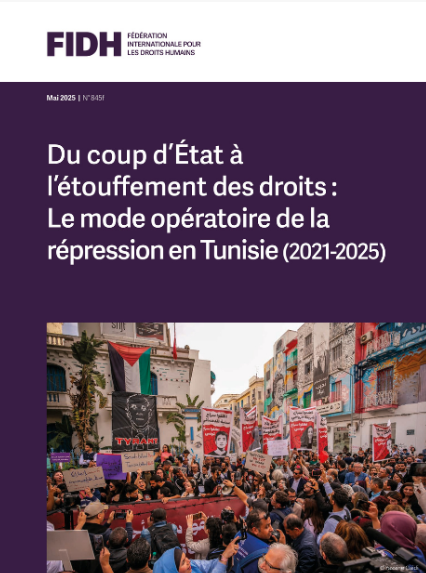
Under the title "Du coup d'État à l'étouffement des droits : Le mode opératoire de la répression en Tunisie (2021-2025)", the International Federation for Human Rights (FIDH) has published its report on Tunisia in May 2025, under number 845f. Presented in an elegant layout, the 46-page document deals with the Tunisian context four years after the coup d'état of July 25, 2021.
Based on verified and referenced data, field reports and expert analysis, this report examines the consequences of the authoritarian excesses that have sounded the death knell for Tunisia's period of democratic transition. The loss of judicial independence, the erosion of civic space, the weakening of checks and balances and the erosion of human rights are, according to FIDH, alarming signs of an authoritarian regime.
The methodology adopted is based on an empirical approach built on reliable documentation: reports, communiqués from local and international NGOs, press articles analyzing current events in Tunisia, and various other reliable sources. It also draws on the results of an FIDH mission to Tunisia. A delegation made up of three members of the Comité de soutien international aux libertés en Tunisie - Alexis Deswaef, Vice-President of the FIDH, Khadija Riadhi, President of the Coordination maghrébine des organisations des droits humains (CMODH), and Giovanna Tanzarella, President of the Réseau Euromed France (REF) - went to Tunisia on a mission of solidarity and observation of the political and social situation. Between September 24 and 25, 2024, the delegation held a series of meetings with key players in civil society, lawyers, journalists, members of the opposition and families of political prisoners.
The report sets out to identify and summarize the tools and mechanisms of the repression currently rife in Tunisia, through five major axes:
- Using the justice system for political ends
- The use of freedom-destroying laws to eradicate all opposition and criticism
- The stranglehold on media space
- Police repression
- Populist rhetoric and delegitimization campaigns
This document is a real reference for understanding the context of repression in post-democratic Tunisia, as well as the contours of an authoritarian project, vague but undeniably liberticidal, that the authorities in place are seeking to implement.
The CRLDHT salutes the FIDH's rigorous and in-depth work, and invites everyone to consult this report on the International Federation for Human Rights website: