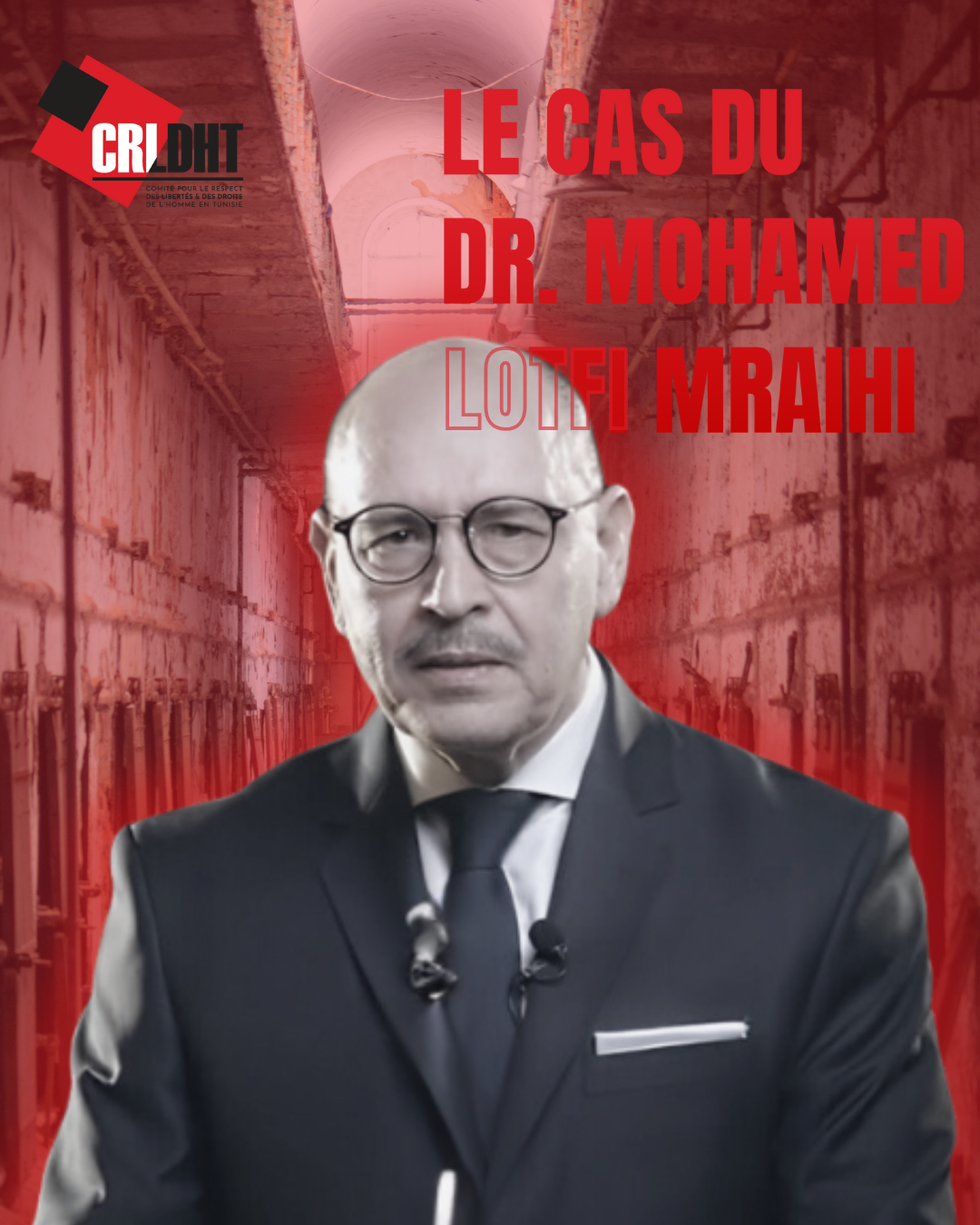
Mohamed Lotfi Mraïhi is one of the political prisoners arrested after July 25, 2021. Like almost all detainees, his "sin" was to enjoy his constitutional rights as a Tunisian citizen. In a veritable counter-revolution, the steamroller of the security apparatus and a judiciary reduced to a kind of official newspaper publishing the instructions of the executive crushed any expression of opinion or critical view.
Dr Mraihi is a lung specialist from Hidra (Kasserine). In 2011, he and a group of activists founded the "Union populaire républicaine" party. The party failed to win representation in the Constituent Assembly, but the municipal elections and, above all, the 2019 presidential election have raised the profile of the party and its president. Classed as one of the opponents of Kaïs Saïed's coup d'état, he was prosecuted for statements made in 2023, then convicted, before falling victim in 2024 to a judicial harassment linked to his presidential ambitions: he was brought before the financial judicial pole and convicted for an alleged "electoral crime".
Kaies Saied, a red line
On August 8, 2023, the Public Prosecutor's Office brought Dr. Mraïhi to trial for "using information systems to disseminate false information and unfounded rumors prejudicial to public safety", on the basis of the infamous article 24 of decree-law 54/2022, following a complaint from the Minister of Justice.
The facts can be summed up in two statements on Radio Mosaïque in which he noted the double talk of the President of the Republic, Kaïs Saïed, and invited him to "leave peacefully".
On January 21, 2024, the Tunis Court of First Instance (judgment no. 28683) sentenced him to six months' suspended imprisonment. However, following an appeal by the Public Prosecutor's Office, the Tunis Court of Appeal (ruling no. 813 of November 22, 2024) confirmed the sentence and aggravated his situation by removing the suspended sentence. A cassation appeal is pending.
It is important to note several anomalies:
- The offending statements were made on the radio, so Decree-Law 115/2011 on the press is the applicable text.
- These statements clearly constitute an opinion and not information or rumor.
- The grounds for the appeal ruling are limited to one sentence:
"Considering the elements mentioned, it appears that there are arguments and presumptions deemed sufficient and concordant establishing the commission of the crime as retained by the indictment, which imposes his criminal conviction." No details are given of the judicial, material and moral elements raised by the defense.
The right to participate in public life: candidacy = betrayal
The right to participate in the conduct of public affairs is a constitutionally and conventionally enshrined human right. But under Kaïs Saïed, even the simplest political criticism is blasphemy and a criminally punishable "sin". To challenge him in a presidential election, or even think of taking him on, becomes an unforgivable sin.
On July 12, 2024, the Tunis Court of First Instance (judgment no. 20770) sentenced Dr. Mraïhi and four of his party officials - including his colleague, Dr. Leila Elouz, the party's executive director - to eight years' imprisonment and a fine of 2,000 dinars. For Dr. Mraïhi, the sentence includes forfeiture for life of his right to stand as a candidate. On September 27, 2024, the Tunis Court of Appeal (ruling no. 14362) confirmed the conviction, but reduced the sentence to six months. An appeal in cassation has been lodged, and the case is still pending.
Dr. Mraïhi and his team are accused of having committed the offence set out in article 161 new of organic law 16/2014, as amended by decree-law 55/2022, namely of having used cash donations in order to influence voters. However, the investigations, closed in five days, led only to second-hand testimony from an individual claiming to have held talks with the party's executive director with a view to benefiting from sponsorships in return for money.
Despite the clear violations of fair trial standards, the trial courts convict the accused, even though the offences are impossible to establish for several reasons:
- Impossibility of the legal element: the offence and its penalties are the result of an unconstitutional amendment, as electoral rules are the exclusive province of organic law. A decree-law, especially a presidential one, cannot modify them (principle of hierarchy of norms and parallelism of forms).
- Temporal impossibility: the alleged events took place in May-June 2024, when only Kaïs Saïed knew that elections would be held. It was only on July 2, 2024 that the elections were officially announced. In May-June, the rules on sponsorship had not yet been published, making the offence legally impossible.
- Legal impossibility: the new article 161 covers fraud committed by a candidate in order to influence a voter, whereas in this case it was only a question of sponsorship, not voting. What's more, neither article 161 nor article 166 incriminates the attempt, and no donation has been established.
Revealingly, not a single document in the file attributes any action or abstention to Dr. Mraïhi. The icing on the cake is that the lifelong ban on standing as a candidate set out in the new article 161 only applies to legislative candidates. The text also provides for the loss of voting rights for ten years for voters who have benefited from donations, which has not been applied here since no one has benefited from donations - quite simply because there have been none.
Justice subject to the political calendar
The appeal to the Court of Cassation is dragging on, as it does every time judicial time is used to serve the political calendar. Justice moves at supersonic speed to obtain a definitive conviction before the elections, in order to prevent any candidacy, but drags on for months once the opponents are in prison.
Dr. Mraihi's case is just one of dozens, if not hundreds, of victims of the struggle to restore democracy. Like the other political prisoners and prisoners of conscience, he is aware that his release will only come with the end of this chaotic episode that Tunisia is going through. All the more reason to rise up against these ignominies and this collective condemnation of the future of Tunisians.