A new feat of counter-revolution
Although President Kaïs Saïed still claims to be "reframing" the Tunisian revolution in its true and proper sense, his actions betray his rhetoric. We are indeed facing a counter-revolution, undeclared but proven.
In addition to the systematic and methodical unravelling of the achievements of the revolution and the period of democratic transition - dubbed the "black decade" by supporters of the July 25, 2021 coup d'état to better legitimize their drift - the experience of transitional justice has been a real offence to the forces that thought themselves untouchable under Ben Ali, notably the security forces. Their current support is one of the major explanations for Kaïs Saïed's new dictatorship. It was therefore "normal" and "logical" for him to put an end to the transitional justice process and erase all traces of it.
As soon as he took power, he dismissed the bâtonnier Abderrazak Kilani, chairman of the Instance des martyrs et blessés de la révolution et des opérations terroristes, which was dissolved. The "El Karama" fund, created by decree 211/2018 to collect funds for compensation, has been abolished and replaced by a new entity with a very different objective. The aim is no longer transitional justice: the name of this new institution, the "Fidaa" (Sacrifice) Foundation, says it all. The decree-law 20/2022 establishing it specifies that it is intended to provide for the victims of acts of terrorism among the military, internal security forces, customs officers, as well as the beneficiaries of the martyrs and wounded of the revolution. Henceforth, priority is given to the forces of law and order, relegating to the background the beneficiaries and wounded of the revolution.
The criminal chambers specialized in transitional justice have suffered the same fate: they are in a state of clinical death, due to the lack of appointment of specialized judges. The only chamber that still holds rare hearings is that of the Tunis Court of First Instance, made up mostly of untrained judges, including the president, contrary to the law. The only effect of these hearings is to undo proceedings previously initiated by the same chamber when it was legally constituted: bans on leaving Tunisian territory are lifted, as are arrest warrants or detention orders. The President has no hesitation in discouraging victims in the middle of a hearing, by asserting the "sterility" of the process, while indefinitely postponing cases in a nihilistic attitude, de facto favorable to the presumed executioners. All this seems to be just waiting for an investigation to close the cases, or for the "biological solution" with the death of the accused.
It goes without saying that the final report of the Truth and Dignity Commission (IVD), published in the JORT, and its recommendations, fell on deaf ears. In the presidential narrative justifying the coup d'état of July 25, 2021, the revolution was betrayed and instrumentalized. As a result, the actors of the pre-July 25 period must be persecuted and brought before courts that have no choice but to ratify the presidential version: either the facts are not proven, or they do not constitute the alleged crimes, or the procedures have not been respected. All these "details" serve as pretexts to guarantee impunity, in line with Kaïs Saïed's criminal - and even judicial - policy.
The president of the IVD, Sihem Ben Sedrine, was a prime target, particularly for the security forces who, even before the coup d'état, had called on their members, through union communiqués, to boycott the IVD and transitional justice. After July 25, 2021, it was time for reprisals. Judicial harassment against Ms. Ben Sedrine took many forms: prosecution for forgery, use of forgeries, corruption... in short, they tried to pull out all the stops. Unlike certain members of the IVD, who benefited from the immunity provided for in the organic law on transitional justice, its president was isolated and targeted. Cooperation" or "participation" in her conviction thus appeared to be the implicit condition for immunity.
Despite all the procedural anomalies, the creation of files without professional rigor, the inconsistencies in the dates of the imputed facts and the absence of new elements, she was arrested following a committal order issued by an examining magistrate appointed by a simple memo from the Minister of Justice. Her age and state of health were not taken into consideration. She was provisionally released after a national and international campaign denouncing these abuses, aimed at further discrediting the transitional justice process by attacking its emblematic figure.
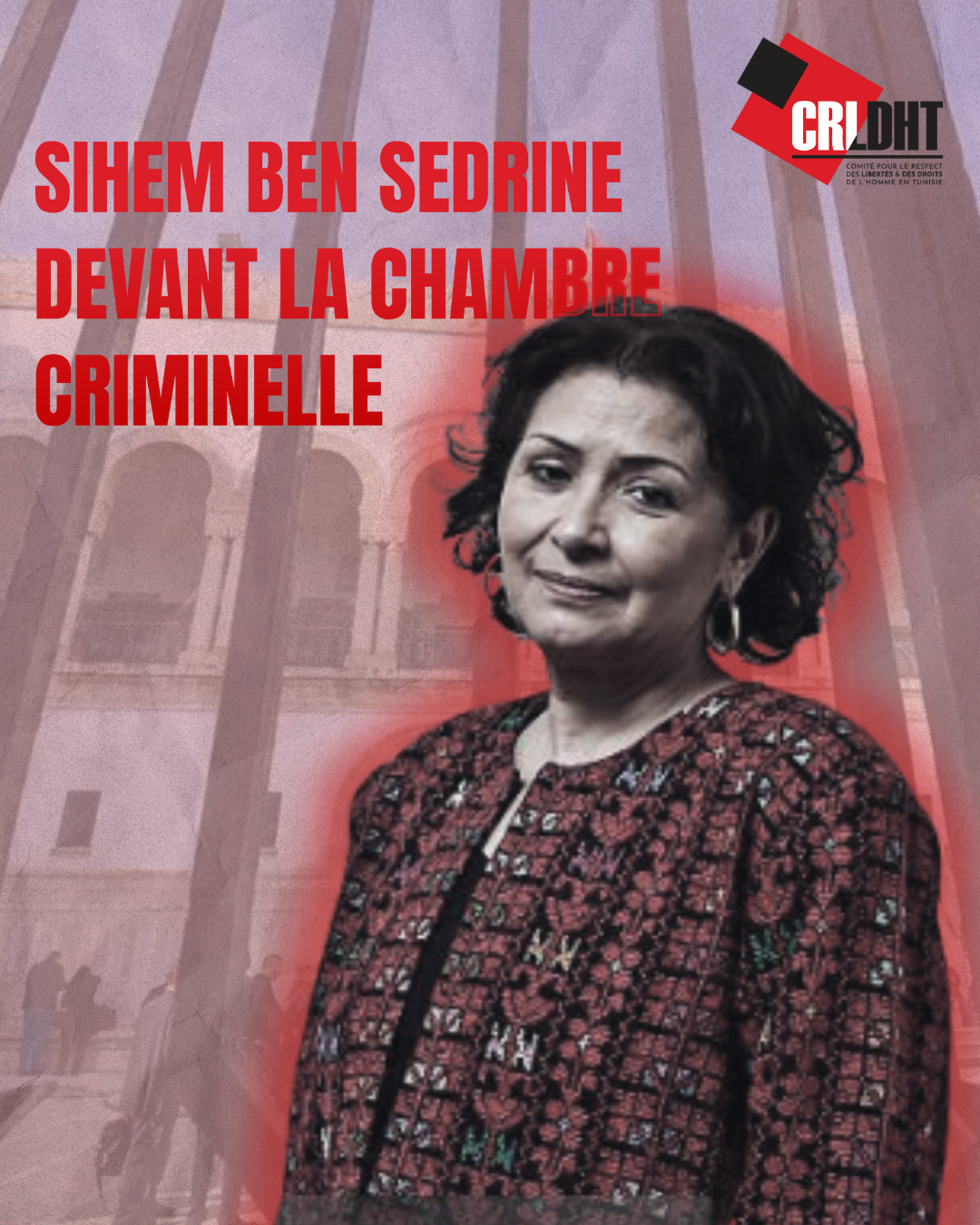
This week, the Indictment Division of the Anti-Corruption Unit of the Tunis Court of Appeal decided - unsurprisingly - to bring Sihem Ben Sedrine before the Criminal Division of the same Unit, attached to the Tunis Court of First Instance, in two cases:
- the first, according to media sources, concerns the Abdelmajid Bouden case in the so-called "BFT" dossier;
- the second concerns a transaction concluded between the IVD and Mr Slim Chiboub, whose request for provisional release has just been rejected by the same chamber.
The former Minister of State Property and Land Affairs, Mabrouk Korchid, is also being brought before this court.
What is anecdotal, but reflects the extent of the ignominy, is that these cases - particularly the first - have been under investigation for years, without any convincing evidence having established the commission of the alleged forgeries. No matter: anyone who dares to exonerate Kaïs Saïed's opponents is considered their accomplice, as he himself has publicly stated. In a country where the President holds all powers, can dismiss any magistrate by simple, unmotivated decree, without any disciplinary procedure or respect for the adversarial process or the right of defence, and where the dismissed magistrate is automatically prosecuted, there is no suspense about the outcome of legal proceedings. Judicial decisions are reduced to propaganda tools to legitimize the president's rantings.
The CRLDHT :
- Reiterates its firm condemnation of these illegal and illegitimate settlements of scores;
- Invites all Tunisians to rehabilitate the transitional justice process as one of the major achievements of their revolution, notwithstanding any reservations they may have about its implementation;
- Expresses its sincere support for Sihem Ben Sedrine, targeted for her early activism against dictatorship, and attacked in order to discredit, through her, the whole process of transitional justice, one of the symbols of the victories of the Tunisian revolution.