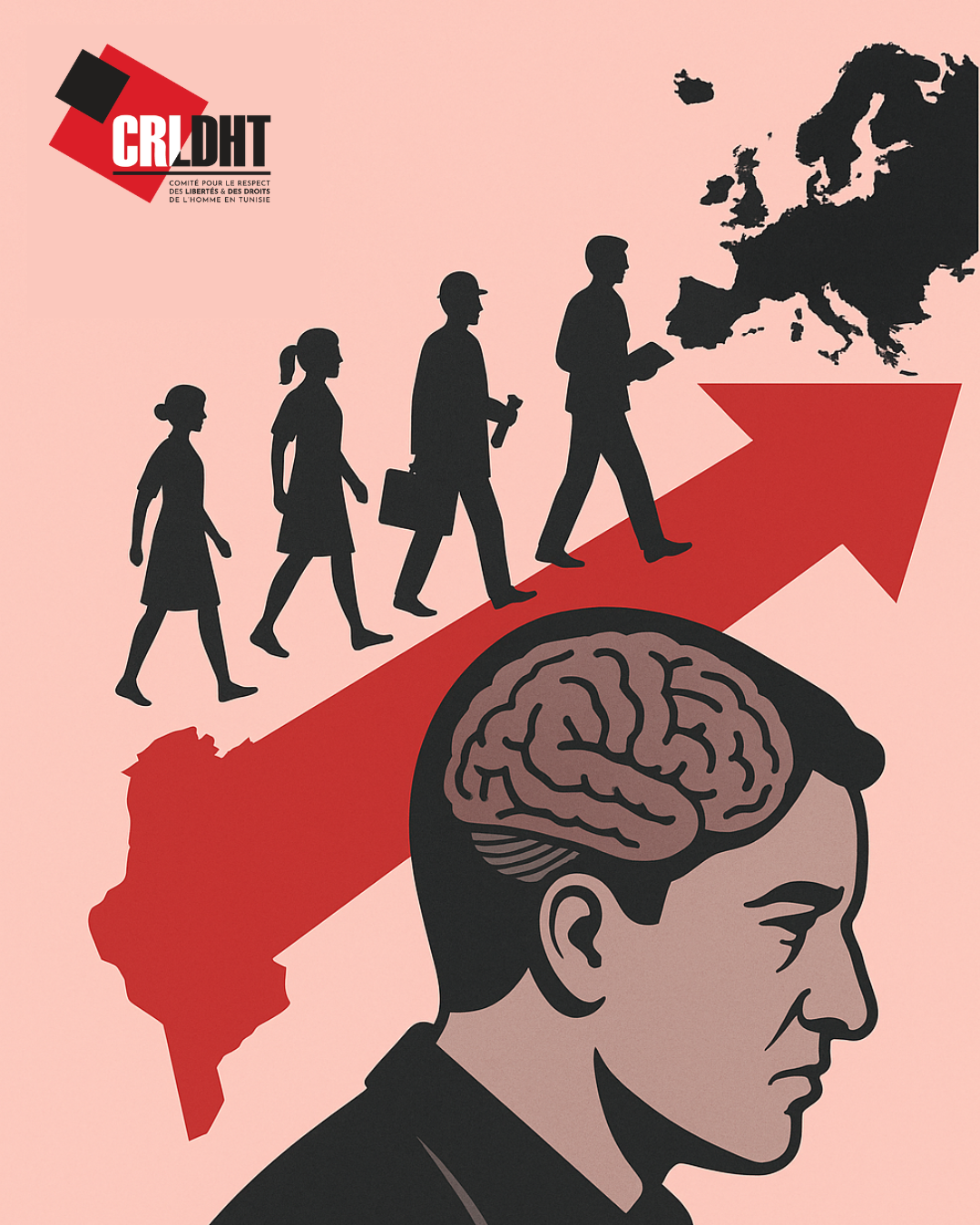
Tunisia is currently experiencing a veritable haemorrhage of its vital forces. The brain drain is not an exaggerated image, but a measurable, quantified and alarming phenomenon. According to the National Migration Observatory, almost 100,000 higher education graduates will leave the country between 2015 and 2023. In 2022 alone, more than 8,500 engineers and 3,300 doctors left the country. The National Federation of Doctors estimates that almost 45% of young specialists trained in Tunisia now work abroad. These are not isolated cases, but a groundswell that is affecting all highly qualified professions: doctors, engineers, IT specialists, researchers, academics, teachers and financial executives.
This exodus is the result of a collective constraint. Tunisia is training entire generations of qualified young people at great cost, but is unable to offer them any prospects. Unemployment among young graduates exceeds 30%, civil service salaries are among the lowest in the Mediterranean basin, working conditions in hospitals and schools are deteriorating every year, and scientific research is suffocated by a lack of funding. For these graduates, staying at home means accepting permanent job insecurity, downgrading and humiliation.
Since 2021, these structural causes have been joined by a decisive political dimension. Kaïs Saïed's coup d'état on July 25 marked a turning point. By dissolving Parliament, governing by decree, drafting a made-to-measure constitution, dismissing independent judges and creating a climate of widespread repression, Saïed emptied Tunisian political life of its democratic substance. Decree 54, supposedly designed to combat "false information", is used to prosecute journalists, opponents and ordinary citizens who publish a Facebook post. Trade unionists are harassed, lawyers criminalized and opposition figures imprisoned. Civil society is under permanent surveillance.
In this authoritarian context, young graduates see not only an economically blocked country, but also a politically locked-in society. Exile then also becomes a way of escaping repression and the total absence of prospects. The brain drain in Tunisia is therefore not just economic: it's political. It's a flight from an authoritarian regime that has shattered the dream of 2011 and offers young people nothing but unemployment, censorship and arbitrariness.
The health sector is a good illustration of the scale of the crisis. Tunisia trains around 1,200 doctors a year, but a considerable proportion leave as soon as they finish their studies. The cost of training a specialist doctor is estimated at 90,000 euros for the Tunisian state. But a young doctor who stays in Tunisia earns around 1,545 dinars (460 euros), not including bonuses, in hospitals that are sorely lacking in equipment. In several inland establishments, gynecologists, anesthetists and pediatricians are sometimes no longer available... Patients are forced to travel hundreds of kilometers for treatment. Hospitals are being emptied of their medical staff, and this medical desertification is a direct consequence of the brain drain.
In France, the contradiction is obvious. Over 5,000 Tunisian doctors work in public hospitals. In some emergency departments in the Île-de-France region, 40% of on-call duty is performed by foreign practitioners, mainly from North Africa and Tunisia. The French hospital system relies on their presence. And yet, these practitioners are kept in a precarious status: "associate practitioner", "acting intern", "trainee". To gain full recognition, they have to pass the Épreuves de Vérification des Connaissances (EVC), a long and selective competitive examination that accepts only a few hundred candidates a year, leaving the others in an undignified waiting situation.
The difference in treatment is scandalous. A Tunisian doctor with a degree from outside the European Union earns between 1,500 and 1,700 euros net per month, while a junior French doctor earns between 3,500 and 4,000 euros for the same work. In other words, two and a half times less. At the same time, they take on equivalent on-call and emergency duties and responsibilities. This situation is institutional discrimination. It reflects a structural racism: Tunisian doctors are indispensable, but kept in an inferior status.
France is not the only destination. Germany is recruiting more and more Tunisian doctors and engineers, offering them high salaries and a simpler integration process. Canada, and Quebec in particular, welcomes hundreds of Tunisian-trained engineers, computer scientists, researchers and teachers every year. Gulf monarchies such as Saudi Arabia, Qatar and the Emirates attract Tunisian doctors, pharmacists and teachers, offering them higher salaries than in Tunisia, but in authoritarian regimes where their political rights are non-existent and their security still fragile. Geographically close by, Italy is also a point of arrival, particularly for young graduates who migrate first in precarious conditions before obtaining partial recognition of their qualifications.
Everywhere, the same pattern is repeated: Tunisia pays for training, host countries reap the benefits. Between 2010 and 2020, the brain drain cost nearly 2% of Tunisia's GDP every year. But this figure doesn't tell the whole story: public services are being emptied, entire regions abandoned, a collective future crumbled. France, Germany, Canada and the Gulf States boast of their "attractiveness" and "modernity" because they attract foreign talent. But this is not about attractiveness, it's about organized plundering, a structural transfer of skills from the South to the North.
This mechanism is colonial. Yesterday, the European powers plundered Tunisia's natural resources and workforce. Today, they are plundering Tunisia's brains, qualifications and skills. They exploit the fact that the Tunisian state, weakened by IMF austerity policies and internal corruption, can no longer retain its young people. Northern countries profit from this failure, without ever compensating Tunisia for the losses. The country's sovereignty is directly at stake: a nation that cannot retain its doctors, engineers and researchers cannot build its future.
The Tunisian brain drain is therefore a double injustice. Graduates are forced to leave a country which has trained them but which does not offer them the means to live with dignity. And once they have left, they come up against discriminatory policies that exploit them and keep them at the bottom of the ladder. In all host countries, the same logic prevails: Tunisians are indispensable, but they must remain invisible, subordinate and precarious.
The CRLDHT affirms that this exodus is not inevitable, but the result of political choices. Tunisia must stop abandoning its young people, put an end to authoritarian drift, invest in health, education and research, raise salaries and create prospects. France and other host countries must recognize Tunisian skills on an equal footing, and put an end to precarious status and institutional discrimination. Dignity is not negotiable: Tunisian doctors, engineers and researchers are not substitutes, but trained, competent professionals who demand justice and recognition. Until this demand is met, the brain drain will remain the symbol of a world where the South pays and the North profits.